
A report lands in your inbox: “Conversions up 240% this month.” Wonderful news — until you ask a simple question and the room goes quiet. What, exactly, was counted? In one business we spoke to, the “conversions” were button clicks. Not purchases, not enquiries — clicks, including people who clicked and immediately left.
That is why the question of what counts as a conversion matters more than most of the numbers built on top of it. Every cost-per-lead figure, every campaign decision, every “this ad is working” judgement depends on the definition underneath. Get the definition wrong and the whole dashboard is confidently, precisely wrong.
This guide settles what counts as conversion in plain English: the two tiers every business should separate, the events that genuinely count for a service business, the vanity traps that inflate reports, and a one-sitting method for choosing yours.
What counts as conversion, really?
Start with the simplest honest definition. A conversion is a visitor completing an action that your business values because it moves money — or is the final, deliberate step before money moves. The classic reference definition of conversion rate says the same thing in drier language: the proportion of visitors who take a desired action. Everything hinges on the word desired — desired by the business, because it leads to revenue, not desired by the person preparing the report because it makes the chart go up.
Notice what the definition excludes. It excludes everything a visitor does that merely shows interest: reading a page, watching a video, downloading a guide, even clicking the call button and changing their mind. Those events are not worthless — the next section gives them their proper place — but they are not conversions, and calling them conversions is how a business ends up celebrating growth while the phone stays silent. It is the same disease we described in our guide to impressions up clicks down, one floor further down: a metric that rises while the thing it was supposed to predict does not.
So, what counts as conversion is a decision, not a discovery. Somebody has to choose, deliberately, which actions earn the title — and defend the choice.
The two tiers: macro and micro conversions
The cleanest way to make that decision is to sort every trackable action into two tiers. Here is what counts as conversion under each tier — and why the labels must never blur.
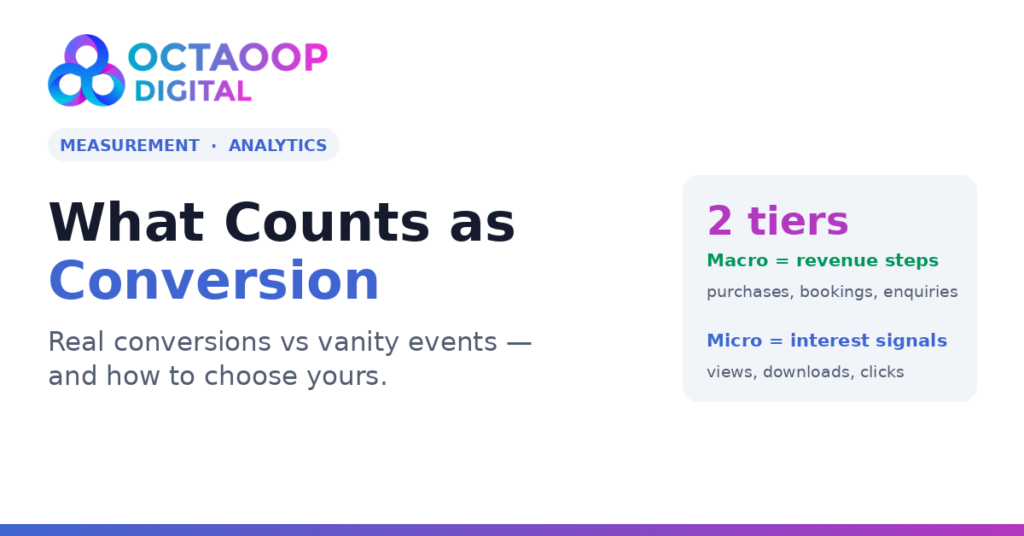
Macro conversions are the revenue steps: a purchase completed, a booking made, an enquiry form genuinely submitted, a quote accepted. These are the events your advertising should be optimised toward, and your reports should headline. When someone asks what counts as conversion for judging whether marketing works, the answer lives in this tier.
Micro conversions are the interest signals on the way: a pricing page viewed, a guide downloaded, a video watched to the end, a directions lookup. They are genuinely useful — they show where interest builds and where it leaks, which is exactly the territory of our breakdown of the low conversion rate website fix — but they belong in a separate column, clearly labelled as signals, never summed into the headline number.
The discipline is in the separation. The moment micro events are allowed to wear the macro label, every report becomes a press release: impressive, and useless for decisions.
What counts as conversion for a service business?
For a service business — no shopping basket, no checkout — the macro list is shorter than most dashboards pretend. It usually looks like this:
- A submitted enquiry form. Submitted, not opened, not started — submitted, and ideally confirmed as received by a human process, not just recorded by a tag.
- A real phone call. A call that connects and lasts long enough to be a conversation. A two-second misdial is not a conversion; most call-tracking setups let you set a duration threshold, and you should. A call that passes your threshold is one of the clearest answers to what counts as conversion in a business that sells by phone.
- A completed booking. An appointment in the diary with a name and a time attached — not a visit to the booking page.
- A quote accepted or a job won. The offline end of the chain, recorded back from the CRM. This is the conversion that actually pays, and it connects directly to the stages in our guide to what is CRM pipeline: the pipeline’s “won” column is where online measurement finally meets money.
And what does not count, however often it appears in reports? A page view. A button click on its own. A form started. An automatic event a platform switched on by default and nobody reviewed. Each of these may earn a place in the micro tier — none of them has earned the macro label. Learning to say the sentence “interesting, but not what counts as conversion” — out loud, in a reporting meeting — is half of honest measurement.
The vanity traps that inflate conversion reports
Once you know what counts as conversion, the common traps become easy to spot.
Counting everything. When a platform is told that ten different events are all “conversions”, its bidding and reporting will favour whichever is cheapest to produce — usually the shallowest one. The account then optimises itself toward clicks and views while enquiry quality quietly rots. The platform is not lying; it is faithfully optimising toward a definition of what counts as conversion that nobody chose on purpose.
The thank-you page double count. A form that fires a tag on the button and loads a thank-you page can record two conversions for one enquiry. The report doubles; the diary does not.
No duration or quality threshold on calls. Counting every dial as a conversion flatters any campaign that generates curious, accidental, or wrong-number calls.
Treating the platform’s defaults as your definitions. Analytics and ad platforms ship with suggested events switched on. Those defaults describe an average business, and your business is not average. The GA4 documentation on Google’s Analytics developer site makes the underlying point clearly: events only become “key events” — the ones treated as conversions — when someone marks them. That marking is a business decision, and it should be made by a person who knows what a real enquiry is worth. It is also, not coincidentally, the first thing our analytics and tracking service audits: the distance between what a business counts and what it actually sells.
How to choose your conversions in one sitting
Here is the method we run with clients. Work backwards from money. Write down the moment revenue actually happens — a job booked, a sale completed. Then walk one step back: the action that directly precedes it (a quote accepted, a booking made). One more step: the action that feeds that (an enquiry submitted, a real call). Those two or three actions are your macro conversions. Write them at the top of one page under the heading the whole team will use — what counts as conversion here — because a definition that lives in one person’s head is not a definition. Everything else a visitor can do is micro — track it, learn from it, never headline it.
Then apply the honesty tests. Could this event happen without any real intent? (A page view: yes — micro.) Would you happily pay your cost-per-acquisition for a hundred of these? (A two-second call: no — threshold it.) Does a human in the business recognise this event as “a real one”? If the sales team laughs at it, it is not a macro conversion.
Finally, write the list down — one page, macro on top, micro below, with the thresholds noted — and give it to everyone who touches reporting. Most measurement arguments are really definition arguments, and a written definition ends them. It also explains a pattern many owners recognise from our article on website traffic but no calls: the traffic was real, the “conversions” were not, and the gap between the two was a definition nobody had examined.
The bottom line
What counts as conversion is the foundation every other marketing number stands on. It is a small definition with outsized consequences, which is why what counts as conversion deserves an hour of honest argument before it deserves a dashboard. Define it as the few actions that move money — purchase, booking, genuine enquiry, accepted quote — keep the interest signals in their own clearly-labelled tier, and your reports start telling the truth: sometimes a less exciting truth, but one you can steer by.
Everything else in measurement gets easier from there. Because once a team agrees on what counts as conversion, the arguments stop being about whose chart is right — and start being about the only question that matters: how do we get more of the real ones?
Editorial Note: This article was researched and written by the Octaoop Digital team, with AI used as a supporting tool for research, structuring, and editorial refinement. In line with Google’s guidance, the final content is reviewed by humans and created to be original, useful, accurate, and written for people first—not search engines.