
You open Google Search Console, look at the last quarter, and the chart seems to argue with itself: impressions up, clicks down. Your website is appearing in far more searches than it used to, yet the clicks have barely moved — and the click-through rate has fallen off a cliff.
If your latest report shows impressions up, clicks down, you are looking at one of the most common, and most misunderstood, patterns in SEO reporting. Sometimes it is a sign of genuine growth. Sometimes it is an early warning. The frustrating part is that the headline numbers alone cannot tell you which one you have.
This guide explains what the pattern really means, walks through a real example from our own client reporting, and gives you a short diagnostic process to work out what to do next.
What impressions up clicks down actually means
Start with the three numbers involved. An impression is counted every time one of your pages appears in someone’s search results. A click is counted when that person chooses your result. Click-through rate, or CTR, is simply clicks divided by impressions — and Google’s Performance report documentation defines each of these terms precisely, so it is worth reading if the report is new to you.
Now consider the arithmetic that creates the pattern. Suppose your impressions double because your site starts appearing for hundreds of new searches, while your clicks grow by only a quarter. Your CTR falls — even though you gained clicks. That is the mechanical heart of impressions up, clicks down: the denominator grew faster than the numerator. It produces the strange picture many business owners describe to us as more impressions, fewer clicks in percentage terms, even while the business is quietly receiving more visitors than before.
So impressions up, clicks down is not one single problem. It is a shape that several different situations can produce, and each situation needs a different response.
A real example from our own client reporting
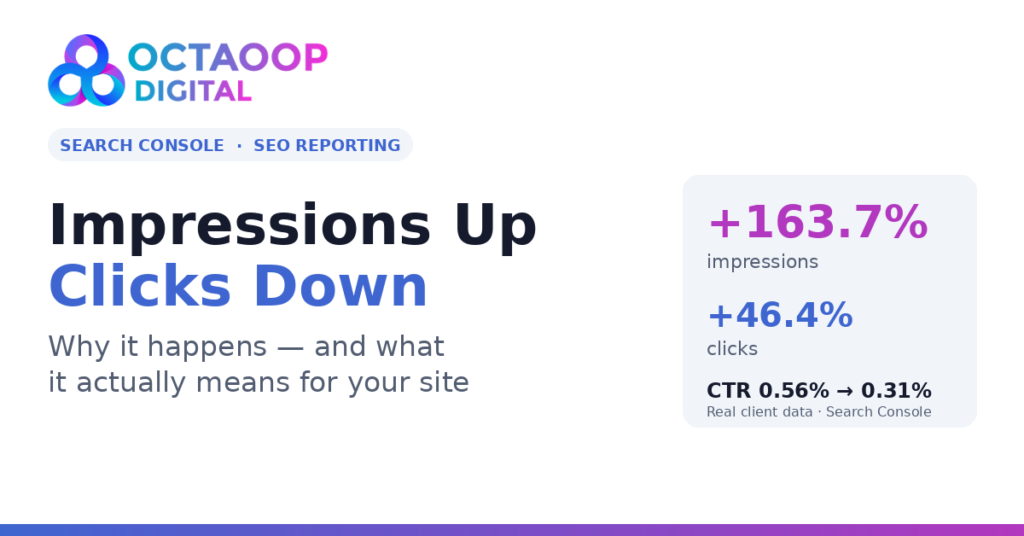
We can show you this exact pattern in our own published work. In our Shah Driving School case study, we compared two consecutive 180-day periods of UK Search Console data, ending 11 October 2026. Impressions rose from 341,349 to 900,242, an increase of 163.7%. Clicks rose from 1,907 to 2,791 — an increase of 46.4%. And CTR fell from 0.56% to 0.31%, while average position moved from 10.12 to 12.61.
Read quickly, those numbers look like failure. Read properly, they are a textbook case of impressions up, clicks down, caused by widening reach. The site had started appearing for a much broader set of searches more lesson types, more local variations, more informational questions — and many of those new appearances sat at weaker positions, where CTR is naturally low. Meanwhile, the clicks that matter still grew by almost half.
The honest verdict was neither “SEO is failing” nor “SEO is smashing it”. It was this: reach had expanded faster than ranking strength, so the next job was improving positions and click appeal on the new queries — not panicking about the CTR line.
Four reasons you see impressions up, clicks down
In our experience, the pattern usually comes from one of these four causes, and often two at once.
1. You are ranking for new, broader queries. New pages and new topics rarely enter the results at the top. They start at positions 11 to 30, collect large numbers of impressions, and earn very few clicks. Your visibility is genuinely growing; it simply has not matured into rankings yet.
2. The search results are answering the question themselves. AI Overviews, featured snippets, and other result features can satisfy simple queries on the results page. This is impressions rising, clicks flat in its purest form: people see your brand, learn something, and never need to visit.
3. Your titles no longer match the new search intent. As your site appears for new kinds of searches, a title written for the old intent earns a smaller share of clicks. The page has not gotten worse; the audience arriving at it has changed.
4. Demand in your market has grown. Seasonal peaks and rising interest lift impressions across a whole sector. Everyone appears more often, competition for each click stays just as fierce, and CTR dips even for well-run sites.
Notice that only some of these are problems. Causes one and four are usually growth wearing a disguise. Causes two and three need work. That is why impressions up, clicks down should always trigger a diagnosis, never an instant verdict.
How to diagnose impressions up clicks down
Work through these five checks in order, and impressions up clicks down usually resolves into a clear story within half an hour.
- Compare like with like. Use two periods of equal length, and keep seasonality in mind before you compare a busy month with a quiet one.
- Split the data by page. If the impression growth sits on new pages, you are looking at expansion. If old pages changed, something shifted.
- Split it by query. Filter for queries that are new in this period versus queries you already ranked for. New queries at weak positions explain most innocent cases of this pattern.
- Separate branded from non-branded searches. Branded CTR behaves differently, and mixing the two hides what is really happening.
- Check CTR by position. If CTR held steady at each position but your average position slipped, the issue is ranking distribution, not your titles.
It helps to ground this in how search works generally. Google’s SEO Starter Guide is a reliable grounding in how pages earn their place in results. And if your situation is different — if clicks are falling in absolute terms, not just CTR — that is a separate problem: our guide on fixing a Google traffic drop and our step-by-step traffic recovery guide cover that scenario in detail.
When the pattern is a warning sign
There are versions of this pattern that should concern you. Treat impressions up, clicks down as a warning when clicks fall in absolute terms at the same time, when your most valuable pages services, locations, booking pages are the ones losing CTR, or when position losses concentrate on the handful of queries that historically brought you enquiries. A flood of impressions for searches you would never want is another red flag: it suggests your topical focus is drifting.
The dividing line is simple. If total clicks and enquiries are stable or growing, you are probably looking at expansion. If clicks, positions on money queries and enquiries all slide together, you have a problem to fix, and it will not fix itself.
The bottom line
Impressions up, clicks down is a question, not a conclusion. It asks you to look one level deeper — at which pages, which queries and which positions changed — before deciding whether to celebrate, adjust or repair. Read at that level, the pattern becomes one of the most useful signals Search Console gives you, because it shows your visibility expanding before your rankings and your click appeal have caught up.
That is also why we report the awkward numbers alongside the good ones in our own case studies, and why our analytics and tracking work focuses on the metrics that connect search visibility to actual enquiries. If your latest report shows impressions up, clicks down, and you cannot tell whether it is growth or trouble, that diagnosis — not more content, and not a new tool — is the right next step.
Editorial Note: This article was researched and written by the Octaoop Digital team, with AI used as a supporting tool for research, structuring, and editorial refinement. In line with Google’s guidance, the final content is reviewed by humans and created to be original, useful, accurate, and written for people first—not search engines.