
For years, digital advertising strategies revolved around a familiar set of platforms.
Google for search demand. Meta for social advertising. YouTube for video. Display networks for wider reach.
But another advertising channel has been growing within the places where consumers already browse, compare, and purchase products.
It is called retail media.
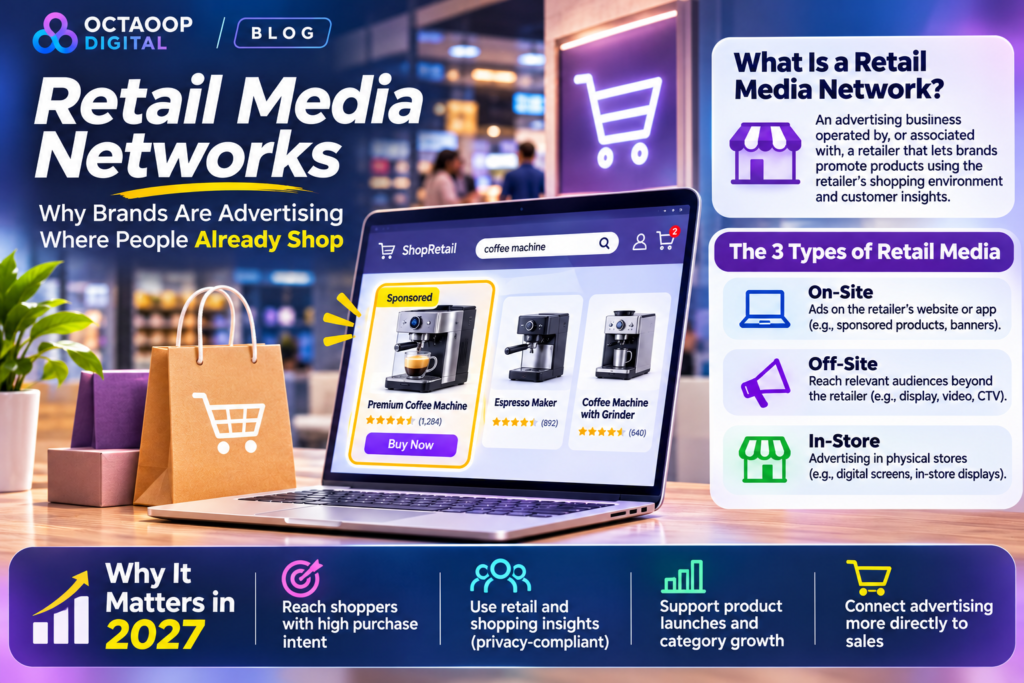
Imagine a customer opening a major retailer’s website to purchase a coffee machine.
They search for a particular type of machine, compare available products, read customer reviews, and evaluate prices.
At that moment, a brand can promote its product directly within the shopping experience.
The customer is not scrolling through unrelated content. They are already considering a purchase.
That combination of shopping intent, product information, and advertising placement makes retail media commercially interesting.
But retail media is no longer limited to sponsored products appearing at the top of marketplace search results.
Retailers are expanding their advertising businesses into connected television, video, websites, apps, digital screens, and physical stores.
Brands can now reach shoppers through a growing collection of advertising environments connected to retailer information.
As marketing teams prepare for 2027, understanding this channel is becoming increasingly valuable.
The question is not whether every business should invest in retail media.
It is which businesses can benefit, how the channel works, and how to evaluate whether the additional advertising investment actually creates value.
What Is a Retail Media Network?
A retail media network (RMN) is an advertising business operated by, or associated with, a retailer.
It allows brands to promote products or services using advertising placements and, where permitted, audience or transaction insights connected to the retailer.
A retailer might offer advertising opportunities across its:
- Ecommerce website
- Mobile shopping application
- Product search results
- Category pages
- Product detail pages
- Digital screens inside physical stores
- Email or promotional channels
- Partner advertising platforms
For example, a consumer electronics manufacturer may advertise its headphones within an electronics retailer’s search results.
A beauty brand might promote products within a cosmetics retailer’s mobile app.
A grocery brand might purchase advertising on digital screens inside supermarkets.
These activities are examples of retail media because advertising takes place within, or is informed by, the retailer’s shopping environment.
How Is Retail Media Different From Traditional Digital Advertising?
Traditional digital advertising frequently targets people based on searches, interests, demographics, contextual information, or other permitted signals.
Retail media adds the opportunity to reach customers using information associated with retail shopping.
That may include product categories, purchasing patterns, loyalty program activity, or on-platform browsing behavior, subject to privacy requirements and the network’s capabilities.
This distinction can be valuable.
A customer reading an article about coffee may be interested in coffee machines.
A customer actively comparing coffee machines on a retailer’s website is closer to a potential purchase.
However, higher apparent purchase intent does not automatically mean that retail media will be more profitable.
Competition, product margins, placement costs, brand recognition, and the quality of the retailer’s audience all influence results.
Why Retail Media Is Gaining Attention
Retail media is not an entirely new concept.
Sponsored product listings and retailer advertising partnerships have existed for years.
What is changing is the scale and sophistication of the industry.
Retailers increasingly recognize that their websites, applications, customer relationships, and physical stores can support advertising businesses alongside product sales.
Brands, meanwhile, are looking for ways to connect marketing activity more directly with purchasing behavior.
What Recent Industry Research Shows
In November 2026, IAB Europe published its third Attitudes to Retail Media Report.
Among the surveyed European retail media buyers:
- 71% had partnered with retailers for more than a year, compared with 51% in 2024.
- Only 12% considered their retail media strategies fully sophisticated.
- 61% identified insufficient measurement and reporting as a leading barrier to additional investment.
The report also found increasing interest in new-to-brand measurement, incrementality, and integrated online and offline reporting.
These findings show two developments occurring at the same time.
Retail media is becoming more established among advertisers, but measurement capabilities are not always keeping pace.
That is important because businesses need more than attractive advertising dashboards.
They need to understand how retail campaigns contribute to additional sales, profitability, and long-term customer acquisition.
Source: IAB Europe — Attitudes to Retail Media Report 2026. Figures represent the study’s surveyed European buyers, not all advertisers globally.
The Three Main Types of Retail Media Advertising
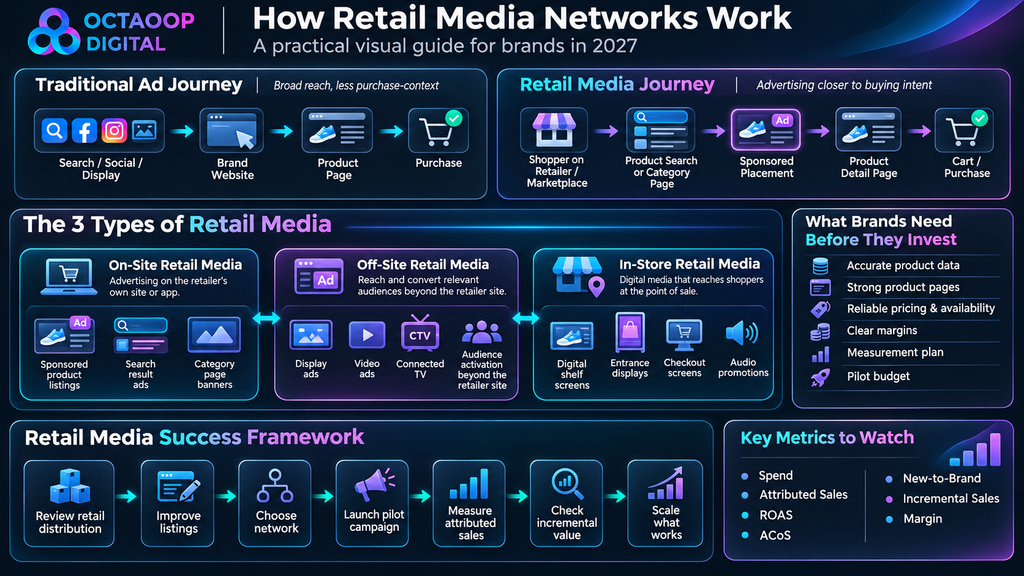
Understanding retail media becomes easier when its advertising placements are divided into three categories.
1. On-Site Retail Media
On-site advertising appears within a retailer’s own digital properties.
Typical placements include:
- Sponsored products in search results
- Promoted listings within category pages
- Sponsored product recommendations
- Display banners
- Promotional video placements
Consider a customer searching for “wireless headphones” on an electronics marketplace.
A manufacturer may sponsor an eligible product listing that appears within those search results.
The advertisement helps the product compete for attention at a moment when the customer is already evaluating the category.
This is one of the most familiar forms of retail media.
However, sponsored placement does not eliminate the need for an attractive price, accurate product details, credible reviews, and a competitive offer.
Advertising can create visibility.
It cannot automatically make a weak product compelling.
2. Off-Site Retail Media
Off-site retail media uses permitted retailer audience or commerce signals to support advertising outside the retailer’s own website or application.
Depending on the network, advertising can appear across:
- Display advertising networks
- Video platforms
- Social media
- Connected television
- Digital audio
- Other supported advertising inventory
For example, a retailer and advertising partner might enable a participating brand to reach a relevant audience through video advertising, rather than limiting promotion to the retailer’s website.
This can help brands communicate with potential customers earlier in their purchasing journeys.
The precise data-sharing and targeting methods vary by network, platform, market, and privacy requirements.
Brands should not assume that using retail media gives them unrestricted access to an individual retailer’s customer data.
3. In-Store Retail Media
Retail media is also expanding into physical shopping environments.
Examples include:
- Digital displays near product shelves
- Screens in store entrances
- Advertising at checkout areas
- In-store audio advertising
- Digital promotional displays
- Supported interactive shopping experiences
Imagine a beverage brand promoting a new product on digital screens inside a grocery chain.
The campaign can reach people who are physically present in a retail environment.
This creates opportunities to connect brand messaging with product availability.
However, measuring the actual impact of in-store advertising can be more difficult than tracking a straightforward online purchase.
Store traffic, promotion schedules, shelf positioning, seasonal demand, and other influences all need to be considered.
IAB Europe has been developing measurement guidance to improve consistency across these environments.
Retail Media vs. Commerce Media: Understanding the Difference
The terms retail media and commerce media are frequently used together.
They are closely related, but not identical.
Retail media generally describes advertising opportunities associated with retailers.
Commerce media is a broader category that can include advertising supported by shopping or transaction information from other commercial environments.
These may include:
- Travel booking platforms
- Food delivery services
- Mobility applications
- Payment providers
- Classified marketplaces
- Other transaction-oriented services
For instance, an advertiser reaching customers through a travel booking platform may be participating in a commerce media environment, even though the platform is not a traditional retailer.
IAB Europe defines commerce media as a category that includes retail media networks and broader environments using commerce-related information for advertising and measurement.
This distinction matters when evaluating suppliers.
Not every advertising platform described as a commerce media network operates like a conventional retail marketplace.
The available inventory, targeting capabilities, attribution methods, and commercial arrangements can be very different.
Google Is Expanding Into Commerce Media, Too
Retail media growth is not limited to marketplaces selling advertising on their own properties.
In September 2026, Google introduced a Commerce Media Network solution designed to help participating brands promote products listed on connected marketplaces across supported Google advertising channels.
According to Google’s announcement, the solution can use marketplace product information to support advertising through channels including Search, YouTube, and Discover.
The advertiser needs an eligible Google Ads account connected to a participating marketplace.
That arrangement creates a different opportunity from simply advertising products on the retailer’s website.
Brands may be able to reach additional audiences through Google’s advertising ecosystem while directing customers toward products available on the marketplace.
However, availability and implementation depend on the supported marketplaces, advertiser eligibility, and regional rollout.
It should not be assumed that the solution is universally accessible.
For brands already selling through participating retail partners, this is another reason to understand how retailer relationships and advertising platforms increasingly intersect.
Source: Google — Scale E-commerce With Commerce Media Network.
Which Businesses Should Consider Retail Media?
Not every business needs a retail media strategy.
The channel is especially relevant when a company sells products through retailers, marketplaces, or commercial platforms that offer suitable advertising inventory.
Consumer Product Brands
Brands in categories such as beauty, food, household goods, personal care, electronics, and consumer accessories may find relevant opportunities.
Their products are often compared directly against alternatives within retailer search results and category pages.
Advertising can support product launches, promotional periods, and category visibility.
Manufacturers and Distributors
Manufacturers selling through retail partners may use retail media to improve visibility within the environments where their products are purchased.
For example, a manufacturer whose products are stocked by multiple electronics retailers might evaluate retail campaigns across selected partners.
The decision should account for available inventory, product margins, and retail relationships.
Ecommerce Marketplace Sellers
Businesses selling through large marketplaces may already be familiar with sponsored product advertising.
Retail media expands the strategic discussion beyond basic product placement into audience targeting, brand campaigns, and broader measurement.
Brands That Do Not Sell Through a Particular Retailer
Some networks offer advertising to non-endemic brands.
These are businesses whose products are not directly sold by the particular retailer.
A financial services company, for example, might be interested in reaching a relevant audience through a commerce media network.
Such opportunities depend on the network’s available inventory and policies.
Who Should Be Cautious?
Retail media may not be the right immediate priority for:
- Businesses without suitable retail or commerce distribution
- Brands with limited product availability
- Companies whose margins cannot support additional advertising costs
- Businesses unable to maintain accurate inventory and pricing information
- Advertisers without clear objectives or a way to evaluate results
A new advertising channel should solve a defined business need.
It should not receive budget simply because the industry is discussing it.
The Product Listing Still Does Much of the Selling
Retail media can bring attention to a product, but the product listing often determines whether interest becomes a purchase.
Imagine two sponsored listings appearing side by side.
Both products have similar prices.
The first listing contains a vague title, one product image, incomplete specifications, and unclear delivery information.
The second provides a clear product name, useful photographs, accurate specifications, understandable shipping terms, and credible customer feedback.
Even when both products receive advertising exposure, the quality of the shopping information can influence customer decisions.
Before investing heavily in retail media, businesses should review:
- Product titles and descriptions.
- Product identifiers and variants.
- Images and visual consistency.
- Pricing and promotional accuracy.
- Inventory availability.
- Product reviews and customer concerns.
- Delivery and return information.
- Brand consistency across retail channels.
Advertising and product information should be treated as connected responsibilities.
A campaign cannot reliably compensate for repeated stock shortages, misleading listings, or an uncompetitive purchasing experience.
How Does Retail Media Advertising Work?
The exact process differs by platform, but a typical campaign follows several stages.
Stage 1: Select the Retail Network
A business identifies a retailer or commerce network with an audience relevant to its products.
The decision should be based on where customers actually shop, not simply which network has the largest audience.
Stage 2: Determine the Campaign Objective
Common objectives include:
- Improving product visibility
- Supporting a new product launch
- Increasing category awareness
- Attracting new buyers
- Supporting seasonal promotions
- Generating additional sales
These objectives require different creative strategies and measurement approaches.
Stage 3: Choose the Advertising Format
Advertisers may select sponsored product placements, display advertising, video, in-store media, or other supported formats.
The available options depend on the network.
Stage 4: Configure Targeting and Budget
Depending on the platform, targeting may use search terms, product categories, audiences, contextual signals, or other approved methods.
Campaigns may use cost-per-click, cost-per-thousand-impressions, fixed placement fees, or other commercial arrangements.
Stage 5: Launch and Monitor
Once the campaign is active, the advertiser evaluates performance, product availability, costs, and relevant sales outcomes.
Stage 6: Evaluate Business Impact
This is where retail media needs careful analysis.
A campaign can report impressive attributed sales without necessarily generating an equivalent amount of additional business.
Understanding that difference is essential.
The Biggest Measurement Challenge: Attributed Sales vs. Incremental Sales
Retail media networks may offer attractive reporting because they operate close to the point of purchase.
Some can connect advertising interactions with transactions that occur within their environments, subject to their measurement capabilities.
This can provide useful information.
But there is a distinction between attributed sales and incremental sales.
Attributed sales are purchases assigned to an advertising interaction under the platform’s reporting rules.
Incremental sales are the additional purchases that occurred because of the advertising, beyond what would likely have happened without it.
Consider a well-known household product.
Some customers may already intend to buy the brand before seeing a sponsored listing.
If they click the advertisement and purchase the product, the campaign may receive attribution under the platform’s rules.
But that does not automatically mean the advertisement created a new purchase.
This is one reason advertisers increasingly want incrementality testing and better cross-channel reporting.
Metrics Worth Reviewing
| Metric | What it tells you |
|---|---|
| Advertising spend | How much the campaign cost |
| Attributed sales | Sales credited to the campaign under a stated attribution model |
| ROAS | Attributed revenue relative to advertising spend |
| Advertising Cost of Sales (ACoS) | Advertising cost as a percentage of attributed sales |
| New-to-brand customers | Buyers classified as new under the platform’s definition |
| Incremental sales | Estimated additional sales caused by advertising |
| Contribution margin | Revenue remaining after relevant variable costs |
| Product availability | Whether advertised items can consistently be purchased |
Not every network provides every metric.
Even when two networks report the same metric, their attribution windows, definitions, and data sources may differ.
Comparing ROAS figures across networks without understanding those differences can be misleading.
Why Profitability Matters More Than an Attractive ROAS
A campaign reporting strong attributed revenue is not necessarily profitable.
Product manufacturing costs, marketplace commissions, logistics, discounts, returns, and advertising expenses all affect the final result.
For a low-margin product, an apparently successful campaign could still leave the business with very little profit.
Retail media investment should therefore be evaluated against product economics, not just advertising dashboards.
A Practical Example: A Skincare Brand Entering Retail Media
Consider a fictional skincare manufacturer selling three products through a major beauty retailer.
The company wants to expand product awareness and encourage purchases among customers comparing competing brands.
Instead of launching campaigns across every available placement, it begins with a controlled pilot.
Step 1: Select products. The company chooses items with adequate inventory, clear differentiation, and margins that can support advertising.
Step 2: Improve listings. Each product receives accurate ingredient information, suitable images, usage guidance, and relevant descriptions.
Step 3: Choose placements. The company tests sponsored products against relevant category or search placements within the retailer.
Step 4: Establish a baseline. The team records normal sales performance, product availability, prices, and promotional activity before the campaign.
Step 5: Run the test. Campaigns operate for a defined period with documented budgets and targeting settings.
Step 6: Review outcomes. The team evaluates advertising costs, attributed sales, customer acquisition indicators, margins, and any available incrementality evidence.
Step 7: Decide whether to expand. Additional investment depends on results—not on a predetermined expectation that retail media must work.
This example is illustrative, not a case study or claim of campaign performance.
Its value is the decision-making process.
Retail media should be treated as a measurable commercial experiment before it becomes a permanent budget commitment.
Seven Questions to Ask Before Choosing a Retail Media Network
Before committing advertising spend, brands should ask potential network partners several important questions.
1. Who Can We Actually Reach?
Understand the network’s audience and whether it aligns with your products, geographical markets, and customer profile.
2. Where Will Our Ads Appear?
Request clear information about on-site, off-site, and in-store placements.
Different placements may serve different marketing objectives.
3. What Targeting Information Is Available?
Ask which audience or shopping signals can be used, how those signals are sourced, and what privacy restrictions apply.
4. What Are the Minimum Investment Requirements?
Some networks may require minimum budgets, managed-service fees, or specific contractual arrangements.
Understand these requirements before planning the campaign.
5. What Measurement Will We Receive?
Ask about attributed sales, incrementality, new-to-brand reporting, attribution windows, and online/offline data integration.
6. How Will We Receive the Data?
Determine whether reporting is available through dashboards, scheduled exports, APIs, or other supported integrations.
7. How Will We Evaluate Incremental Value?
A network should be able to explain its measurement methodology, limitations, and available testing options.
If a platform reports a strong ROAS but cannot clarify what the metric includes, additional investigation is warranted.
How Should Brands Prepare for Retail Media in 2027?
Businesses considering the channel do not need to create a complex new advertising department immediately.
A structured assessment is usually a better starting point.
First: Review Retail Distribution
Identify where customers already buy your products.
Understand which retailers and marketplaces account for meaningful sales.
Research whether those partners offer advertising opportunities.
Second: Assess Product Economics
Review gross margins, variable costs, marketplace fees, and stock availability.
Determine which products can realistically support paid promotion.
Third: Improve Product Information
Ensure listings are accurate, complete, and suitable for the retail platforms involved.
Resolve inventory and pricing discrepancies before launching new campaigns.
Fourth: Review Available Media Inventory
Explore on-site sponsored product advertising, supported off-site campaigns, and other suitable placements.
Do not assume that every network offers the same capabilities.
Fifth: Establish Measurement Requirements
Decide what success means before spending.
That might include incremental revenue, new customers, category penetration, or improved product launch performance.
Sixth: Run a Controlled Pilot
Start with a defined budget, suitable products, and a specific evaluation period.
Document concurrent discounts, pricing changes, and other promotions that may affect outcomes.
Seventh: Compare With Other Investment Options
Retail media should compete for budget based on expected and demonstrated value.
A business may discover that improving product listings, strengthening distribution, or investing in another channel offers a better immediate return.
The objective is not to maximize the number of advertising channels.
It is to build a more effective commercial strategy.
Is Retail Media Going to Replace Google Ads or Social Advertising?
No evidence supports treating retail media as a universal replacement for established advertising channels.
Different channels influence different parts of the customer journey.
Search advertising can reach people actively seeking information, products, or services.
Social media can help brands introduce products, communicate their identity, and reach audiences through creative formats.
Retail media can offer opportunities within or connected to shopping environments where product consideration and purchase activity already occur.
These channels may complement one another.
A consumer might discover a new brand through video, research alternatives through Google, and finally purchase from a retailer.
The challenge for marketers is understanding how those experiences interact.
Moving budgets from one platform to another without measuring the broader effect can produce misleading conclusions.
For 2027, businesses should focus on coordinated marketing investment rather than assuming that a single emerging channel will solve every acquisition challenge.
The Future: Retail Media Is Expanding Beyond the Digital Shelf
The most interesting development in retail media may be its expansion beyond sponsored marketplace listings.
Retailers and technology partners are exploring more connected advertising experiences involving:
- In-store digital advertising
- Connected television
- Video and commerce integrations
- Cross-channel audience activation
- Improved online and offline reporting
- AI-assisted campaign management
- More automated commerce experiences
Not all of these capabilities are available uniformly across the industry.
Some remain market-specific, experimental, or dependent on particular technology partnerships.
IAB Europe’s October 2026 retail media analysis identifies the expansion beyond retailer websites, the growing role of physical stores, and the need for stronger measurement as important industry themes.
For brands, this creates both opportunity and complexity.
More advertising inventory does not automatically mean better performance.
Retail media will become more useful as businesses gain better ways to determine which placements generate genuine commercial value.
Frequently Asked Questions
What is a retail media network?
A retail media network allows brands to purchase advertising through a retailer’s properties or related advertising partnerships. Placements can include ecommerce websites, mobile apps, sponsored product listings, off-site advertising, and physical retail environments.
What are examples of retail media advertising?
Examples include sponsored product listings on marketplaces, promotional banners on retailer websites, digital advertising inside stores, and supported off-site advertising using retailer audience information.
Is retail media the same as marketplace advertising?
Marketplace advertising is an important part of retail media, but retail media can also include video, display, connected television, and in-store advertising connected to retail environments.
Can small brands use retail media networks?
Potentially. Eligibility and costs vary by network. Businesses should review minimum budgets, product margins, retailer relationships, and measurement capabilities before investing.
How is retail media performance measured?
Common metrics include advertising spend, attributed sales, ROAS, ACoS, new-to-brand purchases, and incremental sales. Available metrics and definitions vary by network.
What is the difference between retail media and commerce media?
Retail media focuses on advertising associated with retailers. Commerce media is broader and can include advertising supported by commerce activity from other types of platforms, such as travel booking or delivery services.
Will retail media grow in 2027?
Industry research indicates continued investment and expansion, although growth will vary by region, retailer, and advertising format. Better measurement, transparency, and profitability remain important challenges.
Advertising Closer to Purchase Requires Better Decisions
Retail media is changing how brands think about advertising.
It introduces more opportunities to reach customers within environments where products are already being evaluated and purchased.
But proximity to a transaction should not be confused with guaranteed performance.
Successful retail media strategies require more than sponsored placements.
They depend on accurate product information, suitable distribution, competitive offers, adequate margins, careful budgeting, and credible measurement.
The brands that benefit will not necessarily be those spending the most across retail networks.
They will be the ones that understand where advertising genuinely creates additional commercial value.
As 2027 approaches, retail media deserves a place in the marketing conversation—but it should earn a place in the budget through evidence.
Looking Beyond Individual Advertising Channels?
Octaoop Digital Agency works with businesses on digital marketing strategy, search visibility, paid advertising, ecommerce websites, analytics, and marketing technology.
Understanding how acquisition channels connect to product discovery and customer purchasing decisions is an important part of building sustainable digital growth.
Explore Octaoop Digital Agency
References and Further Reading
- IAB Europe — Attitudes to Retail Media Report 2026
- IAB Europe — Retail & Commerce Media Glossary
- IAB Europe — Retail Media’s Next Chapter
- IAB Europe — Commerce Media Measurement Standards
- Google — Scale E-commerce With Commerce Media Network
- IAB Europe — Retail Media Hub
Researched and produced by the Octaoop Digital team. While AI tools assisted with initial data synthesis and structural outlining, every insight, strategy, and recommendation has been reviewed and verified by our strategists to ensure practical accuracy and real-world value.