
For driving schools and independent driving instructors, getting students isn’t about competing nationally—it is about dominating your local geographic area. When prospective learners or their parents search for driving lessons online, over 80% of bookings go to businesses appearing in the Google Local 3-Pack or at the top of organic local search results.
If your site is buried on page 2 or 3, you are losing dozens of high-value student inquiries every month. Here is the step-by-step blueprint to rank a driving school website on Google and keep your instructors fully booked year-round.
1. Dominate the Google Local 3-Pack
Before making major structural changes to your website, focus on optimizing your Google Business Profile (GBP). Google’s local map pack appears above standard organic rankings for searches like “driving lessons near me” or “driving school in [City Name]”.
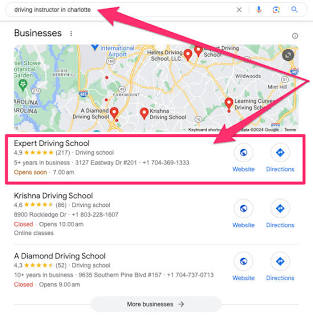
Key Google Business Profile Steps:
- Primary Category: Set your main category to Driving School. Add secondary categories like Driving Test Center or Traffic School if applicable.
- Service Areas: Explicitly specify every city, neighborhood, and postal code you cover.
- Consistent NAP Data: Ensure your Name, Address, and Phone Number are 100% identical across your website, social profiles, and directory listings.
- High-Quality Real Photos: Upload genuine photos of your instructor vehicles, dual-control cars, and happy students holding their pass certificates. Authentic photos build far more trust than stock images.
Before making major structural changes to your website, focus on optimizing your Google Business Profile Manager
. If you need expert assistance setting up your local presence, check out our Octaoop Digital Local SEO Services.
2. Target High-Intent, Location-Based Keywords
Trying to rank for broad, generic keywords like “driving school” nationally is extremely difficult. Instead, target localized, high-intent keywords that match what ready-to-book students type into search engines.
| Search Intent Category | Focus Keyword Formulas | Example Target Keywords |
| Core Local Service | Driving school in [City/Town] | Driving school in Manchester |
| Lesson Specifics | [Type] driving lessons [Area] | Automatic driving lessons Bolton |
| Instructor Type | [Gender/Niche] driving instructor [Town] | Female driving instructor Atherton |
| Urgent / Intent | Pass fast driving courses [City] | Intensive driving courses Salford |
Pro Tip: Structure your core keywords inside your page titles (
<title>), main headings (<h1>), subheadings (<h2>), and early paragraphs to give clear relevance signals to search engine crawlers.
3. Build Dedicated Location & Service Pages
If you cover multiple towns, postcodes, or test center zones, do not just list them in your website’s footer. Search engines rank specific pages, not just entire websites.
Best Practices for Dedicated Pages:
- Unique Landing Pages: Create individual pages for each key city or neighborhood (e.g.,
/driving-lessons-stockport,/driving-lessons-bolton). - Local Test Center Context: Mention nearest driving test centers, local test routes, complex roundabouts, or tricky junction points.
- Hyper-Local Reviews: Feature testimonials and pass photos specifically from students residing in or taking tests in that particular area.
4. Optimize On-Page and Mobile User Experience
Most learner drivers research and book lessons directly on mobile devices. A slow or difficult-to-navigate website directly harms rankings and lowers conversion rates.
UX & Technical Requirements:
- The “Thumb Test”: Position a clear “Book Lessons” or “Call Now” button visible at the top of the mobile screen without requiring users to scroll down.
- Fast Page Load Times: Compress all vehicle and pass photos so your pages load in under 2.5 seconds.
- Image Optimization: Use descriptive filenames and alt attributes (e.g.,
alt="student-passing-driving-test-in-bolton.jpg"). - Clear Pricing & Packages: Clearly present hourly rates, block booking discounts, and lesson choices to reduce drop-offs.
Compress all vehicle and pass photos so your pages load in under 2.5 seconds. You can audit your current loading times using the Google PageSpeed Insights tool
5. Build Local Trust & High-Quality Backlinks
Google measures local authority through online mentions, citations, and quality backlinks pointing to your site.
- Automated Review Engine: Ask students for a Google Review immediately after they pass their driving test—text or WhatsApp them your direct Google Review link while they are celebrating.
- Local Business Directories: Submit accurate business citations to trusted platforms like Yell, Bing Places, Apple Maps, and regional directories.
- Community Partnerships: Sponsor local youth sports teams, partner with high schools or colleges, or guest blog on local automotive platforms to acquire high-authority local backlinks.