
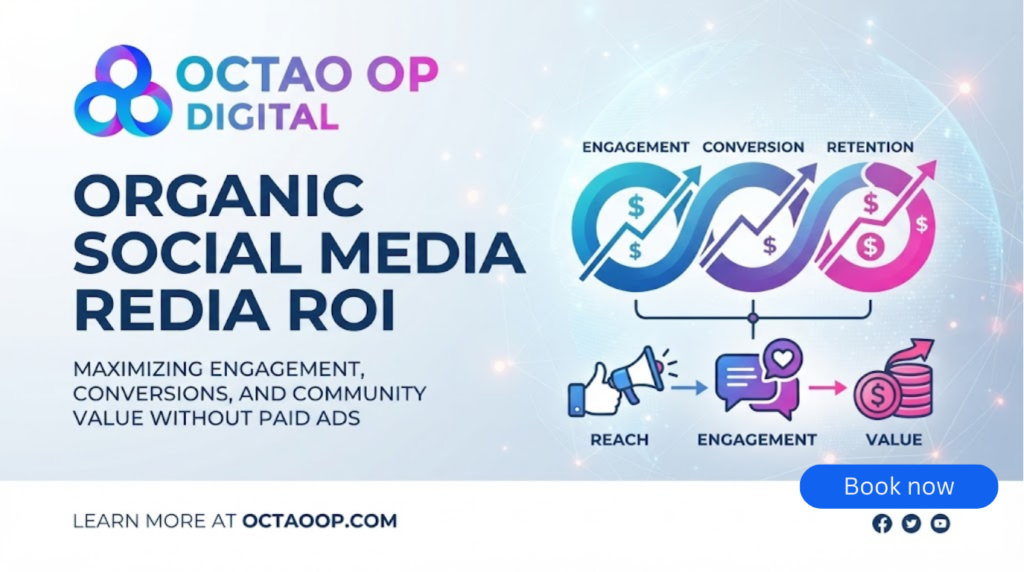
For years, social media marketing operated on a wave of enthusiasm for digital community building. Brands were content collecting Facebook likes, tracking Twitter retweets, and measuring double-taps on Instagram.
However, in today’s performance-focused commercial landscape, executives and finance teams are demanding clear accountability. The age of vanity metrics is over. Today, marketing managers are consistently asked one critical question by leadership: “What is our exact organic social media roi?”
Proving the financial return on unpaid social media channels is notoriously tricky. Unlike paid ads—where a direct line connects ad spend to clicks and immediate conversions—organic social operates across longer sales cycles, non-linear touchpoints, and subtle brand-building channels.
In this comprehensive guide, we will break down the true formulas for calculating organic social media ROI, explain how to set up bulletproof tracking models, and show you how to transform non-paid social content into a reliable engine for sales and lead generation.
1. What Is Organic Social Media ROI and Why Is It Hard to Track?
At its core, organic social media roi represents the revenue generated from your unpaid social media efforts relative to the total cost (time, tools, and talent) required to create and distribute that content.
Organic Social ROI (%) = [ (Gross Revenue Generated - Total Social Investment) / Total Social Investment ] x 100
The Attribution Challenge
The primary reason brands struggle to calculate this return is the non-linear nature of customer journeys:
- Dark Social Channels: Prospective buyers frequently share your posts via direct messages, Slack groups, or email, stripping away referral tracking parameters.
- Multi-Touch Journeys: A buyer might discover your brand on LinkedIn, read five posts over three months, listen to your podcast, and then finally navigate directly to your site to request a quote. Standard “last-click” analytics tools misattribute that sale to direct traffic, leaving social credited with zero value.
- Delayed Conversions: Organic social builds trust and domain authority over time. The conversion rarely happens on the exact day a post goes live.
2. Vanity Metrics vs. Revenue-Driving Business Metrics
To accurately measure organic performance, you must stop equating post engagement with commercial success.
| Metric Category | Metrics to Stop Prioritizing | Commercial Metrics That Matter |
| Vanity Metrics | Total Followers, Page Likes, Raw Impressions | Engagement Rate on Commercial Posts, Profile Link Clicks |
| Lead Generation | Video Views, Post Shares | Lead Form Submissions, Content Gated Downloads, Booked Calls |
| Financial Impact | Share of Voice, Brand Reach | Customer Acquisition Cost (CAC), Customer Lifetime Value (LTV) |
While likes and shares signal that your content resonates with an audience, they mean very little unless they eventually push prospective buyers down your conversion funnel.
[Internal Link: Transform your content infrastructure into a revenue-generating channel with our specialist Octaoop Digital SEO and Content Marketing Services].
3. The True Cost Equation: What Counts as Investment?
Many marketers assume that because organic content does not require ad spend, it is essentially “free.” This mindset skews your ROI calculation. To get an honest performance baseline, you must calculate your total investment across three core areas:
- Human Resource Costs: Calculate the hourly wages or salary proportions of community managers, copywriters, graphic designers, and video editors working on organic posts.
- Software & Tech Stack: Factor in monthly subscription costs for scheduling platforms, social listening tools, design software (e.g., Adobe Creative Cloud, Canva Pro), and analytics software.
- Asset Production Costs: Include external agency fees, freelance contractors, props, stock footage libraries, and studio equipment used for non-paid social production.
4. Step-by-Step Blueprint to Track & Prove Organic Social ROI
To move beyond guessing and present concrete financial metrics to your leadership team, implement this four-stage tracking framework:
1.Standardize UTM Tracking Across Every Link:Step 1.
Never post a raw URL on social profiles or posts. Use custom Google Campaign URL Builders to add explicit UTM parameters (Source, Medium, Campaign, and Content Variant) to every single link.
2.Configure Custom Conversion Events in GA4:Step 2.
Set up specific event tracking inside Google Analytics 4 (GA4) for micro-conversions (newsletter signups, whitepaper downloads) and macro-conversions (demo requests, purchases).
3.Implement Self-Reported Attribution Fields:Step 3.
Add an open text field to your website inquiry forms asking: “How did you first hear about us?”. This captures hidden organic social influence that digital analytics miss.
4.Transition to Data-Driven or Multi-Touch Attribution:Step 4.
Move away from simple “Last Click” attribution models in your analytics software. Utilize “Linear” or “Position-Based” models to grant credit to early-stage social touchpoints.
The Social Proof Principle: Organic social media rarely acts as a standalone closing mechanism. Instead, it serves as an trust accelerator that increases the conversion rate of your paid ads, email campaigns, and direct sales outreach.
[External Link: Learn more about setting up custom tracking parameters on Google Analytics Help].
[Internal Link: Pair your social presence with high-converting web experiences through our Octaoop Digital Custom Web Design Services].
Turn Your Organic Social Media into a Measurable Profit Center
Calculating your true organic social media roi shifts your marketing team from a perceived cost center into an indispensable growth driver. By replacing vanity metrics with rigorous attribution tracking, clear financial formulas, and strategic lead capture, you can justify your budget and scale your brand’s digital authority.
At Octaoop Digital, we take the guesswork out of digital marketing. We build full-funnel strategies that combine search engine visibility, technical web performance, and conversion-focused content designed to fuel your commercial pipeline.
Want to stop guessing your marketing returns? Contact the Octaoop Digital Strategy Team today to request a comprehensive digital marketing performance audit.