
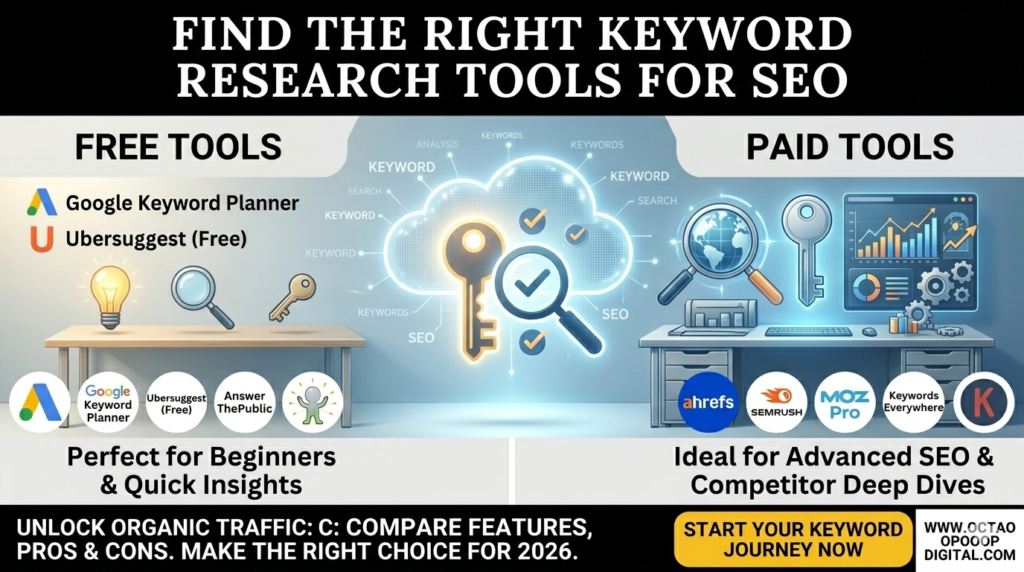
Getting your website noticed online is tough without the right tools. Many site owners find it hard to understand what people search for. This makes it hard to get their site seen. Keyword research tools are the secret to getting your website noticed online. Many site owners find it hard to understand what people search for, making it difficult to get their site seen.
Using keyword research tools can change this. They help you find out what your audience wants. This guide will show you the best tools to improve your site’s ranking and attract more visitors. For the most accurate search volume data directly from the source, visit Google Keyword Planner.

Choosing the right software is key to your online success. We’ll look at how these tools work and why they’re crucial for success in the UK market.
Key Takeaways
- Understanding search intent is vital for your content success.
- Proper analysis helps you prioritise high-value opportunities.
- Choosing the right software saves time and improves your results.
- Data-driven decisions lead to better organic performance.
- Consistent monitoring ensures your strategy remains effective.
Understanding the Role of Keyword Research in SEO
Keyword research is key in SEO. It finds the terms people use to look for things online. This helps your business reach the right audience.
Knowing how to do keyword research is crucial. It makes your content hit the mark and boosts your site’s ranking on search engines.
Why Keywords Remain the Foundation of Search Visibility
Keywords are essential for being seen online. They tell search engines what your content is about. This helps your site rank better.
Effective keyword research means using the best keyword research tools. Tools like Google Keyword Planner, SEMrush, and Ahrefs are great for finding the right keywords.
| Keyword Research Tool | Primary Function | Usefulness for Beginners |
| Google Keyword Planner | Identifying keywords and search volume | High |
| SEMrush | Competitor analysis and keyword research | Medium |
| Ahrefs | Backlink analysis and keyword research | Medium |
How Search Engines Interpret User Queries
Search engines look at what you type in the search bar. They figure out what you want and show you the best results.
Understanding user intent is key. A keyword analysis tool helps you see what people are looking for. This way, you can make content that meets their needs.

Matching your content with what people want makes your site more visible. It also brings more people to your site.
Defining Your SEO Objectives and Target Audience
Knowing your SEO goals and understanding your audience is key. It helps you use top keyword research tools well. Your SEO goals should match your business strategy. This ensures your online presence supports your company’s mission.
To align your SEO with your business, define what you want to achieve. Do you want to boost brand awareness, increase sales, or get more leads? Your goals should be specific, measurable, achievable, relevant, and time-bound (SMART).
Aligning Keywords with Your Business Goals
Next, match your keyword strategy with your business goals. Find the keywords your target audience uses to find products or services like yours. Top keyword research tools help you discover these keywords, their search volume, and competition.
For example, if you aim to boost sales, use transactional keywords. If you want to increase brand awareness, target informational keywords that interest your audience.

Segmenting Your Audience for Better Targeting
Segmenting your audience is vital for creating content that speaks to different groups. Understanding your audience’s demographics, interests, and behaviours helps tailor your keyword strategy. This ensures your content meets their needs.
Use data and insights to create buyer personas or audience profiles. These profiles guide your content creation and keyword use. For instance, different age groups or locations might prefer different keywords or content types.
By knowing your SEO goals and your audience well, you can craft a keyword strategy that works. This approach boosts your search rankings and digital marketing success.
Essential Features to Look for in Keyword Research Tools
To boost your SEO, you need a keyword research tool with key features. The right tool helps find the best keywords, understand competition, and improve your content for better rankings.
When choosing a keyword research tool, look for certain features. These features help find the right keywords and plan your content to beat your rivals.
Search Volume and Difficulty Metrics
Knowing search volume and keyword difficulty is key. Search volume shows how often a keyword is searched. Keyword difficulty tells you how hard it is to rank for that keyword. A good tool gives accurate metrics for both.
For example, a keyword with high search volume but low difficulty is great to target. Keywords with very high difficulty need more advanced SEO strategies to rank.
Competitor Analysis Capabilities
Looking at your competitors’ keyword strategies can reveal market gaps and opportunities. A tool with strong competitor analysis lets you see the keywords your rivals rank for and their content plans.
“Knowing your competitors’ strengths and weaknesses in terms of keyword usage can significantly inform your SEO strategy.”
Localisation Features for the United Kingdom
For UK-focused businesses, localisation features are vital. A tool that filters results by region, like the UK, helps tailor your SEO to specific areas.
This is crucial for local businesses. It lets them target local search queries more effectively.
By focusing on these key features, you can pick a keyword research tool that boosts your SEO and digital marketing strategy.
Evaluating Free Keyword Research Tools for Beginners
For those new to SEO, it’s key to use free keyword research tools. These tools help find the right keywords and create content that your audience will love.
As a beginner, you’ll find many tools claiming to be the best. But, not all are right for you. Let’s look at some top free keyword research tools.
Maximising Google Keyword Planner
Google Keyword Planner is a must-have for SEO. It shows search volume, trends, and competition. Here’s how to get the most out of it:
- Use it to find keyword ideas and forecasts.
- Look at historical data to see search volume trends.
- Filter results by location, like the United Kingdom.
Utilising Google Trends for Seasonal Insights
Google Trends is great for seeing what’s trending now. It helps you:
- Find seasonal trends and patterns.
- See how popular different keywords are.
- Analyse search trends by location.
Using Google Trends, you can plan your content for the right time. This boosts your visibility when searches are high.
Leveraging AnswerThePublic for Question-Based Queries
AnswerThePublic gives you content ideas from questions people ask. It’s good for:
- Creating content that answers user questions.
- Finding long-tail keywords.
- Understanding what users are searching for.
By using these free keyword research tools, you can improve your online presence. The most important thing is to know your audience and make content for them.
Leveraging Professional Keyword Analysis Tools for Competitive Advantage
Boost your SEO with top-notch keyword analysis tools. These tools give you a deep look at your SEO world. They help you make smart choices to grow your online presence.
Deep Dive with Semrush
Semrush is packed with features to boost your keyword game. Its keyword finder tool reveals a wide range of relevant keywords. You can also see what your competitors are doing and track your own rankings.
What really stands out about Semrush is its competitor analysis. By looking at your competitors’ keywords, you can spot your own strategy’s weaknesses. This lets you find ways to beat them.
Uncovering Opportunities with Ahrefs
Ahrefs is a go-to for SEO experts. It lets you explore new keywords, check their potential, and add them to your content plan.
Ahrefs also has a strong backlink analysis feature. This helps you understand your website’s link profile and find ways to improve. By doing this, you can boost your domain authority and climb the search engine rankings.
Utilising Moz Keyword Explorer for Domain Authority
Moz Keyword Explorer is a flexible tool. It helps you find the right keywords and shows their potential impact. It looks at domain and page authority to help you target valuable keywords.
The tool also shows how hard it is to rank for certain keywords. This gives you a clear view of the competition. It’s super helpful when planning your content and link-building.
| Tool | Key Features | Benefits |
| Semrush | Competitor analysis, keyword research, rank tracking | Identifies gaps in strategy, uncovers new opportunities |
| Ahrefs | Keyword research, backlink analysis, content analysis | Enhances domain authority, improves search engine rankings |
| Moz Keyword Explorer | Keyword research, domain authority analysis, difficulty metrics | Refines keyword strategy, targets high-value opportunities |
Step-by-Step Guide to Using a Keyword Planner Tool
To boost your SEO, it’s key to know how to use a keyword planner tool well. These tools help find keywords your audience uses to find content like yours.
By following a clear plan, you can get the most out of these tools. This will greatly improve your SEO strategy. Here’s how to start.
Initial Seed List Setup
The first step is to set up your seed list. Your seed list should include broad terms related to your business or niche.
To create a strong seed list:
- Find core topics related to your business or content.
- Make a list of keywords linked to these topics.
- Add variations of your main keywords, like synonyms or related phrases.
This list is the base for your keyword research. It helps the tool find more potential keywords.
Filtering Results for Relevance and Search Volume
After getting a list of keywords, filter them by search volume and relevance.
To do this well:
- Use the tool’s filters to narrow down the list by search volume, competition, and other important metrics.
- Choose keywords with a good search volume and are closely related to your content or business.
- Think about the intent behind the keywords. Make sure they match your SEO goals.
By focusing on keywords that are both relevant and have a good search volume, you can improve your content’s search engine ranking.
Exporting Data for Strategic Planning
The last step is to export the data from your keyword planner tool for planning.
To use this data well:
- Export the keyword list with metrics like search volume and competition level.
- Study this data to spot patterns, opportunities, and gaps in your content strategy.
- Use these insights to guide your content creation and optimisation. This makes your SEO strategy more focused and effective.
By following these steps and using a keyword planner tool, you can greatly improve your SEO. This will help increase your online presence.
Analysing Search Intent with a Keyword Finder Tool
To make your content better for search engines, you need to know what users are looking for. A keyword analysis tool helps a lot with this. It’s important because it lets you make content that really meets what your audience wants, which helps your SEO.
Distinguishing Between Informational and Transactional Intent
When you use a keyword finder tool, it’s key to know the difference between search intents. There are mainly two types: informational and transactional.
- Informational Intent: People are looking for answers or information. Keywords like “what is,” “how to,” and “why” show this.
- Transactional Intent: Users want to buy something or do something specific. Keywords like “buy,” “price,” and “discount” show this.
Mapping Keywords to the Customer Journey
It’s vital to know where your audience is in their journey. A keyword analysis tool helps you see this. It shows how keywords fit into different parts of the journey:
- Awareness Stage: People start to notice a problem or need. Keywords here are broad and about information.
- Consideration Stage: Users are looking at options. Keywords might include comparisons and reviews.
- Decision Stage: People are ready to buy. Keywords here are about making a purchase.
To get better at understanding search intent, do this:
Use a keyword finder tool to spot patterns in what users search for. Look at what your competitors do to see how they meet different intents. Change your content strategy based on what you learn from your analysis.
“Understanding the intent behind a search query is key to creating content that resonates with your audience and meets their needs.”
- Find long-tail keywords that are less competitive but more likely to convert.
- Group related terms together with keyword clustering to make comprehensive content.
- Keep your content up to date to match changes in user intent and trends.
By really getting into search intent with a keyword analysis tool, you can boost your SEO. It’s not just about knowing the types of intent. It’s also about making sure your content fits the customer journey well.
Key Takeaways
- Know the difference between informational and transactional intent to make targeted content.
- Match keywords to the customer journey to keep your content relevant at every stage.
- Keep checking and changing your strategy based on what you learn from your keyword analysis tool.
Identifying Long-Tail Opportunities with a Keyword Suggestion Tool
Using a keyword suggestion tool can reveal long-tail opportunities you might miss. Long-tail keywords are detailed phrases with lower search numbers. They are less competitive and more focused on your content.
Value of Low-Competition Phrases
Low-competition phrases are a big win for SEO. They are less crowded, giving you a better chance to rank higher in search results with less work.
Benefits of targeting low-competition phrases include:
- Higher conversion rates due to more targeted traffic
- Less competition, making it easier to rank
- More cost-effective SEO strategy
Using Autocomplete Features for Content Ideas
Autocomplete features in keyword tools give instant suggestions based on what users search for. These can be a treasure trove for content ideas.
To maximise autocomplete features:
- Type a broad keyword related to your niche into the tool.
- Analyse the suggestions provided.
- Refine your search based on the suggestions to find more specific long-tail keywords.
Comparing popular keyword tools can help you pick the best one for your needs.
| Tool | Autocomplete Feature | Long-Tail Keyword Suggestions |
| Ahrefs | Yes | Extensive list |
| SEMrush | Yes | Comprehensive suggestions |
| Moz Keyword Explorer | Yes | Detailed suggestions |
Visual aids can help in understanding how keyword suggestion tools work.
Comparing the Best Keyword Research Tools for UK Markets
Choosing the right keyword research tool is key for UK businesses. There are many options, so it’s important to compare them. Look at their features and how well they suit the UK market.
The UK’s search scene is different, with its own trends. So, a tool that gives accurate data for British searches is crucial.
Assessing Data Accuracy for British Search Trends
Data accuracy is top when picking keyword tools. Tools that give current and precise data on British searches can really boost your SEO.
Some tools have localisation features for the UK. This helps you reach your audience better.
Cost-Benefit Analysis of Paid Subscriptions
Paid subscriptions for keyword tools come with extra features. It’s vital to do a cost-benefit analysis. This helps decide if the extra features are worth the cost.
- Evaluate the extra features in paid plans.
- Think about the tool’s growth with your business.
- Check the support you get with paid subscriptions.
User Interface and Ease of Use
The user interface and ease of use matter a lot. A tool that’s easy to use can save time and boost productivity.
Look for tools with a clean, simple design. This makes it easy to find and use the features you need.
Integrating Keyword Data into Your Content Strategy
Keyword data is key to a good content strategy. It helps you make content that meets your audience’s needs. Using keyword planner tools and keyword finder tools lets you plan content that speaks to your audience. This boosts your search engine rankings too.
Optimising On-Page Elements with Targeted Keywords
It’s important to make your content friendly to search engines. This means using the right keywords in places like the page title and headings. Doing this makes your content more visible in search results.
For example, a keyword planner tool can find the best keywords for your content. Then, you can use these keywords to boost your content’s SEO.
Creating Content Clusters for Topical Authority
Content clusters help you become an authority on a topic. You create a main piece of content and link it to related topics. This shows search engines your site is a go-to for that topic.
A keyword finder tool helps find related topics and keywords for your clusters. Grouping content this way makes your site more useful and relevant to search engines.
Monitoring Performance and Adjusting Your Strategy
It’s vital to check how your content is doing. Look at page views, engagement, and conversion rates. This helps you see what’s working and what needs tweaking.
| Metric | Description | Action |
| Page Views | Number of visitors to your page | Analyse popular content to identify trends |
| Engagement | Likes, shares, and comments on your content | Adjust content type to increase engagement |
| Conversion Rates | Percentage of visitors completing a desired action | Optimise content to improve conversion rates |
Keep an eye on your content’s performance and tweak your strategy as needed. This keeps your content fresh and effective in reaching your SEO goals.
Conclusion
You now know how important it is to pick the right keyword research tools for your SEO plan. These tools help boost your search rankings and bring more visitors to your site.
Google Keyword Planner, Semrush, and Ahrefs are great for finding the right keywords. They also help you understand what people are searching for and improve your content. Using this data in your content strategy can grow your online presence and help you reach your business goals.
Keep an eye on how well your strategy is working and make changes as needed. With the right tools, you can make the most of your SEO efforts and thrive in the UK market.
FAQ
Why is it essential to use a keyword analysis tool for my SEO strategy?
A keyword analysis tool helps you understand search trends and what people are looking for. It shows you how competitive certain keywords are. This way, you can make your content more visible on Google and attract more relevant visitors.
What are the best keyword research tools currently available for digital marketers?
The best keyword research tools give you detailed data and are easy to use. Semrush, Ahrefs, and Moz Pro are top choices. They help you see what your competitors are doing and how to stay ahead.
Are there effective free keyword research tools for those just starting out?
Yes, there are great free keyword research tools for beginners. Google Trends shows you what’s popular seasonally. AnswerThePublic reveals the questions people are asking. These tools are perfect for starting your SEO journey without spending money.
How should I use a keyword planner tool to refine my content plan?
Use a keyword planner tool like the one in Google Ads to find promising keywords. Filter them by relevance and how often people search for them. This helps you plan your content to attract the right audience for your business.
Why is a keyword finder tool important for understanding search intent?
A keyword finder tool helps you see if people are looking for information or ready to buy. Knowing this lets you create content that meets users’ needs at the right time.
How can a keyword suggestion tool assist in finding long-tail opportunities?
A keyword suggestion tool uses data to suggest specific, less competitive phrases. These phrases often attract more focused traffic, helping you stand out and reach the top of search results.
What features define the top keyword research tools for the UK market?
The top keyword research tools for the UK need to focus on local data. Tools like KWFinder by Mangools let you target specific areas in the UK. This is key to local SEO success.
