
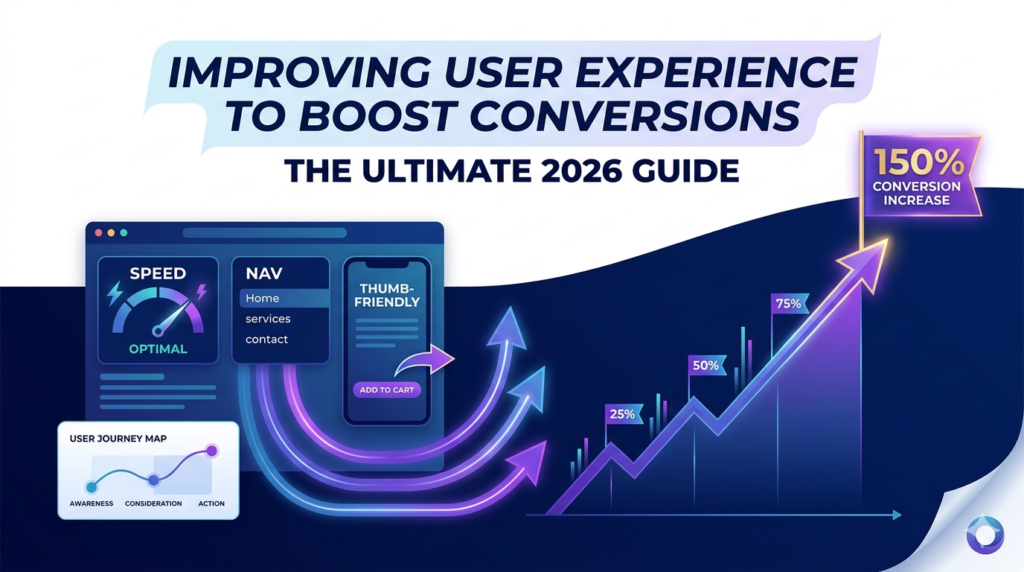
Introduction: Why UX is the New SEO
In the digital landscape of 2026, the success of your business hinges on a single factor: how a human feels when interacting with your interface. Improving user experience is no longer just a “design choice”; it is the most critical metric for search engine visibility and customer retention.
At Octaoop Digital, we have monitored the evolution of Google’s algorithms. Today, search engines prioritize “Search Task Accomplishment.” If a user lands on your site and leaves without completing their goal, your rankings will suffer. By focusing on a user-friendly design, you aren’t just pleasing your customers—you are signaling to the world that your brand is the gold standard of digital reliability. Strategically improving user experience for a digital marketing agency website.
1. The ROI of Website Usability
Before diving into the “how,” we must understand the “why.” High-quality website usability translates directly into bottom-line growth.
Conversion Rate Optimization (CRO)
A friction-heavy website is a leak in your revenue bucket. By optimizing user journey paths, you remove the barriers that cause “cart abandonment” or “form fatigue.” Data suggests that every $1 invested in UX brings $100 in return—an ROI of 9,900%.
Enhancing Customer Satisfaction and Lifetime Value (LTV)
It is five times cheaper to retain a customer than to acquire a new one. When you enhance customer satisfaction through seamless interactions, you build brand equity. A user who finds your site easy to navigate today is 70% more likely to choose you over a competitor tomorrow.
2. The Core Pillars of User-Friendly Design
A user-friendly design is founded on clarity, consistency, and accessibility.
Visual Hierarchy and the “Scannability” Factor
Most users do not read every word on your page; they scan. To increase engagement, you must design for the “F-Pattern” or “Z-Pattern” of eye movement.
- Primary Headers: Use bold H1 and H2 tags to define the topic.
- Call to Action (CTA): Use high-contrast colors (like our signature Octaoop purple) to make buttons pop.
- Whitespace: “Breathing room” prevents cognitive overload and keeps the user focused on your core message.
Enhancing Accessibility (WCAG 2.2 Standards)
To truly enhance accessibility, your site must be perceivable, operable, and understandable for all users, including those using screen readers.
- Color Contrast: Ensure a ratio of at least 4.5:1 for normal text.
- Alt Attributes: Every image must include the focus keyphrase or a synonym. For example:
<img src="ux-design.jpg" alt="Improving user experience through clean layout">.
3. Technical Mastery: Improve Site Performance
You can have the most beautiful design in the world, but if it doesn’t load, it doesn’t exist. To improve site performance, you must look under the hood.
Core Web Vitals in 2026
Google’s Core Web Vitals are now more sophisticated, focusing on:
- LCP (Largest Contentful Paint): How fast the main content loads.
- INP (Interaction to Next Paint): Measuring the responsiveness of every interaction.
- CLS (Cumulative Layout Shift): Ensuring elements don’t jump around while loading.
Advanced Speed Optimization
- Server-Side Rendering (SSR): Essential for complex web apps to feel instantaneous.
- Edge Computing: Using CDNs to serve content from the server closest to the user (crucial for our global clients at Octaoop).
- Image Optimization: Use Next-Gen formats like AVIF or WebP.
4. Mobile-First and Responsive Web Design
The “mobile-first” era has matured into “mobile-only” for many demographics. Responsive web design is the art of ensuring your site is a shapeshifter, providing an elite experience on a 6-inch screen and a 32-inch monitor alike.
Thumb-Zone Mapping
Design your mobile interface so that primary actions are within the natural reach of a thumb. Avoid placing small links too close together, which leads to “fat-finger” errors and frustrates the user.
5. Optimizing the User Journey: The Path to Conversion
To optimize user journey maps, you must map out every potential entry point—from a “Bolton driving lessons” search to a direct LinkedIn referral.
The Awareness-to-Action Pipeline
- Entry: Landing page clarity. Does the user know exactly what you offer in 3 seconds?
- Education: Use content clusters to establish authority. (See our Keyword Research Guide for more on this.
- Conversion: Frictionless forms. Ask only for what you need. Every extra form field reduces conversions by 11%.
6. Psychology of UX: Beyond the Screen
UX design is applied psychology. By understanding how humans process information, we can increase engagement naturally.
- Hick’s Law: Simplify choices. If a user is overwhelmed by options, they will choose nothing.
- The Zeigarnik Effect: Use progress bars in long forms. People are more likely to finish a task they have already started.
- Social Proof: Integrating reviews and “EST” founding dates (like Octaoop’s EST 2022) provides the “safety in numbers” that humans crave before buying.
7. Measuring Success: The UX Audit
How do you know if you are successfully improving user experience? You must measure it.
Key Metrics to Track
| Metric | What it Tells You | Actionable Goal |
| Bounce Rate | Relevance of content | Aim for under 40% |
| Average Session Duration | Level of engagement | Aim for 2+ minutes |
| Conversion Rate | Effectiveness of UX/UI | Benchmarked by industry |
| Task Success Rate | Ease of use | Should be 90%+ |
8. Conclusion: Your Partner in UX Excellence
At Octaoop Digital, we don’t just build websites; we build digital legacies. Improving user experience is a continuous journey of testing, learning, and refining. Whether you are looking to improve site performance or undergo a total user-friendly design overhaul, our team is ready to scale your vision.
For more insights into the latest search trends, visit Google Search Central to stay updated on algorithm shifts.
