The Growth Handoff Problem: Why More Marketing Channels Don’t Always Produce More Customers
Businesses are investing in SEO, paid advertising, social media, AI and automation. But adding more channels does not necessarily create more customers. The real competitive advantage may lie in what happens between those channels.
The digital marketing problem nobody is measuring properly
A business invests in SEO. Website traffic increases.
It starts running Google Ads. More people visit its website.
The social media team publishes consistently. Brand visibility improves.
The business introduces a CRM. Leads are recorded.
On paper, every marketing activity appears to be moving in the right direction. Yet revenue remains inconsistent, enquiries are not converting as expected, and the business cannot clearly explain where its growth is getting stuck.
This is a problem worth examining more closely.
The issue is not necessarily poor SEO, ineffective advertising or weak content. Sometimes, the individual activities are performing reasonably well, but the connections between them are failing.
We call this the Growth Handoff Problem.
It occurs when a potential customer moves from one part of a business’s digital ecosystem to another, but the information, experience or action required to move them forward is missing.
A visitor discovers a company through Google but lands on an unconvincing page. Someone clicks an advertisement but receives no timely response after submitting an enquiry. A prospect researches a company through several sources but finds inconsistent messaging.
Each individual channel may be functioning. The overall customer journey is not.
What industry research tells us about changing customer behaviour
The traditional marketing funnel assumed that businesses could attract attention, generate interest and guide customers towards a purchase through a relatively predictable sequence.
That assumption is becoming increasingly difficult to maintain.
Research published by Boston Consulting Group in June 2026 highlights how consumers increasingly research and compare their options before purchasing. Its research found that 43% of consumers want to research and compare options, while digital channels outperform traditional media by 9 percentage points in information discovery and 13 percentage points in purchase conversion.
Meanwhile, HubSpot’s 2026 State of Marketing, based on more than 1,500 marketers, identifies AI-assisted personalization, automation and adapting SEO to changes in search as major priorities.
These developments point towards a different competitive environment: customers have more ways to discover businesses, more sources from which to evaluate them and more opportunities to abandon a buying journey.
The challenge is no longer simply getting attention. It is maintaining relevance and trust throughout the decision-making process.
Research worth exploring:
- BCG – The Research-Led Consumer Journey Is Changing the Rules of Marketing Influence
- HubSpot – 2026 State of Marketing
- Basis – AI and the Future of Marketing: 2026 Edition
Traditional channel-based marketing versus connected growth
One of the biggest strategic mistakes businesses make is evaluating marketing activities independently.
A company might measure SEO through rankings, advertising through clicks, social media through engagement and its website through traffic.
These metrics are useful, but they do not necessarily explain whether the entire customer acquisition process is working.
Consider the difference:
| Marketing area | Traditional approach | Connected growth approach |
|---|---|---|
| SEO | Improve keyword rankings | Attract relevant visitors and support buying decisions |
| Paid advertising | Generate clicks and traffic | Generate qualified opportunities at sustainable costs |
| Content | Publish regularly | Answer customer questions and establish credibility |
| Social media | Increase engagement | Build familiarity, trust and consideration |
| Website | Present products and services | Convert interest into meaningful actions |
| CRM | Store customer information | Manage opportunities and follow-up |
| Automation | Reduce manual tasks | Improve response, consistency and operational efficiency |
| Analytics | Produce performance reports | Identify bottlenecks and guide business decisions |
The difference is not about abandoning traditional marketing channels.
SEO still matters. Paid media still matters. Social media, content and websites remain important.
The difference is how these activities are planned, connected and evaluated.
A channel-based strategy asks: How well is this individual activity performing?
A connected growth strategy asks: How effectively is the entire system turning market attention into business outcomes?
Five handoffs where businesses lose growth opportunities
1. Discovery to credibility
A potential customer finds a business through a search engine, an advertisement, a social post or an AI-assisted recommendation.
But discovery alone does not establish trust.
Customers may look for:
- Clear service descriptions.
- Evidence of experience.
- Consistent brand messaging.
- Relevant reviews and testimonials.
- Useful answers to their questions.
- A professional website.
This is where search visibility and brand credibility need to work together.
Businesses should consider investing in SEO, Local SEO, AI Search Optimization and Digital PR as connected parts of their discovery and credibility strategy.
2. Credibility to conversion
A customer might trust a business but still decide not to enquire.
Why?
Perhaps the website is confusing. The service offering is unclear. Pricing information is difficult to understand. The contact process requires too many steps.
This is where website experience becomes a commercial issue rather than simply a design decision.
A business should examine:
- Whether landing pages match customer intent.
- Whether its services are explained clearly.
- Whether calls to action are visible.
- Whether mobile visitors can enquire easily.
- Whether the website communicates enough trust.
Web Design & Development, WordPress Development, Shopify Development and Conversion Rate Optimization can address different parts of this challenge.
3. Content to commercial intent
Content marketing has traditionally been associated with publishing blogs, creating social posts and increasing website traffic.
But publishing volume is not the same as commercial value.
A company could publish 30 articles and attract thousands of visitors without generating meaningful enquiries.
A better approach connects content to the questions customers ask before making a purchasing decision.
For example:
- What makes one provider different from another?
- Which solution is appropriate for my business?
- What should I consider before purchasing?
- What are the potential costs?
- What problems should I avoid?
This is where Content Marketing, Social Media Marketing, Video Content, Branding and Creative Design should contribute to one consistent brand experience.
4. Enquiry to meaningful follow-up
This is one of the most commercially important handoffs.
A potential customer completes a form, requests a quotation or sends a message.
What happens next?
In many businesses, enquiries are distributed manually, responses are delayed, information gets lost and nobody has a clear view of which opportunities require attention.
The solution is not necessarily another employee or a more expensive software subscription.
Sometimes the business needs a better process.
A properly structured CRM & Marketing Automation system can help manage enquiries, assign responsibility, organize follow-ups and maintain visibility.
AI & Business Automation can further support repetitive workflows where automation makes operational sense.
5. Activity to measurable business outcomes
A business cannot improve what it does not properly understand.
However, collecting more data does not automatically produce better decisions.
A useful measurement system should connect:
- Marketing investment.
- Qualified leads.
- Conversion rates.
- Customer acquisition costs.
- Revenue contribution.
- Response and follow-up performance.
Analytics & Tracking provides the measurement foundation, while Custom Software & Integrations can help businesses connect systems when standard tools are insufficient.
The comparison that matters: More channels versus fewer gaps
Consider two hypothetical businesses operating in the same competitive market.
Both have similar marketing budgets and offer comparable services.
| Business A: Channel-first | Business B: Connected growth |
|---|---|
| Runs SEO independently | SEO supports relevant service pages |
| Buys advertising traffic | Ads lead to intent-matched landing pages |
| Publishes frequent content | Content addresses actual buying questions |
| Receives enquiries by email | Enquiries enter an organized CRM |
| Follows up manually | Follow-up has clear ownership and processes |
| Reports traffic and clicks | Reviews qualified leads and commercial outcomes |
Neither business necessarily spends more.
However, Business B has fewer gaps between discovery, trust, conversion and follow-up.
That creates a potential operational advantage.
It is important to clarify that this is an illustrative comparison, not a controlled experiment proving a particular percentage of additional revenue. Actual performance depends on the market, offer, execution, sales capability and customer demand.
The strategic point is that marketing performance should be evaluated beyond individual channel metrics.
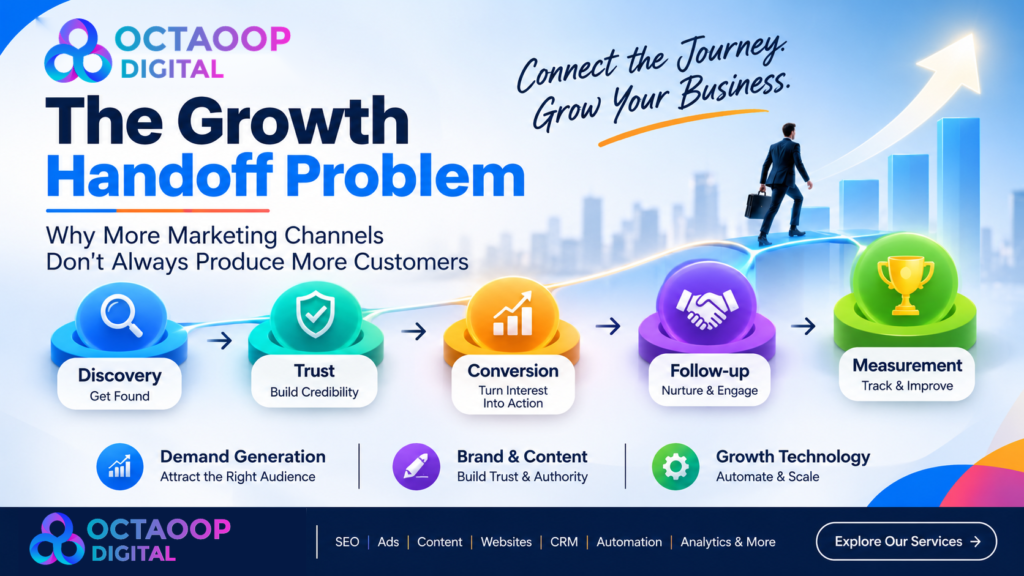
A practical framework: Measure the growth handoffs
Businesses can begin by examining five stages of their customer journey.
| Stage | What to examine | Useful measurement |
|---|---|---|
| Discovery | Are relevant customers finding us? | Qualified organic and paid traffic |
| Trust | Are visitors finding enough reasons to choose us? | Engagement with commercial content and trust signals |
| Conversion | Are visitors taking the intended action? | Enquiry and purchase conversion rates |
| Follow-up | Are opportunities being handled properly? | Response time and follow-up completion |
| Improvement | Are we learning from the results? | Lead quality, acquisition cost and revenue contribution |
A useful additional concept is Growth Handoff Leakage.
This describes the opportunities potentially lost when a customer moves between two stages of the buying journey.
For example, a company may attract 1,000 relevant website visitors but receive only 20 enquiries. Of those 20, perhaps 12 receive a timely response. Only five progress to a sales conversation.
These numbers are hypothetical, but they demonstrate why measuring traffic alone gives an incomplete picture.
A business should investigate where customers stop progressing, why they stop and what needs to change.
The objective is not to optimize every metric independently. It is to improve the transitions that matter commercially.
AI is changing discovery, but technology alone is not the strategy
AI is creating another layer of complexity.
Customers can now use AI-assisted search and conversational tools to explore products, compare providers and understand solutions before visiting a company’s website.
This creates opportunities for businesses to strengthen their visibility beyond traditional search results.
However, publishing AI-generated articles or adding an AI chatbot to a website is not, by itself, an AI growth strategy.
Businesses need to consider:
- Whether their online information is accurate and consistent.
- Whether their expertise is clearly communicated.
- Whether their content answers meaningful questions.
- Whether their website provides useful information to visitors.
- Whether AI tools are solving actual business problems.
- Whether automation can be measured against operational outcomes.
The same principle applies to AI-powered marketing: technology should improve a business process, not become a substitute for understanding it.
What should businesses prioritize first?
Not every business needs to invest in every digital marketing service simultaneously.
The correct starting point depends on where the business is currently losing opportunities.
| Business situation | Recommended starting priority |
|---|---|
| Low search visibility | SEO, Local SEO or AI Search Optimization |
| Need faster lead acquisition | Google Ads / PPC and Paid Social |
| Weak brand recognition | Branding, Content Marketing and Digital PR |
| Website traffic but few enquiries | Web Development and CRO |
| Poor social engagement | Social Media Marketing and Video Content |
| Leads are not followed up | CRM and Marketing Automation |
| Repetitive operational processes | AI and Business Automation |
| Limited performance visibility | Analytics and Tracking |
| Complex technology requirements | Custom Software and Integrations |
| Ecommerce conversion problems | Shopify Development and CRO |
The objective is to prioritize the constraint rather than automatically purchase a larger marketing package.
Some businesses need a single specialist service. Others need multiple disciplines working together.
Both approaches can be appropriate.
The future belongs to businesses that connect the entire growth journey
The next phase of digital competition will not be determined solely by who publishes the most content, spends the most on advertising or adopts the latest AI tools.
It will increasingly reward businesses that understand their customers, communicate value clearly, deliver a credible digital experience and manage opportunities effectively.
This requires a more connected way of thinking about digital growth.
At Octaoop Digital, this is the thinking behind three connected areas of work:
Demand Generation focuses on helping businesses become discoverable and attract relevant opportunities through search, paid media and conversion-focused marketing.
Brand & Content focuses on communicating expertise, developing recognition and building the credibility customers need before making decisions.
Growth Technology focuses on websites, CRM, automation, analytics and software that help turn interest into measurable business activity.
These are not three unrelated service categories. They are connected parts of a wider commercial system.
Businesses can start with one service and expand where a genuine need exists.
The important question is not how many marketing channels a company uses.
It is whether those channels are helping customers move from discovery to a confident decision.
More activity does not automatically mean more growth. Better connections can make the activity you already invest in work harder.
How Octaoop Digital can help
Octaoop Digital connects digital marketing, creative and technology services to help businesses improve the complete customer journey.
Explore the relevant capabilities:
Demand Generation & Search
Brand & Content
Websites & Growth Technology
- Web Design & Development
- WordPress Development
- Shopify Development
- CRM & Marketing Automation
- AI & Business Automation
- Analytics & Tracking
- Custom Software & Integrations
Ready to identify where your digital growth journey is breaking down?
Explore all Octaoop Digital services or contact Octaoop Digital to discuss your business goals.
Octaoop Digital — Get Found. Build Trust. Convert More Customers.