
Every marketing budget is a collection of decisions.
Invest more in paid advertising, or strengthen organic search? Produce more videos, or improve the website? Experiment with AI tools, or fix the systems already in place?
These are not simply channel decisions. They determine how a business allocates money, time, attention, and technical resources.
For 2027, the challenge is becoming more complicated.
Search experiences are evolving. Advertising platforms offer increasingly automated campaign management. Customers discover brands through different combinations of search, social media, creators, marketplaces, and AI-assisted tools.
Meanwhile, businesses still need to accomplish familiar objectives: attract relevant customers, build credibility, generate sales, and retain the customers they acquire.
The temptation is to respond by adding more channels, subscriptions, and campaigns.
But a larger marketing operation is not necessarily a more effective one.
A good digital marketing budget should fund the activities that matter most to the business, while reserving enough flexibility to respond when the evidence changes.
This guide explains how to build that budget, where different marketing disciplines fit, and how to distinguish worthwhile investment from unnecessary spending.
1. Start With the Business Objective, Not the Marketing Channel
One of the most common budgeting mistakes is starting with a list of marketing activities.
The business decides it needs SEO, Google Ads, social media, video production, email campaigns, and perhaps an AI tool.
Then it tries to distribute money between them.
A more useful starting point is the business objective.
Consider three companies.
Business A: A newly established professional services company needs its first consistent enquiries.
Business B: An established consumer brand wants to expand into a new market.
Business C: An ecommerce retailer wants to increase repeat purchases and improve customer lifetime value.
All three need marketing.
They do not need identical marketing budgets.
Business A may prioritize high-intent search visibility, a credible website, and lead conversion.
Business B may need market research, brand positioning, creative production, paid acquisition, and local adaptation.
Business C may benefit more from customer segmentation, lifecycle marketing, conversion optimization, and better product merchandising.
Before approving any expenditure, ask:
- What commercial objective does this investment support?
- Which audience are we trying to reach?
- How will the activity contribute to that objective?
- What evidence supports the investment?
- When should we expect useful signals?
- What would cause us to reduce, change, or stop spending?
These questions turn marketing budgeting from a collection of purchases into a set of business decisions.
2. What Does the Latest Marketing Budget Research Tell Us?
The pressure to make marketing spending more accountable is not merely theoretical.
Gartner’s 2026 CMO Spend Survey found that average marketing budgets represented 7.8% of company revenue among surveyed organizations, compared with 7.7% in 2025.
The same research found that 56% of surveyed CMOs believed their organizations lacked sufficient budget to deliver their marketing strategies.
AI was also receiving substantial attention.
On average, 15.3% of marketing budgets were allocated to AI initiatives, yet only 30% of surveyed organizations reported mature or fully developed AI readiness.
These findings reveal an important tension.
Businesses are expected to deliver stronger performance and adopt new technologies without unlimited resources.
However, Gartner’s survey primarily represented large organizations in North America and Europe, most with annual revenues exceeding $1 billion.
Its figures should not be used as an automatic benchmark for a small retailer, local services company, or early-stage startup.
The more useful lesson is about prioritization.
More technology and more advertising do not replace a clear understanding of where investment creates value.
Source: Gartner — CMO Spend in 2026.
3. Calculate Your Real Marketing Budget
Marketing spending is often underestimated because businesses count advertising costs but exclude the work required to make advertising effective.
A complete budget may include:
| Budget component | Typical expenses |
|---|---|
| Media investment | Google Ads, Meta Ads, retail media, sponsored placements |
| Strategy and management | Planning, campaign management, consulting, agency fees |
| Content and creative | Articles, graphics, video, photography, copywriting |
| Website and ecommerce | Development, hosting, maintenance, conversion improvements |
| Marketing technology | CRM, automation, analytics, integrations, software |
| Measurement | Reporting, testing, research, attribution, data quality |
| Experimentation | New channels, formats, platforms, and controlled pilots |
For example, a company spending $5,000 per month on advertising may also spend $1,500 on campaign management, $1,000 on content, and $500 on software.
Its actual monthly marketing investment is $8,000, not $5,000.
That distinction matters when calculating acquisition costs or evaluating profitability.
A practical budgeting formula
Start with:
Total marketing investment = Media spend + People and agency costs + Creative production + Technology + Research and measurement + Testing.
Then identify which costs are recurring and which are one-time investments.
A website redevelopment, for example, should not automatically be treated like a monthly advertising subscription.
Likewise, a campaign that produces sales this month should be evaluated differently from a content initiative designed to build visibility over several quarters.
4. Allocate Money Across Three Business Functions
Instead of beginning with individual marketing platforms, a useful approach is to organize investment around three functions:
- Getting discovered and generating demand.
- Building recognition, relevance, and trust.
- Supporting the technology and experience that convert interest into business.
These functions can help businesses understand why different services belong in the budget.
They also reflect the three connected service areas offered by Octaoop Digital Agency: Demand Generation, Brand & Content, and Growth Technology.
The right allocation depends on the business’s existing capabilities, market, growth stage, and objectives.
A. Demand Generation: Fund Customer Acquisition With a Clear Purpose
Demand generation is about making a business discoverable and creating opportunities for customers to engage.
But not every acquisition channel operates on the same timeline.
Paid campaigns can generate traffic once configured and approved.
Organic search generally takes longer to build.
Local search can be especially important for businesses serving defined geographic markets.
AI-assisted discovery introduces new considerations, although established search fundamentals remain relevant.
A balanced acquisition strategy might involve several capabilities.
Search Engine Optimization (SEO) supports visibility when potential customers actively research problems, products, and services.
Local SEO supports relevant businesses appearing in geographic and map-based discovery.
AI Search Optimization focuses on making accurate, useful business information accessible and understandable across evolving search experiences.
Google’s official guidance confirms that foundational SEO remains relevant to AI Overviews and AI Mode. It does not require a separate set of special AI-only technical optimizations for eligibility.
Google Ads / PPC can help businesses reach customers searching for relevant products or services, subject to appropriate targeting, budgets, and conversion measurement.
Paid Social can support audience discovery, demand creation, retargeting, and campaign distribution across suitable social platforms.
Conversion Rate Optimization (CRO) improves the experience after a visitor arrives, helping turn relevant traffic into enquiries or purchases.
These six disciplines serve different purposes.
A business with a strong website but little qualified traffic might prioritize search and paid acquisition.
A business entering a new market might combine advertising with awareness-building activity.
A company receiving substantial relevant traffic but producing too few sales may benefit more from reviewing its offer and conversion experience.
Budget principle: Do not increase acquisition spending automatically when the existing customer journey needs improvement.
Explore Octaoop’s Demand Generation services.
5. Brand & Content: Budget for the Work That Builds Preference
Advertising helps a brand reach people.
Content, positioning, and customer experience influence what those people think once they encounter it.
This becomes especially important in competitive categories where customers have several similar options.
A potential buyer may compare multiple businesses before contacting any of them.
They might read an article, watch a video, examine customer reviews, visit social profiles, and evaluate the company’s website.
Each interaction can influence confidence.
A thoughtful brand and content budget should consider six distinct capabilities.
Content Marketing
Useful articles, buying guides, educational resources, case studies, and other content help people understand problems and evaluate options.
A financial software company, for example, might create an implementation guide explaining how businesses migrate accounting records between systems.
That article can attract relevant readers while helping them make a better decision.
Social Media Marketing
Social media can support distribution, community engagement, brand familiarity, customer communication, and audience research.
But businesses should choose platforms according to audience behavior, not because every competitor appears to be active on them.
Video Content
Video can demonstrate products, explain complex services, answer questions, show real applications, and communicate expertise.
The right format depends on its purpose.
A 30-second product demonstration and a detailed technical tutorial do different jobs.
Branding
Branding defines how a company presents itself and what customers should understand about it.
Visual identity matters, but so do positioning, language, differentiation, and consistency.
Creative Design
Effective creative design helps communicate information across advertising, websites, social campaigns, presentations, and other brand touchpoints.
Good design should support clarity, not simply decoration.
Digital PR
Digital public relations can help businesses reach relevant audiences through expert commentary, industry publications, credible mentions, and other editorial opportunities.
This is distinct from purchasing arbitrary links or manufacturing publicity.
A well-managed content budget does not need to fund every format at the same intensity.
A specialist B2B company may achieve greater value from original research, expert articles, and relevant industry coverage.
A consumer lifestyle brand may require more frequent visual and video production.
Budget principle: Invest in content formats that match how customers research and evaluate your category, then distribute that content through channels where your audience is active.
Explore Octaoop’s Brand & Content services.
6. Growth Technology: Make the Customer Experience Worth the Marketing Spend
Marketing investment does not end when a customer clicks an advertisement or opens a product page.
The destination matters.
A retailer may have excellent advertising but an inconvenient checkout process.
A professional services firm may attract interested prospects but offer no clear way to contact the right person.
A larger organization may receive enquiries through several channels without an organized customer management process.
The relevant technology should help the business manage these experiences.
Web Design & Development
A well-designed website should help visitors understand what the business offers, evaluate its credibility, and complete relevant tasks.
Usability, accessibility, performance, and clear navigation deserve attention alongside aesthetics.
WordPress Development
WordPress can provide flexible content management, service websites, publications, and ecommerce functionality through suitable integrations.
Development budgets should account for maintainability, updates, security, performance, and future content management needs.
Shopify Development
For ecommerce businesses, Shopify development may involve storefront design, product organization, customer journeys, app integrations, and checkout-related improvements.
The objective is to make products easier to discover, evaluate, and purchase.
CRM & Marketing Automation
Customer relationship management systems can organize enquiries, opportunities, communications, and customer information.
Appropriate automation can reduce repetitive tasks while preserving human involvement where necessary.
AI & Business Automation
AI can support selected business activities, including information retrieval, classification, customer assistance, workflow support, and internal productivity.
But adding an AI subscription is not a strategy.
The investment should address a defined task with appropriate reliability, oversight, and security controls.
Analytics & Tracking
Analytics helps businesses understand user behavior, campaign performance, and business outcomes.
Tracking should be configured according to applicable privacy requirements and actual measurement needs.
For companies with longer sales cycles, connecting eligible advertising conversion information with CRM outcomes can make reporting more useful.
Custom Software & Integrations
Some businesses have operational requirements that standard tools cannot fully address.
Custom software or direct integrations may be appropriate when a documented business need justifies the development and ongoing maintenance costs.
These seven areas should not be treated as mandatory purchases for every company.
A small business with a functional website may need only modest improvements.
A growing ecommerce operation with complex inventory and fulfillment processes may require more substantial development.
Budget principle: Technology spending should be tied to specific business requirements, ownership, maintenance, and measurable operational value.
Explore Octaoop’s Growth Technology services.
7. A Practical Digital Marketing Budget Breakdown for 2027
There is no universal percentage allocation that suits every business.
However, a hypothetical example can help explain how to construct a balanced budget.
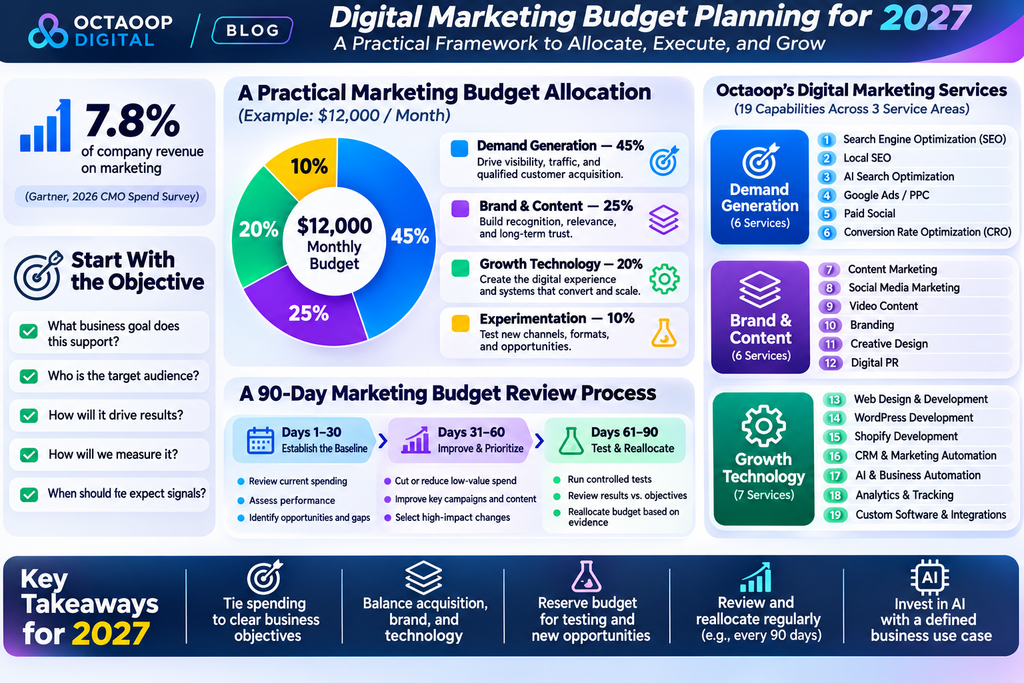
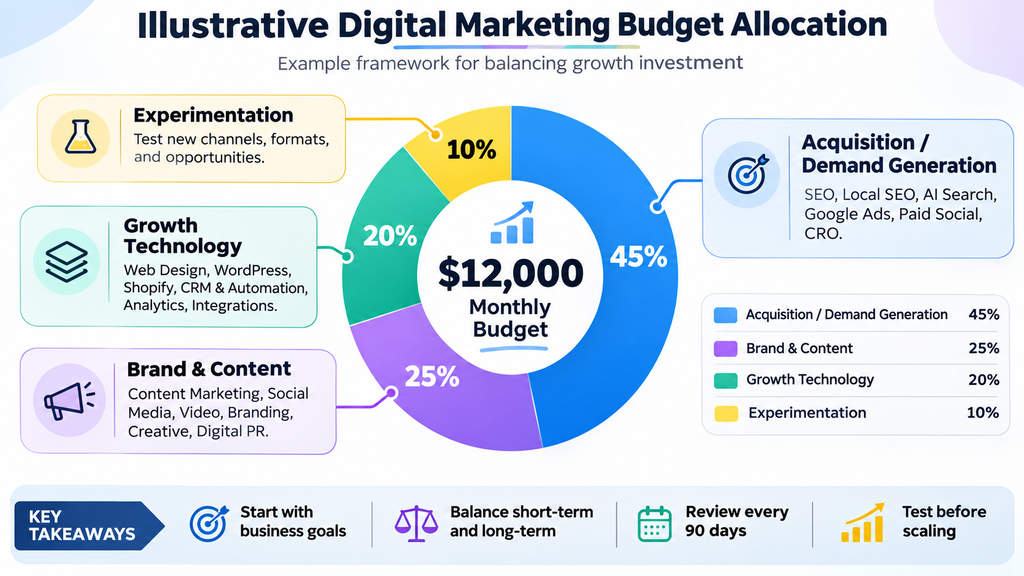
Imagine a growing business with a $12,000 monthly marketing budget, including media, management, production, and technology costs.
Its objective is to increase qualified customer acquisition while developing stronger long-term visibility.
One illustrative allocation might be:
| Investment area | Allocation | Monthly amount |
|---|---|---|
| Demand Generation | 45% | $5,400 |
| Brand & Content | 25% | $3,000 |
| Growth Technology | 20% | $2,400 |
| Experimentation and contingency | 10% | $1,200 |
| Total | 100% | $12,000 |
These figures are hypothetical planning assumptions, not industry benchmarks or recommended fixed percentages.
How might this work?
The demand generation budget could support a combination of paid search, organic visibility, and acquisition optimization.
The brand and content budget could fund expert articles, video production, or other formats relevant to the audience.
The growth technology budget could support website improvements, CRM integration, and necessary measurement infrastructure.
The experimentation allocation could fund a controlled new channel pilot, creative test, or emerging discovery opportunity.
A different business might allocate considerably more to technology while developing a new ecommerce platform.
Another company with strong infrastructure and established brand awareness may prioritize acquisition.
The best allocation is the one supported by the company’s commercial requirements.
8. Choose Your Budget Based on Business Maturity
Budgeting should account for what is already in place.
Early-Stage Businesses
A newly established business may have limited brand recognition, traffic, and customer information.
Its immediate priorities could include:
- A credible website.
- Clear service or product positioning.
- Basic analytics.
- Appropriate acquisition channels.
- Essential content.
- A reliable enquiry or checkout process.
Spending heavily on sophisticated automation before establishing these foundations may create unnecessary cost.
Growing Businesses
A growing company often has established products or services and some evidence about customer acquisition.
The challenge becomes deciding which activities to expand.
Relevant investments may include:
- Improving successful paid campaigns.
- Expanding organic search coverage.
- Developing stronger content.
- Testing new audiences.
- Improving conversion rates.
- Integrating acquisition and customer data.
At this stage, measurement and repeatable processes become increasingly valuable.
Established and Enterprise Businesses
Larger organizations may operate across markets, brands, business units, or customer segments.
Their budgeting decisions can involve:
- Multi-market acquisition.
- Brand and creative production.
- Advanced analytics.
- Customer data infrastructure.
- Enterprise software integrations.
- Governance and compliance.
- Experimentation across channels.
Scale makes budgeting more complicated, but it does not eliminate the need to prioritize.
Even a large marketing team should be able to explain why each major investment exists.
9. How Much Should You Invest in AI Marketing?
AI deserves consideration in a 2027 marketing budget, but it should not automatically receive a fixed share.
The correct question is not:
“How much should we spend on AI?”
It is:
“Which business or marketing process becomes more useful, reliable, or efficient with AI assistance?”
Potential applications include:
- Research and analysis support.
- Content production assistance.
- Creative experimentation.
- Customer service workflows.
- Internal knowledge management.
- Marketing data analysis.
- Workflow automation.
- Product information management.
However, every proposed implementation should address several issues.
Accuracy: Can the system produce dependable information?
Human oversight: Who reviews consequential outputs?
Data protection: What information enters the system, and how is it handled?
Integration: Does the tool work with existing processes?
Cost: What are the software, implementation, and maintenance expenses?
Business value: What measurable improvement justifies those costs?
A business using one well-integrated automation system effectively may achieve more value than another organization maintaining numerous disconnected subscriptions.
The lesson from Gartner’s 2026 AI marketing research is not that every business should copy the surveyed AI spending percentage.
It is that investment and organizational readiness need to develop together.
10. Decide What to Keep, Test, Improve, or Stop
A marketing budget should not remain unchanged simply because particular activities were approved last year.
Regular evaluation helps distinguish useful investment from historical habit.
A practical review can divide activities into four categories.
| Decision | When it makes sense |
|---|---|
| Keep | The activity supports a clear objective and evidence justifies continued investment |
| Improve | The channel has potential but requires better execution, creative, targeting, or measurement |
| Test | There is a credible opportunity, but insufficient evidence to justify large spending |
| Stop | The activity has no clear purpose, consistently weak economics, or little defensible value |
Consider a company running three advertising campaigns.
One is acquiring profitable customers.
Another has reasonable engagement but weak conversion performance.
The third has continued spending for months without a meaningful objective.
Treating all three campaigns as equally valuable because they are active is not a sensible budgeting decision.
The first may justify increased investment.
The second may require a controlled improvement plan.
The third deserves a serious review of whether it should continue.
This process should also apply to content programs, software subscriptions, agency services, and development projects.
Avoid judging every activity on the same timeline
A paid search campaign and a technical SEO improvement may produce useful signals at different speeds.
Brand activity can be harder to attribute to immediate revenue than direct-response advertising.
A software integration may create operational savings rather than new website traffic.
Measure each investment against the outcome it was intended to produce.
11. Build a 90-Day Marketing Budget Review
If the annual budget feels complicated, begin with a 90-day review cycle.
Days 1–30: Establish the Baseline
Review current spending across advertising, content, websites, software, and management.
Identify:
- Existing commercial objectives.
- Major budget commitments.
- Current performance information.
- Known measurement limitations.
- Customer acquisition economics.
- Operational dependencies.
The first month is about understanding what the company is already funding.
Days 31–60: Improve and Prioritize
Identify unnecessary expenditure and opportunities for improvement.
Review campaign performance, customer experience, content usefulness, and technology requirements.
Select a manageable number of high-impact changes.
For example, a company may decide to improve key product pages and conversion measurement before expanding paid acquisition.
Days 61–90: Test and Reallocate
Implement selected improvements and controlled experiments.
Review early evidence against the objectives established at the beginning.
Reallocate spending where the evidence supports it.
Keep a record of decisions so the team can distinguish genuine improvement from assumptions.
The objective is not to change the marketing plan every week.
It is to create regular opportunities to make informed decisions.
12. What Should a Marketing Budget Dashboard Actually Show?
A dashboard should help decision-makers understand progress and identify actions.
It does not need to display every available metric.
A practical marketing budget dashboard might include:
| Area | Useful measures |
|---|---|
| Acquisition | Spend, qualified opportunities, customer acquisition cost |
| Organic visibility | Relevant search demand, qualified visits, enquiries |
| Content | Relevant engagement, assisted journeys, useful conversions |
| Ecommerce | Revenue, contribution margin, conversion rate, repeat purchase |
| Brand | Awareness research, branded demand, relevant reach |
| Website | Conversion rate, usability, performance, task completion |
| Sales integration | Lead qualification, pipeline progression, sales outcomes |
| Operations | Time saved, error reduction, system reliability |
| Experiments | Cost, hypothesis, observed outcome, decision |
Not all metrics will be available or meaningful for every company.
Attribution also has limitations.
A customer might see a social advertisement, read an article, visit a marketplace, and later make a purchase through a branded search.
A reporting system that assigns the entire conversion to one interaction may not represent the complete journey.
For this reason, digital marketing budgeting should consider multiple forms of evidence rather than relying on one attribution figure.
13. Five Budgeting Mistakes to Avoid in 2027
Mistake 1: Copying Another Company’s Budget Percentages
Two businesses with similar revenues may have very different margins, markets, customer acquisition models, and growth objectives.
Benchmarks can provide context, but they cannot replace company-specific planning.
Mistake 2: Funding Every New Trend
AI shopping, agentic commerce, new advertising placements, and emerging content formats may create opportunities.
They do not all deserve immediate funding.
Research eligibility, audience relevance, operational requirements, and potential business value before investing.
Mistake 3: Ignoring Maintenance Costs
Websites, software, integrations, and analytics systems require ongoing attention.
A project budget that covers only the initial build may underestimate the actual long-term investment.
Mistake 4: Treating All Conversions as Equally Valuable
A newsletter registration, qualified enquiry, completed purchase, and repeat customer purchase are different outcomes.
Marketing reporting should distinguish between them where possible.
Mistake 5: Spending Without a Review Process
An annual budget should establish direction, not prevent learning.
Businesses need a way to examine results, respond to changes, and reallocate funds when appropriate.
14. How to Choose Which Marketing Services You Actually Need
A useful budgeting decision begins with the business situation.
| Business priority | Capabilities worth evaluating |
|---|---|
| Increase visibility in search | SEO, Local SEO, AI Search Optimization |
| Reach potential customers through advertising | Google Ads / PPC, Paid Social |
| Improve website enquiries or sales | CRO, Web Design & Development |
| Strengthen recognition and credibility | Branding, Content Marketing, Digital PR |
| Improve visual communication | Creative Design, Video Content |
| Build audience relationships | Social Media Marketing, Content Marketing |
| Develop an ecommerce storefront | Shopify Development, WordPress Development |
| Organize customer information and follow-up | CRM & Marketing Automation |
| Reduce repetitive operational work | AI & Business Automation |
| Understand marketing outcomes | Analytics & Tracking |
| Connect complex business systems | Custom Software & Integrations |
This is a decision guide, not a recommendation to purchase every service.
A company should start with the capabilities that address its actual requirements.
Sometimes one improvement is sufficient.
Sometimes the business needs several disciplines working together.
The important thing is to define the objective before deciding on the deliverables.
Frequently Asked Questions
How much should a business spend on digital marketing in 2027?
There is no universal amount. A suitable budget depends on company revenue, margins, growth objectives, competition, market conditions, and available resources. Published spending benchmarks provide context but should not replace business-specific planning.
What percentage of a marketing budget should go to SEO?
There is no fixed percentage that works for every company. SEO investment depends on organic search opportunities, competition, website condition, and the role search plays in customer acquisition.
Should businesses spend more on SEO or paid advertising?
The decision depends on the timeline, search demand, competition, and commercial objectives. Paid campaigns may provide faster access to audiences, while SEO can support ongoing discoverability. Some companies benefit from using both.
How much should businesses spend on content marketing?
Start with the content required to support customer research, product evaluation, brand communication, and distribution. Production frequency should follow audience needs and available expertise rather than arbitrary publishing quotas.
Is AI marketing software worth the investment?
It can be when it improves a defined process and produces measurable value. Businesses should review accuracy, privacy, integration requirements, oversight, and ongoing costs before adopting a tool.
What is the difference between marketing spend and advertising spend?
Advertising spend generally refers to money paid for media placements. Marketing spend is broader and may include strategy, staff, agencies, content, websites, software, research, and measurement.
How often should marketing budgets be reviewed?
Many businesses benefit from monthly operational reviews and quarterly strategic reviews. The appropriate frequency depends on campaign volume, sales cycles, business maturity, and market conditions.
Should a small business use multiple marketing agencies?
It depends on the required expertise and internal coordination capacity. A business can use specialists for individual needs, but responsibilities, reporting, and handoffs should be clear.
Your 2027 Marketing Budget Should Be a Decision System
The purpose of a marketing budget is not simply to determine how much money each department can spend.
It should help the business make better decisions.
Which audiences matter most?
Where can customers discover the business?
What information do they need before choosing?
Which experiences help them become customers?
What technology makes those interactions easier?
And which investments are producing enough value to justify continued spending?
A useful budget connects those questions to action.
It balances near-term acquisition with longer-term visibility and brand development. It supports the customer experience rather than concentrating exclusively on traffic. It gives new opportunities room to prove themselves without letting experimentation consume the entire budget.
Most importantly, it remains adaptable.
The strongest marketing budgets in 2027 will not necessarily be the largest. They will be the ones that make the clearest connection between investment, customer needs, and measurable business value.
Need Help Building a More Focused Digital Growth Plan?
Octaoop Digital Agency helps businesses evaluate and execute digital marketing and technology initiatives across acquisition, content, websites, analytics, and automation.
Whether your immediate priority is one specialist service or a broader digital strategy, the starting point should be a clear understanding of the business objective and the work required to achieve it.
Explore All Octaoop Digital Services
You can also explore the three main service areas:
Official Sources and Further Reading
- Gartner — CMO Spend in 2026
- Gartner — 2026 CMO Spend Survey Press Release
- Google Search Central — AI Features and Your Website
- Google Search Central — Optimizing for Generative AI Features
- Google Ads — Enhanced Conversions for Leads
Editorial note: This article was prepared by the Octaoop Digital team, with AI-assisted support for research, structuring and editorial refinement. Technical explanations and final recommendations should be reviewed against the specific implementation and business requirements before deployment.