
AI Shopping Is Changing Product Discovery
For years, online shopping followed a familiar pattern.
A customer searched for a product, opened several websites, compared prices, read reviews, and eventually decided where to buy.
That process is changing.
Instead of searching for “best running shoes,” a shopper might ask an AI assistant:
“I’m looking for comfortable running shoes under $120. I have wide feet, mostly run on pavement, and want something that will last. What should I consider?”
That is a very different shopping query.
The customer is no longer asking for a page containing matching keywords. They are describing a need, providing constraints, and expecting help with a buying decision.
AI-powered shopping experiences can interpret those requirements, compare available products, and present options that appear relevant.
For online retailers, this creates an important challenge.
How does your product become discoverable when a customer describes what they need instead of searching for its name?
The answer involves more than adding AI-generated descriptions to a store.
It requires accurate product information, clear differentiation, technically accessible websites, reliable availability data, and an understanding of how product discovery is evolving across search engines and AI assistants.
As retailers prepare for 2027, these fundamentals deserve closer attention.
1. Product Discovery Is Moving From Keywords to Conversations
Traditional ecommerce search is largely built around queries, categories, filters, and product listings.
A customer might search for:
- Lightweight laptop for students
- Waterproof hiking jacket
- Ergonomic office chair
- Best coffee machine under $200
These searches are useful, but often leave the customer to do much of the comparison independently.
Conversational shopping introduces another layer.
A shopper can explain their situation, receive suggestions, ask follow-up questions, and narrow down options without starting a completely new search.
For example:
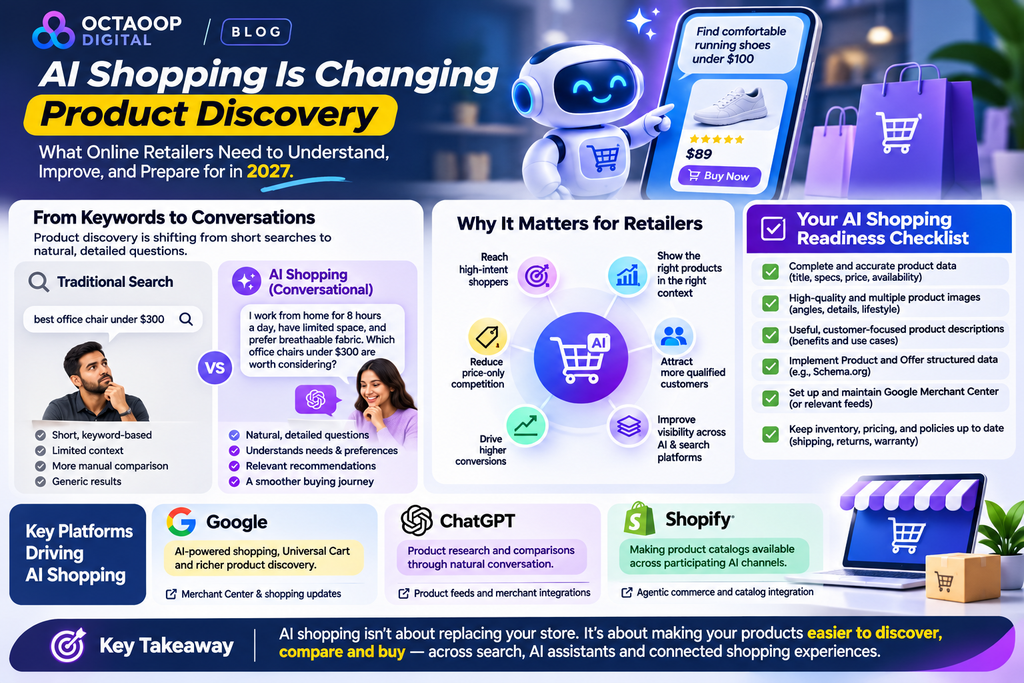
Traditional search: “Best office chair under $300”
Conversational shopping: “I work from home for eight hours a day, have limited desk space, and prefer breathable fabric. Which chairs under $300 are worth comparing?”
The second question reveals information that a simple keyword may not capture.
It identifies the customer’s budget, usage, space limitations, material preferences, and underlying problem.
This is where AI-assisted product discovery becomes commercially interesting.
Retailers are no longer competing only to match a product keyword. They also need to communicate why a particular product suits a particular use case.
A chair described only as “Premium Ergonomic Office Chair” provides limited information.
A product listing that accurately explains adjustable lumbar support, seat dimensions, breathable mesh construction, weight capacity, and suitability for extended desk work gives a discovery system much more useful information to work with.
The lesson: Product descriptions should help customers evaluate suitability, not simply repeat commercial keywords.
2. This Change Is Already Happening Across Major Platforms
AI shopping is not a single product or a future concept waiting for one company to launch it.
Several major platforms are already developing different approaches to discovery, comparison, and transactions.
Google: AI-Powered Discovery and Shopping Infrastructure
Google has expanded shopping experiences that combine product information with AI-assisted discovery.
Its Shopping Graph provides a large source of product listings, while AI shopping features increasingly help customers research and compare items.
In October 2026, Google announced the US launch of its Universal Cart, designed to help shoppers organize products from multiple retailers and manage purchasing decisions.
Google has also been developing its Universal Commerce Protocol, an open approach intended to support interactions between AI agents and commerce systems.
For retailers, these developments make product information accuracy especially important.
If a shopping experience needs to identify a suitable item, it must be able to work with information such as:
- Product identity
- Price
- Availability
- Variations
- Seller information
- Shipping conditions
Google has also introduced AI performance insights in Merchant Center for businesses in selected markets, providing additional visibility into product and brand discovery across AI-assisted search experiences.
These features have market-specific availability and should not be assumed to be accessible to every retailer worldwide.
Official sources:
Google — Universal Cart Launch
Google — AI Shopping Updates for Retailers
ChatGPT: Product Research Through Natural Conversation
OpenAI has introduced richer shopping experiences within ChatGPT, allowing users to explore products, compare options, and review product details during a conversation.
This matters because shopping decisions often involve uncertainty.
Someone might know they need a new laptop but not understand which processor, memory configuration, screen size, or battery performance best suits their requirements.
A conversational assistant can help narrow the decision.
OpenAI also supports structured product feeds that allow merchants to provide product catalog information for discovery.
According to OpenAI’s shopping documentation, product and merchant information may come from direct feeds, third-party providers, and other available sources.
However, submitting a product feed does not guarantee that a product will be recommended.
Relevance, available information, pricing, availability, and other factors can affect what appears.
Retailers should therefore focus on making their products accurately represented rather than attempting to manipulate AI recommendations.
Official sources:
OpenAI — Powering Product Discovery in ChatGPT
OpenAI — Product Feed Documentation
Shopify: Making Product Catalogs Available to AI Shopping Channels
Shopify is also developing infrastructure for what the industry calls agentic commerce.
Its catalog and commerce integrations are designed to help eligible merchants make products available through participating AI channels.
Shopify has documented integrations involving ChatGPT, Microsoft Copilot, and Google shopping experiences, with different eligibility requirements and rollout conditions.
The important distinction is between making product data available and receiving product recommendations.
A merchant may have technically accessible product information without appearing in a particular AI-generated response.
That distinction should shape how businesses measure success.
Official source:
Shopify — How Agentic Commerce Works
3. What Is Agentic Commerce, and Why Does It Matter?
AI product discovery and agentic commerce are closely connected, but they are not identical.
AI product discovery helps customers find and compare items.
Agentic commerce goes further by enabling AI-assisted systems to support parts of the shopping process, potentially including selecting options, preparing a cart, and facilitating checkout through supported integrations.
Consider a customer purchasing equipment for a small home office.
They need a desk, monitor, keyboard, and chair within a fixed budget.
An AI assistant might help compare suitable products, identify compatible options, and organize a shortlist.
In supported environments, an agent may also help the customer move toward purchasing.
But that does not mean every AI assistant can independently complete every transaction.
Checkout support depends on the platform, participating merchants, payment infrastructure, geographic availability, and customer authorization.
The transaction still needs accurate inventory, final pricing, shipping calculations, payment processing, and fraud controls.
The opportunity for retailers is not simply to appear inside a chatbot. It is to make the buying journey more connected, informative, and reliable.
4. Product Data Is Becoming a Competitive Asset
Many ecommerce businesses invest heavily in paid advertising, website design, and promotional campaigns while treating product information as routine administrative work.
That approach deserves reconsideration.
Product data influences how products are understood across shopping platforms.
Google Merchant Center, for example, uses structured product information to help match listings with relevant searches and determine eligibility for different shopping experiences.
Incomplete or inaccurate attributes can limit how effectively products are represented.
What high-quality product data should include
| Product attribute | Why it matters |
|---|---|
| Clear product title | Identifies exactly what the item is |
| Brand and model | Helps distinguish similar products |
| Accurate description | Explains features, uses, and limitations |
| Price and currency | Supports accurate comparisons |
| Availability | Reduces disappointment from out-of-stock recommendations |
| Size, color, and material | Helps match specific customer preferences |
| GTIN or other valid identifiers | Supports accurate product identification |
| Product images | Helps customers evaluate the product visually |
| Shipping and returns | Clarifies practical purchasing conditions |
Not every field applies to every product. Businesses should follow the relevant platform specifications and use genuine identifiers rather than inventing missing data.
A simple product-description example
Weak product listing
“Premium backpack. Stylish, high quality, perfect for everyone. Buy now.”
This tells the customer very little.
More useful product listing
“25-liter commuter backpack with a padded compartment designed for laptops up to 15.6 inches, water-resistant polyester exterior, two side bottle pockets, and an adjustable chest strap. Suitable for daily commuting and short trips.”
The second description gives both customers and discovery systems more concrete information.
It explains capacity, compatible device size, materials, features, and potential use cases.
Of course, every detail must accurately describe the actual product.
The objective is not to make descriptions longer.
It is to make them more informative.
5. Product Pages Need to Answer Buying Questions
An ecommerce product page should do more than display an image, price, and Add to Cart button.
Customers often need answers before purchasing.
Consider a retailer selling home appliances.
Potential buyers might want to know:
- Will this fit in my kitchen?
- How much electricity does it consume?
- Is it suitable for a small household?
- What accessories are included?
- Is installation required?
- How does it compare with the previous model?
- What is covered by the warranty?
If that information is missing, the customer has to search elsewhere.
AI-assisted shopping systems also depend on available product information when helping people compare options.
A useful product page should therefore include accurate specifications, clear descriptions, relevant images, variant information, FAQs when appropriate, and transparent purchasing policies.
Explain suitability, not just features
Specifications are essential, but context makes them useful.
For example:
“Battery capacity: 5,000 mAh” provides a technical detail.
“Designed for users who need a portable charger during commuting or travel” explains the intended use.
Both can be valuable.
A retailer that communicates technical facts alongside realistic usage information makes products easier to evaluate.
This does not require writing an essay on every product page.
It requires understanding the questions customers actually ask before buying.
6. Structured Data Still Matters
With all the discussion around AI shopping, some retailers may assume that conventional technical SEO is becoming irrelevant.
That would be a mistake.
Product pages still need to be accessible, understandable, and technically correct.
Google supports Product and Offer structured data to help describe products and merchant listings.
Depending on eligibility and implementation, structured data can help Google understand information such as:
- Product name and identity
- Price and currency
- Availability
- Merchant offers
- Shipping details
- Return policies
- Product variants
For products sold in different sizes, colors, or configurations, Google also supports ProductGroup structured data with properties such as hasVariant and variesBy.
This helps establish relationships between different versions of the same product.
What retailers should check
First, confirm that their ecommerce platform generates valid structured data for product pages.
Next, verify that the information matches what customers actually see.
If a page displays a different price from its structured data or shopping feed, that inconsistency needs to be corrected.
Product variants must also be represented properly.
For example, a clothing retailer should not make it difficult to distinguish between a medium blue shirt and a large black shirt if their prices, stock levels, or URLs differ.
Use Google’s Rich Results Test and Merchant Center diagnostics to identify technical problems.
Importantly, valid structured data makes a page eligible for supported experiences; it does not guarantee rich results or AI recommendations.
Official technical guidance:
Google Search Central — Merchant Listing Structured Data
Google Search Central — Product Variant Structured Data
7. Product Images Are Part of the Discovery Experience
Online shoppers do not evaluate products through text alone.
Images help customers understand design, size, appearance, and practical details.
For many categories, visual information can be decisive.
A furniture customer wants to see proportions and materials.
A clothing shopper wants to understand fit, texture, and styling.
An electronics buyer wants to see ports, accessories, and physical dimensions.
Retailers should provide images that genuinely support these decisions.
That can include:
- A clear primary product image.
- Additional views from different angles.
- Detail photographs of important features.
- Accurate lifestyle images.
- Variant-specific images.
- Size or dimension references where relevant.
Images should reflect the real product.
AI-generated lifestyle imagery may be useful in some contexts, but businesses should not present invented product features or misleading visual representations.
The goal is to reduce uncertainty for the customer.
That remains valuable regardless of whether the purchase begins in Google Search, ChatGPT, a marketplace, or the retailer’s own website.
8. Product Reviews and Trust Cannot Be Replaced by Better Metadata
Product information helps systems understand what a retailer sells.
Trust influences whether customers want to buy it.
An accurate product listing still needs to be supported by a credible shopping experience.
Customers may evaluate:
- Product reviews.
- Brand reputation.
- Return policies.
- Warranty coverage.
- Delivery reliability.
- Customer support.
- Payment security.
- Product authenticity.
AI shopping experiences may incorporate available third-party information and merchant metadata when helping customers compare products.
That makes consistency and credibility important.
However, businesses should avoid treating reviews as another field to manufacture for search visibility.
Fake testimonials, misleading ratings, or unsupported claims can harm customer trust and violate platform policies.
A better approach is to collect genuine feedback, respond to recurring complaints, and improve the underlying customer experience.
Retailers that describe products accurately and deliver what they promise create a stronger foundation for long-term discovery.
9. What Should WooCommerce and Shopify Store Owners Do Differently?
The broad principles of AI shopping readiness apply across ecommerce platforms.
The implementation details differ.
For WooCommerce Stores
WooCommerce retailers should review whether their current configuration supports reliable product feeds and structured data.
Important checks include:
- Product catalog completeness.
- Google Merchant Center integration.
- Schema output and plugin compatibility.
- Variant handling.
- Accurate stock synchronization.
- Product image quality.
- Website performance.
- Crawlable product URLs.
Store owners should also confirm that multiple SEO, schema, and ecommerce plugins are not producing conflicting product information.
For additional AI shopping channels, evaluate official merchant onboarding requirements and available feed integrations rather than assuming that a particular plugin guarantees visibility.
For Shopify Stores
Shopify merchants should review their Shopify Catalog eligibility and participating sales-channel configurations.
Relevant actions include:
- Completing important product attributes.
- Maintaining accurate availability and prices.
- Reviewing Google & YouTube channel settings.
- Checking product eligibility and publishing status.
- Understanding how eligible products are shared with AI shopping channels.
- Reviewing channel-specific controls.
Shopify’s AI commerce integrations can reduce some of the technical work involved in distributing structured product information.
However, eligibility, geography, product restrictions, and platform rollout status still matter.
The larger point: The choice between Shopify and WooCommerce does not determine whether a retailer will succeed in AI shopping. Product quality, accurate data, customer experience, and suitable integrations remain essential.
10. How Will Retailers Measure AI Shopping Performance?
This is one of the more difficult questions.
Traditional ecommerce reporting often focuses on familiar acquisition channels such as organic search, paid search, email, social media, and direct traffic.
AI-assisted shopping creates additional interactions that may not fit neatly into those categories.
A shopper might discover a product inside an AI assistant, research it further on Google, and later purchase directly through the retailer’s website.
Another customer might receive an AI-generated comparison but never click through to the retailer until much later.
That makes attribution challenging.
Begin with the data you can actually observe
Retailers should establish a reliable baseline for:
- Organic product-page traffic.
- Product impressions and clicks in available Google reporting.
- Merchant Center diagnostics.
- Ecommerce conversion rates.
- Referral traffic from identifiable AI platforms.
- Product revenue and average order value.
- Feed errors and product disapprovals.
- Product availability and pricing accuracy.
Where available, newer AI-specific platform reporting can provide additional insights.
For example, Google’s Merchant Center AI performance insights have been introduced in selected markets.
Businesses should check whether those reports are available in their own accounts rather than assuming universal access.
Avoid overstating attribution
A referral from an AI assistant may indicate that a customer clicked through from that platform.
It does not automatically prove that AI generated the original demand or that the sale would not otherwise have happened.
Likewise, AI-driven exposure may not always produce an identifiable website session.
The practical goal is to build a better understanding of discovery and purchasing behaviour while acknowledging measurement limitations.
11. A Practical 2027 AI Shopping Readiness Plan
Retailers do not need to rebuild their entire ecommerce operation to begin preparing.
Start with the highest-impact fundamentals.
Phase 1: Audit the Catalog
Review your most important products first.
Check whether titles, descriptions, specifications, images, identifiers, prices, and availability are complete and accurate.
Prioritize products that generate meaningful revenue or have strong commercial potential.
Phase 2: Review Technical Visibility
Check product structured data, canonical URLs, indexing, mobile usability, and feed configuration.
Identify discrepancies between website content and the information provided to external platforms.
Phase 3: Improve Buying Information
Look at the questions customers ask before purchasing.
Add useful answers to product pages.
Clarify compatibility, fit, specifications, shipping, warranty conditions, and product limitations where relevant.
Phase 4: Review Shopping Channels
Evaluate the platforms that matter for your market.
These may include Google Merchant Center, Shopify’s supported sales channels, or available merchant feed integrations for conversational shopping products.
Confirm eligibility before investing in channel-specific development.
Phase 5: Establish Measurement
Record current product visibility, traffic, conversion rates, and feed health.
Monitor identifiable AI referrals and available platform-level AI shopping reporting.
Avoid creating unsupported performance claims from incomplete attribution data.
Phase 6: Improve Continuously
Treat catalog management as an ongoing business process.
When pricing, inventory, product specifications, or policies change, update the systems that distribute that information.
A product page that was accurate three months ago may no longer be reliable today.
AI shopping readiness is not a one-time plugin installation.
It is a commitment to better product information and commerce operations.
12. Mistakes Retailers Should Avoid
As interest in AI shopping grows, businesses will encounter tools promising instant visibility in AI recommendations.
Some may be useful. Others may offer little more than familiar SEO features under a new label.
Before investing, watch for these mistakes.
Believing AI shopping will replace every existing channel. Traditional search, marketplaces, paid advertising, social commerce, and direct brand traffic will continue to matter.
Publishing more AI-generated product descriptions without checking them. A longer description is not necessarily more informative. Inaccurate information is especially damaging.
Assuming schema markup guarantees recommendations. Structured data helps systems interpret information but cannot force a platform to recommend a product.
Ignoring inventory and pricing synchronization. An appealing recommendation quickly becomes frustrating if the product is unavailable or the final price is different.
Purchasing expensive integrations before establishing a business case. Start by identifying relevant channels, eligibility, likely customer use cases, and operational requirements.
Treating product discovery as separate from customer experience. Visibility is only one part of selling. Retailers still need clear policies, reliable fulfillment, usable websites, and responsive customer support.
The strongest ecommerce strategy does not chase every emerging platform feature.
It evaluates which changes actually make the business easier to discover and easier to buy from.
Frequently Asked Questions
What is AI shopping?
AI shopping refers to shopping experiences that use artificial intelligence to help customers discover, compare, evaluate, or purchase products. It can include conversational product recommendations, AI-powered search experiences, and supported agent-assisted commerce workflows.
How is AI shopping different from traditional ecommerce search?
Traditional ecommerce search commonly starts with keywords and filters. Conversational AI shopping can use detailed natural-language requests, consider multiple preferences, and help customers compare products through follow-up questions.
Can small ecommerce businesses benefit from AI shopping?
Potentially, yes. Small retailers can improve product information, structured data, merchant feeds, and shopping experiences without developing their own AI systems. Access to particular AI shopping channels depends on platform and market eligibility.
How can I get my products discovered in ChatGPT?
Retailers should maintain accurate, accessible product information and review supported merchant feed options. Shopify merchants may also have product discovery integrations through Shopify Catalog, subject to eligibility. Providing product data does not guarantee recommendations.
Does Google Merchant Center help with AI shopping?
Google Merchant Center provides structured product information used across Google’s shopping ecosystem. Google has also introduced AI-related reporting and shopping capabilities, although some features have regional or account-specific availability.
Do I need special AI SEO software?
Not necessarily. Start with accurate product data, suitable feeds, valid structured data, accessible product pages, and a strong customer experience. Specialized software should address a specific problem rather than simply promise AI visibility.
Will AI shopping replace ecommerce websites?
There is no basis for assuming that ecommerce websites will disappear. Even when discovery and parts of checkout happen through AI interfaces, merchants still need reliable product data, inventory systems, payment handling, customer service, and fulfillment operations.
The Future of Product Discovery Is About Better Information
AI shopping is changing the way customers move from discovering a need to evaluating a product.
That does not mean every shopping decision will happen inside a chatbot.
It means retailers should prepare for a wider range of discovery experiences, including those where a customer explains what they need rather than searching for an exact product name.
The businesses best positioned for that environment will be those that make their products easier to understand.
Clear specifications. Accurate prices. Reliable inventory. Useful descriptions. Good images. Transparent policies. Technically sound storefronts.
None of these principles is new.
What is changing is how widely and quickly that information may be used across the shopping journey.
For retailers preparing for 2027, the priority is not to make every product page sound as though it was written for an AI assistant. It is to make product information genuinely useful wherever customers encounter it.
Preparing Your Ecommerce Store for What Comes Next?
Octaoop Digital Agency helps ecommerce businesses strengthen the foundations behind product discovery, search visibility, content, website performance, and digital customer journeys.
Whether your store runs on Shopify, WooCommerce, or a custom platform, preparing for AI-assisted shopping starts with understanding how your products are represented and how effectively your storefront supports customers.
Explore Octaoop Digital Agency
Official References and Further Reading
- Google — Boost Your Holiday Sales With Agentic Commerce Updates
- Google — Universal Cart Launch
- Google Merchant Center — Product Data Specification
- Google Search Central — Merchant Listing Structured Data
- OpenAI — Powering Product Discovery in ChatGPT
- OpenAI Developers — Submit Product Feeds
- Shopify — Agentic Commerce on Shopify