
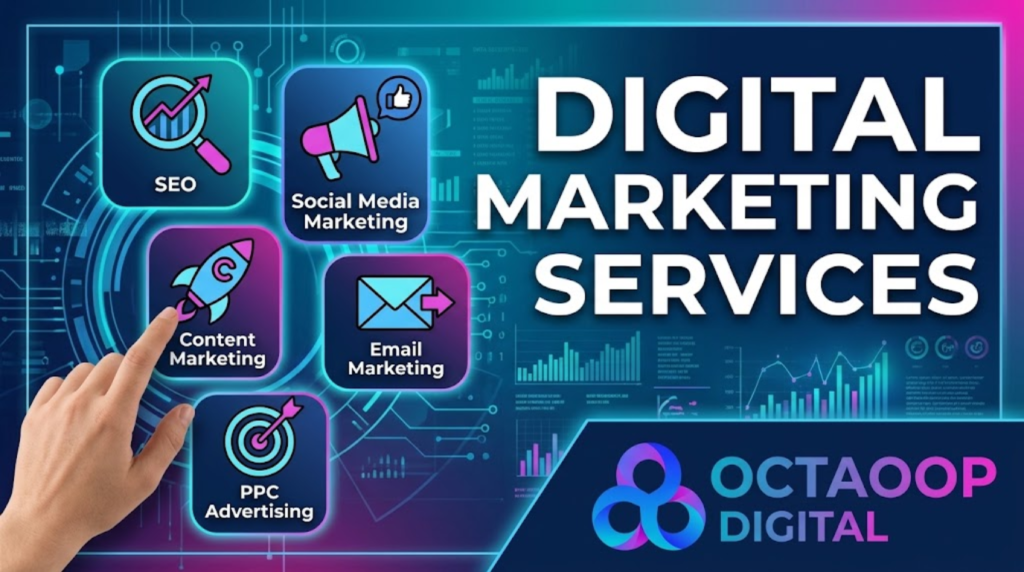
Digital marketing works best when the individual activities support one another.
Search visibility can bring qualified visitors to your website. Paid media can help you test demand and reach defined audiences. Content can answer questions and clarify your offer. Social media can build familiarity and engagement. A well-designed website can turn attention into action. Analytics can show which parts of the journey are producing useful outcomes.
Octaoop Digital brings these capabilities together into practical digital marketing systems built around your business objectives. We help ambitious brands identify the most important growth opportunities, choose the right mix of services, execute the work, and improve performance using evidence rather than guesswork.
Discuss your marketing priorities with Octaoop Digital
Digital marketing services should solve a business problem
A service list is easy to produce. A useful strategy requires more thought.
You may be looking for more qualified enquiries, stronger visibility in search, a website that converts, more efficient advertising, clearer reporting, or a consistent brand presence. Those objectives can involve several marketing disciplines, but that does not mean every business needs every service at once.
The right starting point is the constraint holding back the customer journey.
If relevant prospects cannot find you, search engine optimisation or paid acquisition may deserve attention. If people arrive but do not understand the offer, positioning, content, user experience, or conversion-rate optimisation may come first. If marketing activity is generating data but not decisions, analytics and reporting may be the priority. If the business is growing into a new stage, a more connected demand-generation system may be needed.
Octaoop’s role is to help identify that priority, build the right foundation, and connect the work to measurable outcomes.
Our digital marketing services
Search engine optimisation
SEO helps your business become visible when potential customers search for the problems, products, services, and solutions you provide.
A serious SEO programme can include technical SEO, information architecture, keyword and search-intent research, on-page optimisation, content planning, internal linking, digital PR, authority development, and performance reporting. The work should be adapted to your market, business model, competition, and sales process.
The objective is not to attract irrelevant traffic. It is to make the right pages easier to discover, easier to understand, and more useful to people who may become customers.
SEO may be a good starting point when:
•your target customers are already searching for your services;
•important pages are not appearing for relevant queries;
•your website has technical or structural issues limiting discovery;
•your content attracts attention but does not support commercial intent; or
•you want to build a longer-term source of qualified organic demand.
Recommended next step: Build a dedicated SEO service page at /seo-services/ after this hub is updated, then link supporting SEO guides to it. The current site’s public service inventory confirms SEO as a core offer.[2]
Paid media and PPC
Paid media can help you reach a defined audience, test an offer, support a launch, or create demand while organic visibility develops.
Octaoop’s public service inventory includes paid advertising across Google Ads, Meta Ads, LinkedIn, and YouTube.[2] Effective campaign management involves more than placing ads. It can include account structure, audience and keyword selection, ad creative, landing-page alignment, budget control, conversion tracking, lead-quality review, and ongoing optimisation.
The key question is not simply whether an ad received clicks. It is whether the campaign attracted the right people, generated useful actions, and gave the business enough information to make the next budget decision.
Paid media may be a good starting point when:
•you need to test demand or offers quickly;
•your business has a clear conversion action and a realistic follow-up process;
•you are launching in a new market or promoting a time-sensitive offer;
•existing campaigns generate clicks but poor-quality leads; or
•you cannot yet rely on organic visibility for an important commercial term.
Recommended next step: Build a dedicated Google Ads/PPC service page at /google-ads-management/ and route paid-media articles to it rather than to the homepage.
Social media marketing and management
Social media can support brand awareness, community, creative testing, engagement, lead generation, and customer relationships. Its role should be defined by the audience and the buying journey rather than by a fixed posting schedule.
Octaoop’s public service page describes social media strategy, content creation, community management, and paid social advertising across platforms including Facebook, Instagram, LinkedIn, TikTok, and X.[2]
A useful social-media programme may involve content planning, platform selection, creative direction, publishing, community response, paid promotion, reporting, and conversion-path improvement. The mix should reflect where the intended audience pays attention and what action the business wants them to take.
Social media services may be a good starting point when:
•your brand needs a clearer and more consistent voice;
•your team lacks the capacity to plan, create, publish, and respond reliably;
•social content receives attention but does not support a defined business objective;
•you need creative assets for both organic and paid campaigns; or
•your audience expects ongoing education, proof, or community interaction before buying.
Recommended next step: Build a dedicated social-media service page at /social-media-marketing/ with a clear distinction between strategy, content production, management, and paid social.
Content marketing and creative content
Content should help a real audience understand a problem, evaluate an option, make a decision, or take the next step.
Octaoop lists blog and article writing, landing-page copy, social posts, and visual assets within its content and creative-content offer.[2] Those outputs become more valuable when they are connected to a defined audience, search intent, brand position, and conversion path.
A content programme may include editorial strategy, topic and keyword mapping, service-page copy, landing-page messaging, articles, case studies, social content, email assets, and visual communication. The correct mix depends on what your audience needs to know before contacting or buying from you.
Content marketing may be a good starting point when:
•prospects need education before they are ready to speak with sales;
•your service pages are too generic to answer commercial questions;
•your sales team repeatedly answers the same questions;
•your brand voice varies across channels; or
•you need content that supports SEO, paid campaigns, social activity, and conversion.
Recommended next step: Use the Octaoop Digital blog hub as a supporting resource, while keeping service pages and case studies as the primary commercial destinations.
Website design and development
Your website is often the place where search, paid media, social, referrals, and direct visits meet. It therefore needs to do more than look polished.
Octaoop’s public service description focuses on responsive, fast-loading, user-centred websites that are optimised for SEO and performance.[2] A strong website project should also consider information architecture, copy, accessibility, mobile navigation, forms, analytics, redirects, content migration, and the next action you want visitors to take.
Website design and development may be a good starting point when:
•the site does not explain your offer quickly;
•visitors struggle to find important information;
•the design does not reflect the quality or position of the business;
•a redesign or migration could affect existing search visibility; or
•your website receives traffic but creates unnecessary conversion friction.
Recommended next step: Build a dedicated website-design and development page at /website-design-development/ and connect it to the existing portfolio and future case studies.
Email marketing and automation
Email marketing can support lead nurturing, customer education, repeat engagement, onboarding, and retention. Automation is most useful when it responds to a meaningful stage or action in the customer journey.
The strategy should begin with the audience, consent model, data quality, message sequence, and desired outcome. A larger mailing list is not automatically a better asset if the messages are irrelevant or the follow-up is unclear.
Email marketing may be a good starting point when:
•leads need more than one interaction before making a decision;
•your business has useful educational or onboarding information to share;
•follow-up depends too heavily on manual reminders;
•existing customers could benefit from structured communication; or
•you need to reconnect acquisition activity with retention and repeat engagement.
This service can sit within a broader demand-generation or growth-optimisation engagement until the business has enough validated demand for a standalone email page.
Analytics, reporting and growth optimisation
Analytics should make marketing decisions clearer. It should not simply produce a larger monthly report.
Octaoop’s public service inventory includes analytics, reporting, performance analysis, Google Analytics setup, and custom dashboards.[2] Depending on the business, the work may involve measurement planning, event tracking, channel reporting, customer-journey analysis, CRM integration, dashboard creation, attribution review, and performance recommendations.
Useful reporting distinguishes between attention and progress. Impressions and clicks can help diagnose visibility, while form submissions, calls, qualified opportunities, sales, pipeline, and revenue may be needed to evaluate commercial impact.
Analytics and reporting may be a good starting point when:
•different platforms report conflicting results;
•you cannot tell which marketing activities produce qualified opportunities;
•lead quality is inconsistent;
•important conversion actions are not tracked reliably; or
•monthly reporting describes what happened but does not explain what to do next.
Recommended next step: Build a dedicated analytics and reporting page at /marketing-analytics-reporting/ and link it from SEO, paid-media, website, and CRO pages.
Conversion-rate optimisation
CRO focuses on what happens after visitors reach your website or landing page. It can include message clarity, page structure, calls to action, forms, trust signals, navigation, mobile usability, user behaviour analysis, and testing.
CRO does not always require a complete redesign. A clearer explanation of the offer, a more relevant call to action, fewer unnecessary form fields, better proof, or a more direct route to contact may remove a meaningful source of friction.
CRO may be a good starting point when:
•traffic is growing but enquiries are not;
•visitors reach important pages but do not continue;
•form completion is weak or error-prone;
•your sales team receives poorly qualified leads; or
•paid traffic is expensive because the landing experience is not doing enough work.
Recommended next step: Build a dedicated CRO page at /conversion-rate-optimisation/ and link to it from website, analytics, SEO, and paid-media content.
Online reputation management
Reputation affects how potential customers interpret a business before they make contact. Review monitoring, response processes, feedback collection, and consistent brand information can support trust and local visibility.
Reputation management should be handled carefully and ethically. The aim is to understand customer experience, respond professionally, make accurate information easy to find, and address recurring problems—not to manufacture praise or hide legitimate criticism.
This capability may be especially relevant for local businesses, professional services, and organisations where trust is a major part of the buying decision.
Video and visual marketing
Video and visual content can explain an offer, demonstrate a product or process, introduce a team, support a campaign, or make a brand easier to remember.
The format should follow the job to be done. A short social asset, a case-study video, a product demonstration, a paid-media creative, and a brand film require different messages, production choices, and measurement. Visual quality matters, but clarity and relevance matter just as much.
AI-powered SEO and search optimisation
Octaoop’s public service page describes AI-powered SEO as a combination of artificial intelligence and established SEO strategy, including keyword research, topic clustering, search-intent mapping, content optimisation, technical automation, competitor intelligence, and voice and semantic search.[2]
AI can assist with research, classification, pattern finding, and workflow efficiency. It should not replace editorial judgement, original analysis, verification, or accountability. Google’s people-first guidance recommends creating useful, original content for people rather than producing large volumes of search-engine-first material.[3]
A responsible AI-search workflow should therefore include human review, source verification, clear ownership, quality control, privacy considerations, and a reason for using automation in the first place.
How the services work together
The strongest engagement is not necessarily the one with the longest list of deliverables. It is the one where each service has a clear role in the customer journey.
Demand generation creates qualified attention
SEO, paid media, content, social media, and digital PR can help the right audience discover the business. The mix depends on whether demand already exists, how quickly the business needs learning, and how competitive the market is.
Brand acceleration reduces uncertainty
Positioning, messaging, visual identity, content, case studies, and reputation signals help prospects understand why the business deserves consideration. Strong brand work is not separate from performance; it can influence whether a visitor remembers, trusts, and chooses the business.
Technology performance makes decisions measurable
Web development, analytics, CRM integration, tracking, dashboards, CRO, and reporting help connect marketing activity to the actions that matter. Without reliable measurement, growth decisions are made with incomplete information.
The three areas should be planned together, even when the work is delivered in stages.
Which digital marketing service should you start with?
Use the questions below to identify the most likely starting point. They are not a substitute for a full assessment, but they can help clarify the initial conversation.
| If your main problem is… | Consider starting with… | What to examine first |
| Relevant prospects cannot find you | SEO or local SEO | Search demand, technical health, service pages, local signals, and competition |
| You need faster campaign feedback | PPC or paid social | Offer, audience, tracking, landing page, budget, and lead qualification |
| Visitors do not understand or trust the offer | Content, positioning, web, or CRO | Message clarity, proof, page structure, and next-step friction |
| Marketing activity is inconsistent | Strategy, content, or social management | Audience, channel roles, content process, and approval workflow |
| You cannot explain what is working | Analytics and reporting | Conversion definitions, data quality, CRM handoff, and reporting cadence |
| Your website looks dated or underperforms | Web design, development, and CRO | Information architecture, mobile experience, speed, copy, forms, and migration risk |
| Leads need education before a sales conversation | Content and email automation | Buyer questions, lifecycle stages, consent, nurture logic, and sales follow-up |
| Customers hesitate because of trust concerns | Reputation, proof, content, and case studies | Reviews, evidence, accuracy, response process, and third-party validation |
The best first service is the one that addresses the largest constraint and can be measured with a realistic outcome.
Why Octaoop Digital uses a strategy-first approach
Octaoop Digital’s public positioning is built around strategy, data, and measurable performance. The homepage describes demand generation, brand positioning, marketing-technology integration, customer-journey analysis, conversion bottlenecks, acquisition costs, and performance dashboards as parts of its approach.[1]
That positioning should translate into a practical engagement model:
Understand the business before recommending the channel
Clarify the offer, customer, market, margins, sales process, current acquisition mix, and constraints. This prevents the strategy from becoming a generic list of services.
Prioritise the highest-value constraint
Choose the work that can remove the most important barrier in the customer journey. This may be a technical issue, a weak commercial page, a tracking gap, an unclear offer, poor lead quality, or a lack of qualified demand.
Build the smallest useful system first
A business does not need every service on day one. It needs a coherent first stage with clear ownership, realistic implementation, and measurement that can support the next decision.
Use evidence to improve the system
Review visibility, engagement, conversion, lead quality, and commercial progress. Keep what is working, revise what is not, and avoid changing so many variables that the result becomes impossible to interpret.
What to ask before choosing a digital marketing partner
Which service is the priority, and why?
A credible agency should be able to explain its recommended starting point in relation to your business problem. If every prospect receives the same package, the strategy may not be sufficiently tailored.
What will be delivered?
Ask for a clear scope. This may include audits, research, page work, campaigns, creative, tracking, reporting, meetings, and optimisation. The details should make it possible to understand what the engagement involves and what depends on the client.
How will success be measured?
Agree on the difference between leading indicators and commercial outcomes. Search impressions may help diagnose visibility. A qualified enquiry or sales opportunity may be closer to the business result. The measurement plan should reflect the sales cycle.
What evidence supports the recommendation?
Ask what the agency has observed, which assumptions remain untested, what comparable work it can show, and how it will learn. Be cautious of guaranteed rankings, guaranteed leads, or unsupported performance claims.
How will the relationship work?
Clarify communication, approvals, access, reporting, response times, ownership of accounts and assets, and the process for changing priorities. A good operating model prevents avoidable delays and confusion.
Start with a focused digital marketing conversation
You do not need to choose every service before contacting Octaoop Digital. Bring the problem you want to solve: weak search visibility, inconsistent enquiries, inefficient advertising, unclear reporting, an underperforming website, fragmented content, or a growth plan that needs a more reliable system.
Octaoop Digital can help assess whether the right next step is SEO, paid media, social media, content, web development, analytics, CRO, reputation management, visual marketing, or a connected growth programme.
Discuss your marketing priorities with Octaoop Digital
You can also learn more about Octaoop Digital, review the current service inventory, and explore the available case-study and portfolio information.
Frequently asked questions
What are digital marketing services?
Digital marketing services are professional activities that help a business attract, engage, convert, and retain customers through online channels. They may include SEO, paid advertising, social media, content, websites, email, analytics, CRO, reputation management, and visual marketing.
Which digital marketing services does Octaoop Digital offer?
Octaoop Digital’s public service inventory includes SEO, PPC and paid advertising, social media marketing and management, content and creative content, website design and development, email marketing and automation, analytics and reporting, growth optimisation, CRO, online reputation management, video and visual marketing, and AI-powered SEO and search optimisation.[2]
Do I need every digital marketing service?
No. The right mix depends on your business model, audience, market, goals, budget, existing assets, sales process, and main constraint. A focused plan is usually more useful than starting with every channel at once.
What is the difference between SEO and paid advertising?
SEO focuses on improving a business’s organic visibility and the usefulness of its pages for relevant searches. Paid advertising uses budget to place campaigns in selected channels and can provide faster feedback. They can work together, but they require different strategies, timelines, measurement, and operating processes.
How long does it take to see results from digital marketing?
There is no responsible universal timeline. Results depend on the channel, starting position, competition, offer, website, budget, implementation speed, and sales process. Paid campaigns can generate early data, while SEO, content, brand development, and authority work often require sustained effort. A credible plan should define review points and early indicators without guaranteeing a fixed result.
Can digital marketing services support businesses in different countries?
They can, but the work should account for market-specific terminology, buyer behaviour, competition, regulations, currencies, proof, service areas, and delivery expectations. Octaoop’s future USA, UK, and Dubai/UAE pages should be genuinely localized rather than copies with a location name added.
How should I measure a digital marketing agency’s performance?
Measure the outcomes that matter to your business, using channel metrics as diagnostics. Depending on the model, this may include qualified enquiries, booked calls, sales opportunities, pipeline, revenue, customer acquisition cost, conversion rate, search visibility, and lead quality. Make sure tracking and definitions are agreed before work begins.
