
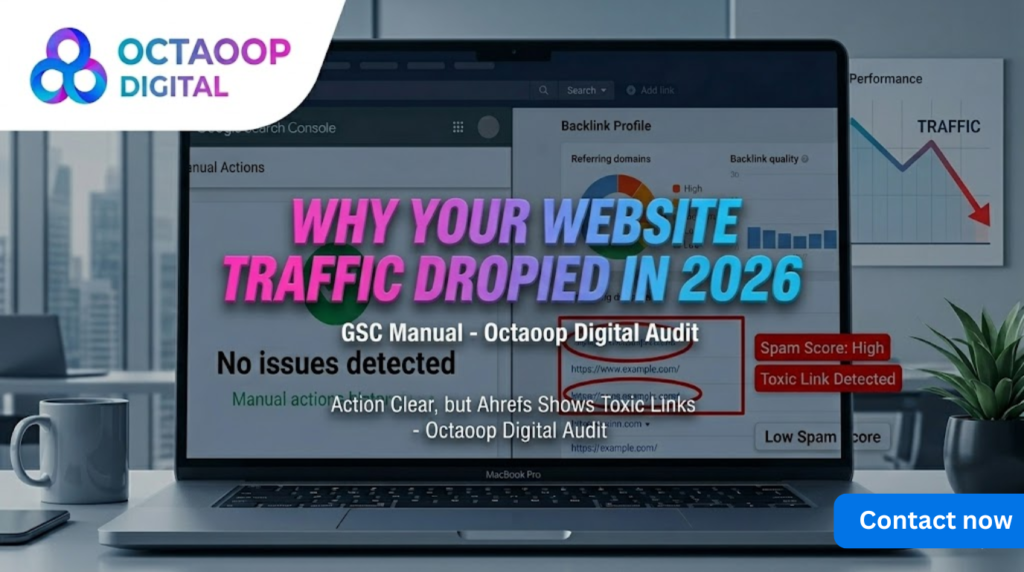
If you’re reading this because you’ve typed “why my website traffic dropped 2026 UK” into Google at some ungodly hour of the morning whilst staring at a Google Analytics graph that looks like the inside of a cliff face—you’re in the right place.
You’re not imagining it. Your rankings are down. Your enquiry form is collecting digital cobwebs. The phone that used to ring is now just a paperweight with a charging cable. And somewhere between January and now, something broke—and nobody told you what, why, or how to fix it.
Here’s the uncomfortable truth: 2026 is the most disruptive year in SEO since Google rolled out Panda in 2011. The rules didn’t just shift slightly. They rewrote the entire playbook. And most UK small businesses—and frankly, most cut-price agencies they’ve hired—have not kept up.
This guide is going to explain exactly what happened to your traffic, how to diagnose the specific cause of your drop, and what it takes to actually recover. No waffle. No vanity metrics. Just a straight-talking technical breakdown from people who fix these problems for a living.
[IMAGE PLACEHOLDER: A split-screen showing a Google Analytics 4 traffic graph with a sharp decline from March 2026, with red trend arrows and a Search Console coverage error panel open on the right. Alt text: “why my website traffic dropped 2026 uk – Google Analytics traffic decline dashboard showing sudden organic drop”]
The Four Real Reasons Your UK Website Traffic Has Dropped in 2026
Reason 1: Google’s AI Overviews Have Eaten Your Informational Traffic
Let’s start with the most seismic shift first—one that no one in your previous agency probably warned you about.
Google’s AI Overviews (formerly SGE, or Search Generative Experience) rolled out aggressively across UK search results in late 2024 and have now saturated informational queries throughout 2025 and 2026. What this means in practice is that if your website was ranking on Page 1 for questions like “how long does it take to learn to drive” or “what is a discovery call in marketing”—Google is now answering that question directly in the search results before anyone clicks through to your site.
This is the shift towards what SEOs are now calling GEO: Generative Engine Optimisation. The old model was: rank for question → get click → get conversion. The new model is: Google answers the question → user gets the gist → maybe clicks through for depth.
For UK SMEs who built their organic traffic on informational blog content, this has been catastrophic. Studies tracking UK SERPs through 2025 showed informational keyword click-through rates (CTR) dropping by 25–40% on queries where AI Overviews appeared. If your analytics shows a steep drop in blog or resource page traffic but your product/service pages are relatively stable, this is almost certainly your primary culprit.
What this means for your recovery: You need to pivot your content strategy away from bare-bones informational posts towards content that earns citations within AI Overviews, and towards transactional and commercial intent keywords that AI Overviews don’t cannibalise as aggressively. You also need to build topical authority so that when Google’s AI synthesises an answer, it’s citing your site.
Reason 2: You’re Failing the New Core Web Vitals Standard—Specifically INP
This one is brutally technical, but stay with it, because it’s costing UK businesses thousands of pounds in lost revenue every month.
Google’s Core Web Vitals are a set of real-world performance metrics that directly influence your search rankings. In March 2024, Google officially replaced FID (First Input Delay) with a new metric called INP: Interaction to Next Paint. Many websites—particularly those built on WordPress with bloated themes, aggressive plugins, or third-party scripts—are now failing this metric badly, and their rankings are suffering as a direct consequence.
What is INP? In plain terms, INP measures how quickly your website responds when a user actually does something—clicks a button, opens a dropdown menu, submits a form. A poor INP score means your site feels sluggish and unresponsive, even if it loads quickly at first. Google views this as a bad user experience and ranks you lower accordingly.
The benchmark is clear:
- Good INP: 200 milliseconds or under
- Needs Improvement: 200–500ms
- Poor (ranking penalty risk): Over 500ms
For WordPress sites in particular—which power the majority of UK SME websites—the culprits are almost always the same: WooCommerce scripts loading on every page, heavy page builders like Divi or Elementor, Google Tag Manager firing dozens of marketing scripts, or slider plugins that nobody actually uses but nobody ever removes.
How to check your INP score right now:
- Go to Google PageSpeed Insights and enter your URL
- Scroll to the “Diagnose Performance Issues” section and look for “Interaction to Next Paint”
- Cross-reference with your Google Search Console → Core Web Vitals report—this shows real-user data, not just lab results
If you’re seeing INP flagged as “Poor” on mobile, particularly, this is a direct ranking suppressor. It won’t show up as a manual penalty in Search Console—it’s algorithmic, quiet, and it’s grinding your visibility down without a single warning message.
Fixing INP properly requires removing or deferring unnecessary JavaScript, auditing third-party scripts, and in many cases, rebuilding page templates without the bloat. This is not a DIY job unless you have solid front-end development experience.
If your traffic is technically fine but you still aren’t getting enquiries, read our guide on [10 Signs Your Website is Losing Customers Instead of Converting Them].
Reason 3: Google’s Core Updates Have Binned Your “AI Slop” Content
Let’s be direct about this one: if you or an agency produced a conveyor belt of thin, templated, AI-generated content throughout 2023 and 2024 and called it an “SEO content strategy,”—Google has spent 2025 and 2026 systematically demoting it.
Google’s March 2024 Core Update and the subsequent August 2024 Core Update were explicitly designed to target what the industry has taken to calling “AI slop”—content that is technically readable, superficially keyword-rich, but adds no genuine insight, experience, or value that couldn’t be pulled from the first page of any search result.
The signals Google uses to identify this content include:
- Zero originality signals: Content that mirrors top-ranking articles without adding new data, case studies, or expert opinion
- No E-E-A-T signals: Missing author credentials, no first-hand experience demonstrated, no trust signals like company information or verified reviews
- Pogo-sticking patterns: Users landing on your page and bouncing back to Google within seconds—a strong signal that your content didn’t satisfy the query
- Thin word counts with no structural depth: Hitting a keyword 12 times across 400 words and calling it a blog post
If your website published more than 20 blog posts in 12 months and not one of them was written by an actual human expert with real-world experience to reference, you may have a content quality issue that is dragging your entire domain down—not just the individual posts.
The fix isn’t deleting everything. It’s conducting a systematic content audit: identifying which posts have genuine organic traction, which are thin and need consolidating or expanding, and which should simply be 301-redirected or noindexed. Done correctly, this often produces a noticeable ranking recovery within 60–90 days.
Reason 4: Toxic Backlinks From a Cheap Agency Have Finally Caught Up
This is the conversation nobody wants to have—especially if you’re still paying a £199/month SEO retainer to an agency that promised you “500 high DA backlinks per month.”
The UK is awash with SEO agencies and freelancers selling link-building packages that, quite simply, violate Google’s webmaster guidelines. We’re talking about private blog networks (PBNs), link farms, spammy directory submissions, and paid guest posts on low-quality sites with zero editorial standards. For a few years, some of these tactics could produce short-term ranking lifts. Google’s spam systems have caught up dramatically.
Here’s how to check whether a toxic backlink profile might be contributing to your traffic drop:
- Export your backlink profile from Google Search Console → Links → Top Linking Sites
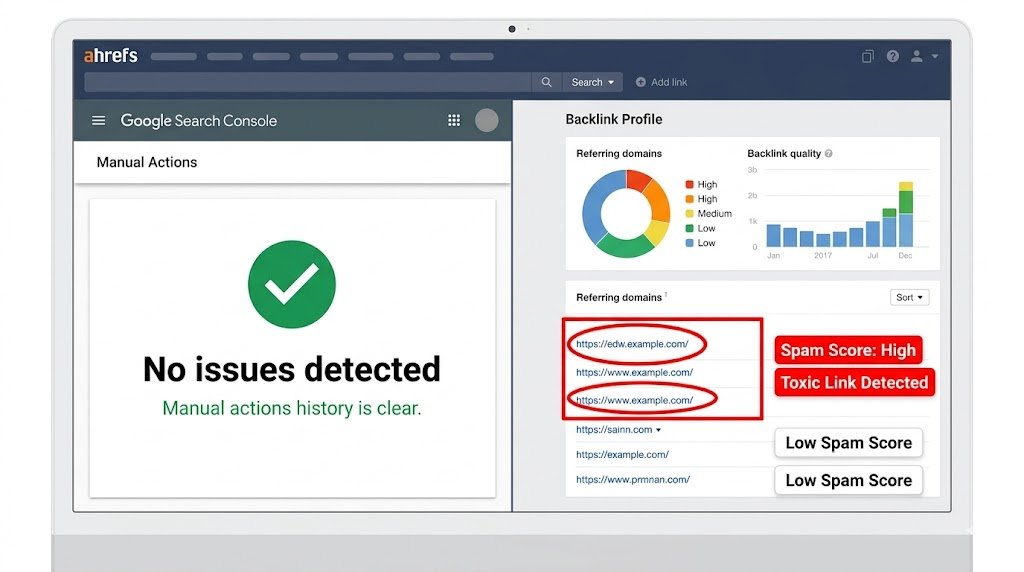
- Run the same export through a tool like Ahrefs, SEMrush, or Moz to see spam scores and link quality metrics
- Look specifically for: links from foreign-language sites with no relevance to your industry, links embedded in blog comment sections, links from exact-match anchor text patterns (e.g., every link says “cheap accountant Bolton” rather than your brand name)
- If you identify a pattern of low-quality links, you’ll need to build a disavow file in Google Search Console’s Disavow Tool and simultaneously build authoritative replacement links through digital PR, industry citations, and genuine editorial coverage
Worth noting: Google doesn’t always issue a manual action for toxic links. Often, the penalty is algorithmic—quiet and gradual, making it difficult to pinpoint without proper diagnostic tools.
How to Properly Diagnose Your 2026 Traffic Drop: A Step-by-Step Audit
Before you can fix a sudden traffic loss, you need to know exactly what broke. Guessing is expensive. Here’s the diagnostic sequence our technical team runs on every UK recovery client:
Step 1: Establish the Timeline
Log into Google Analytics 4 and pull your organic traffic report for the last 18 months. Look for the exact date your traffic began to drop. Then cross-reference that date against the Google Algorithm Update History (available on sites like Search Engine Land or Semrush’s update tracker). If your drop coincides with a known core update, algorithm shift, or Google Ads policy change, that’s your starting hypothesis.
Step 2: Check Search Console for Manual Actions
Go to Google Search Console → Security & Manual Actions → Manual Actions. If you see anything here other than “No issues detected,” you have a penalty that requires direct remediation before anything else will work.
Step 3: Run a Crawl Error and Indexing Audit
In Search Console, go to Pages (formerly Coverage). Look at the “Not indexed” bucket. Specifically check for:
- Discovered – currently not indexed: Pages Google knows about but hasn’t indexed—often a sign of crawl budget issues or thin content signals
- Crawled – currently not indexed: Google crawled these pages and made a deliberate choice not to index them—a significant quality signal
- Noindexed pages: Ensure these are intentional. Sometimes WordPress plugins or theme updates accidentally add a noindex tag to entire content categories
Step 4: Audit Your Core Web Vitals in Search Console
Navigate to Search Console → Experience → Core Web Vitals. Review both mobile and desktop. If you see URLs flagged as “Poor” for INP, CLS (Cumulative Layout Shift), or LCP (Largest Contentful Paint), you have a technical performance issue suppressing your rankings across those templates.
Step 5: Segment Your Traffic Loss by Page Type
In GA4, segment your organic traffic decline by landing page. Is the drop concentrated on:
- Blog/resource pages? → Likely AI Overviews cannibalisation or content quality issue
- Product/service pages? → Likely a technical issue, Core Web Vitals failure, or competitor displacement
- All pages equally? → Likely a sitewide penalty, domain-level signal issue, or catastrophic technical error (broken XML sitemap, robots.txt blocking crawlers)
This segmentation alone can halve the time spent diagnosing the root cause.
What Genuine SEO Recovery Actually Looks Like in 2026
Real recovery isn’t a £299/month package. It’s not “we’ll post 4 blogs per month.” It’s not a report sent every 30 days that you don’t understand with traffic graphs pointing vaguely upward.
In 2026, genuine SEO recovery requires the following components working in concert:
Technical infrastructure rebuild: Core Web Vitals correction—specifically INP, LCP, and CLS—across mobile and desktop. This involves JavaScript auditing, server response time optimisation, image compression pipelines, and in many cases, theme or plugin architecture changes for WordPress sites. Web speed optimisation isn’t a nice-to-have; it’s a ranking prerequisite.
Content quality elevation: A systematic audit of your existing content, followed by consolidation of thin posts, expansion of high-potential pages, and introduction of genuine E-E-A-T signals—real author credentials, original data, customer case studies, and topical depth that earns AI Overview citations rather than losing clicks to them.
Backlink profile remediation: Identifying and disavowing toxic links whilst simultaneously building authoritative digital PR coverage that Google’s algorithms recognise as genuine signals of trust.
GEO-adapted content strategy: Structuring new content specifically to appear within AI Overviews as cited sources—using structured data markup, FAQ schema, and authoritative entity-linked writing that signals expertise to both Google’s algorithm and its generative systems.
Conversion-focused page architecture: Because recovering your traffic is only half the battle. If the visitors you reclaim aren’t converting into enquiries, appointments, or sales, you’ve done the expensive part for nothing.
Why Most UK Agencies Are Making This Worse
There’s something that needs to be said plainly: the SEO agency landscape in the UK has a serious quality problem.
Too many businesses are paying monthly retainers to agencies that are running the same playbook they were running in 2019—keyword-stuffed content, bulk link building, and a monthly PDF report that nobody action-tests. These agencies aren’t malicious; many of them genuinely believe they’re helping. They’re simply not equipped to handle the technical complexity of modern SEO.
The result is that businesses come to us having already spent £12,000–£40,000 on retainers that didn’t just fail to move the needle—they actively created the toxic backlink profiles and thin content masses that are now suppressing their rankings.
If your current SEO provider cannot tell you what your INP score is, cannot explain what GEO means for your content strategy, and cannot produce a Core Web Vitals remediation plan—you are not working with a modern SEO agency. You’re working with a 2019 agency with a 2026 price tag.
This Is Where Octaoop Digital Comes In
At Octaoop Digital, we don’t offer generic retainers. We don’t sell you 500 backlinks or four blog posts and call it strategy.
We work as a technical SEO surgery team for UK SMEs and e-commerce businesses who have already lost traffic and need it back—fast, sustainably, and without gambling their domain health on outdated tactics.
Our recovery process starts with a live 15-minute diagnostic call where our technical team will look at your Search Console data, your Core Web Vitals report, your backlink profile, and your content indexing status in real time. Within those 15 minutes, we will tell you exactly where the damage is, what’s causing it, and what the recovery pathway looks like.
No obligation. No sales pitch dressed as a consultation. Just an actual technical assessment from people who do this every day.
Our services include:
- Full technical SEO audits covering crawlability, indexing, INP/CWV remediation, and site architecture
- Content quality audits and recovery strategies aligned with Google’s 2026 E-E-A-T standards
- WordPress speed optimisation targeting INP, LCP, and CLS improvements for ranking recovery
- Backlink profile auditing and disavow management
- GEO-adapted content strategy for UK SMEs navigating AI Overviews
- Conversion rate optimisation to ensure recovered traffic actually generates revenue
We work with UK businesses across retail, professional services, trades, healthcare, legal, and e-commerce. We understand the UK market, the UK search landscape, and how Google’s algorithm changes land differently in British SERPs.
Don’t Sit and Watch Your Revenue Vanish.
Every day that passes with a broken SEO profile is a day your competitors are ranking where you used to be. Every week your Core Web Vitals are failing is a week Google is actively suppressing your visibility. Every month you spend on an agency that doesn’t understand INP, GEO, or 2026’s content standards is a month of compounding damage.
Call Octaoop Digital’s UK Recovery Team right now for a live 15-minute diagnostic call.
We’ll look at your data. We’ll identify the problem. We’ll tell you what it takes to fix it.
👉 [Book Your Free 15-Minute Traffic Recovery Call →] (Link to booking page)
📞 Or call us directly at [phone number]
📧 Email:
Info@octaoopdigital.com
You built your business. You shouldn’t be watching Google dismantle it one algorithm update at a time. Let’s get it back.
Frequently Asked Questions: Website Traffic Drop UK 2026
Q: How long does it take to recover from a Google algorithm traffic drop?
Recovery timelines vary depending on the cause. Technical fixes like Core Web Vitals improvements can show ranking improvements within 4–8 weeks once Google reprocesses affected URLs. Content quality recoveries following core updates typically take 2–4 months after the next major core update is released. Backlink penalty recoveries can take 3–6 months depending on the severity and Google’s recrawl schedule.
Q: Can I fix my INP score without rebuilding my WordPress site?
In some cases, yes. Removing or deferring specific JavaScript files, replacing heavy plugins with lightweight alternatives, and eliminating unnecessary third-party scripts can bring INP scores within the “Good” threshold without a full rebuild. However, for sites using page builders like Divi, Elementor, or Beaver Builder, a partial or full theme migration is often necessary for meaningful INP improvement.
Q: Did Google’s 2025 or 2026 core updates affect UK sites specifically?
Google’s core updates are global, but their impact can be disproportionate in specific markets. UK SME sites in competitive verticals—particularly legal, financial services, healthcare, trades, and property—saw significant volatility through 2025 as Google increased its E-E-A-T weighting and AI Overview coverage. Sites without clear author authority, geographic relevance signals, or structured schema markup were disproportionately affected.
Q: How do I know if my traffic drop is a penalty or an algorithm change?
Check Google Search Console’s Manual Actions section first—a confirmed penalty will appear here. If Manual Actions is clean, your drop is likely algorithmic. Overlay your traffic graph against the Google Algorithm Update timeline; if the drop coincides with a known update, you’re dealing with an algorithmic quality signal issue rather than a direct penalty.
Q: Is AI-generated content bad for SEO in 2026?
Not categorically—but low-quality, undifferentiated AI-generated content absolutely is. Google’s systems have become increasingly sophisticated at identifying content that lacks genuine expertise, original perspective, or demonstrable first-hand experience. AI can be a legitimate part of a content production workflow when human experts review, add original insight, and verify accuracy. Using AI to mass-produce templated posts with no human editorial input is what’s being targeted and demoted.
Octaoop Digital is a UK digital marketing and technical SEO agency. We specialise in SEO recovery, Core Web Vitals optimisation, and conversion-focused content strategy for UK SMEs and e-commerce businesses. Visit octaoopdigital.com to learn more.
Last reviewed and updated: June 2026
