
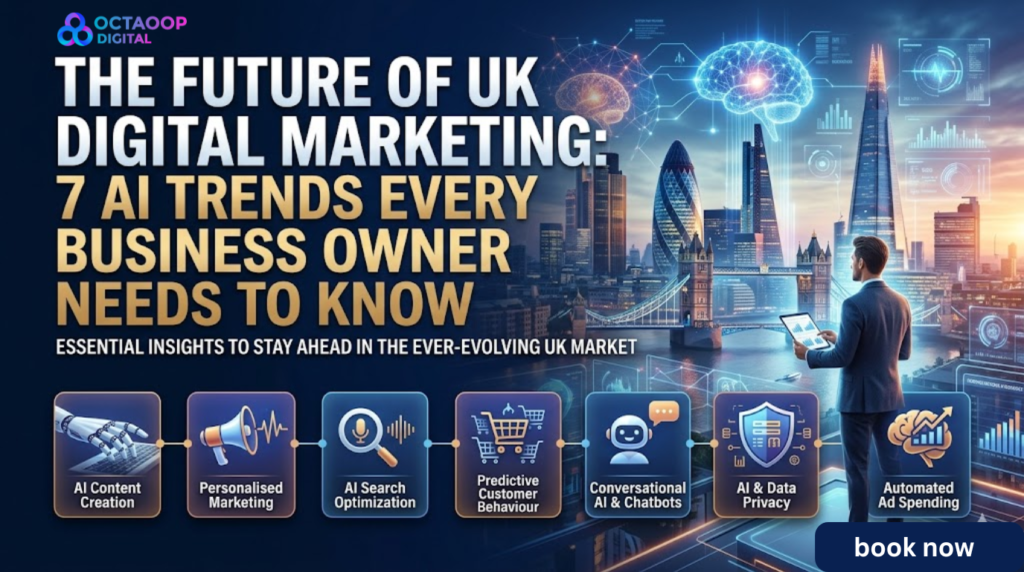
The UK digital marketing landscape is shifting faster than at any point in its history. Not incrementally — but fundamentally. The businesses that thrive over the next three years won’t simply be those with the biggest budgets or the most followers. They’ll be the ones that understand where the technology is going and act on that understanding before their competitors do.
AI is no longer a future consideration for UK businesses. It is a present reality — already reshaping how companies are found on Google, how they communicate with customers, how they convert traffic into revenue, and how they retain clients over the long term. The question is no longer ‘should we engage with AI in our marketing?’ It is ‘which AI trends are most urgent, and how do we implement them intelligently?’
At Octaoop Digital, we work with UK businesses across sectors to build digital strategies that are built for the present and scalable for the future. In this article, we’re sharing the 7 AI trends we believe will define UK digital marketing in 2026 — and exactly what forward-thinking business owners should be doing about each one right now.
The State of UK Digital Marketing Entering 2026
Before we examine the trends, it’s worth grounding the conversation in where UK businesses stand today. The picture is one of significant opportunity — and equally significant risk for those who delay.
72% of UK marketing leaders say AI tools have already meaningfully changed how their teams work — Salesforce State of Marketing Report 2025
£6.2bn projected AI-driven marketing spend in the UK by 2027 — Statista UK Digital Marketing Forecast 2025
Only 31% of UK SMEs have a documented AI integration strategy for their marketing — despite 68% identifying it as a priority (Deloitte UK Digital Business Report 2025)
The gap between awareness and action is the single greatest competitive opportunity available to UK businesses right now. The trends below are your roadmap for closing it.
AI-Powered Search: The End of Traditional SEO as You Know It
Google’s integration of AI into search — through its Search Generative Experience (SGE) and AI Overviews — is fundamentally changing what it means to ‘rank’ on Google. For the first time, AI-generated summaries are appearing above traditional organic results, answering user questions directly on the search page without a click.
What this means for UK businesses: The goal of SEO in 2026 is no longer just page-one ranking — it’s becoming the source that AI cites in its generated answers. This requires a fundamental shift in content strategy toward what Google now defines as E-E-A-T: Experience, Expertise, Authoritativeness, and Trustworthiness.
UK businesses that publish genuinely expert, well-structured, deeply informative content — with clear authorship, cited sources, and real-world proof — will be the ones featured in AI-generated answers. Generic content, no matter how keyword-optimised, will become progressively invisible.
✅ Action for UK Business Owners: Audit your existing website content for E-E-A-T signals. Add author bios, cite real data, include case studies, and structure content to answer specific questions your target customers are asking. This is not optional — it is the new ranking standard.
Hyper-Personalisation at Scale: AI That Knows Your Customer Better Than You Do
Personalisation in marketing is not new. What is new is the scale and precision at which AI now enables it. In 2026, UK businesses using AI-powered marketing tools can dynamically serve different website content, email sequences, ad creative, and product recommendations to different visitor segments — automatically and in real time.
The data is compelling. McKinsey research consistently shows that personalisation at scale can deliver 5–15% revenue uplift and 10–30% improvement in marketing spend efficiency. For UK e-commerce and service businesses, this is not a marginal gain — it represents structural competitive advantage.
What this looks like in practice: A visitor from a UK financial services firm sees a different homepage headline and case study than a visitor from a manufacturing company — automatically, based on firmographic data. An email sequence adjusts its next message based on which links a recipient clicked in the previous one. A remarketing ad shows the exact product category a user browsed, not a generic brand message.
✅ Action for UK Business Owners: Begin by segmenting your email list and creating at least two distinct nurture sequences based on customer profile or intent signal. Then explore tools like HubSpot, Klaviyo, or ActiveCampaign — all of which now include AI personalisation features accessible to UK SMEs without enterprise-level budgets.
Conversational AI & Intelligent Chatbots: Your 24/7 Sales and Support Team
The chatbot of 2019 — rigid, frustrating, unable to handle anything outside its decision tree — is unrecognisable compared to the AI-powered conversational tools available to UK businesses in 2026. Modern conversational AI can qualify leads, answer complex product questions, book appointments, handle objections, and escalate to a human agent seamlessly — all without a single staff member being online.
67% of UK consumers say they would interact with a business chatbot for customer support if it could provide instant, accurate answers — PwC UK Consumer Intelligence Series 2025
For UK service businesses — law firms, accountants, estate agents, digital agencies, consultancies — this represents a transformative opportunity. A well-configured AI assistant on your website means every visitor at 11 pm on a Sunday gets an immediate, intelligent response rather than a contact form and a 48-hour wait.
The lead generation implication is significant: businesses using intelligent chat convert website visitors into qualified enquiries at rates 3–5x higher than those relying on static contact forms alone, according to Drift’s 2025 Conversational Marketing Report.
✅ Action for UK Business Owners: At minimum, implement a basic AI chat widget on your website’s highest-traffic pages — your homepage, services page, and pricing page. Tools like Intercom, Tidio, and Drift offer UK-accessible plans. For a more sophisticated, bespoke implementation integrated with your CRM and sales process, this is where an expert agency adds significant value.
AI-Generated Content — But Not the Way Most UK Businesses Are Using It
Let’s be direct about something: the way the majority of UK businesses are currently using AI for content is wrong — and Google knows it. The instinct to use ChatGPT to write 20 blog posts in an afternoon and publish them unchanged is not a content strategy. It is the fastest route to a Google penalty and a brand that sounds like everyone else.
The correct model — the one that is already separating high-performing UK brands from the noise — is AI-assisted, human-led content production. AI handles research aggregation, structural outlines, first draft acceleration, and data analysis. Human experts provide the strategic framing, editorial voice, real-world experience, and factual accuracy that Google’s AI-detection systems and human readers demand.
The businesses winning with AI content in 2026 are producing it faster, yes — but they are also producing it at a higher standard of relevance and authority than was possible without AI. The tool raises the floor for those who use it intelligently. It creates a ceiling for those who use it lazily.
✅ Action for UK Business Owners: Establish an AI content workflow: use AI for keyword clustering, content briefs, and first drafts — then invest in expert editorial review before publication. If your team lacks the expertise to review and elevate AI output, partnering with a specialist content agency is not an expense. It is quality control on one of your most significant marketing assets.
Predictive Analytics: Marketing That Anticipates, Not Just Reacts
The shift from descriptive analytics (what happened?) to predictive analytics (what will happen?) is one of the most profound changes AI is bringing to UK marketing. Tools now available to SMEs — not just enterprise businesses — can predict which leads are most likely to convert, which customers are at risk of churning, which products are likely to spike in demand, and which ad creative will outperform before a campaign has even launched.
2.9x
more likely to report above-average revenue growth — UK businesses using predictive analytics vs those using only historical data (Forrester Research 2025)
For UK B2B businesses with longer sales cycles, predictive lead scoring is particularly powerful. Rather than treating every enquiry equally, AI models analyse behavioural signals — pages visited, time on site, email open patterns, company size, sector — and rank leads by conversion likelihood. Sales teams focus their time on the leads most likely to close. Pipeline efficiency increases. Revenue per head goes up.
✅ Action for UK Business Owners: Start with predictive lead scoring if you have a CRM. HubSpot, Salesforce, and Pipedrive all offer AI-powered lead scoring features. Integrate this with your website analytics to build a complete behavioural picture of your prospects. The data you’re already collecting is almost certainly not being used to its full potential.
AI in Paid Media: Smarter Bidding, Sharper Targeting, Better ROI
Google’s Performance Max campaigns and Meta’s Advantage+ advertising products are not simply new campaign types — they represent a fundamental shift in how paid media works. Both are AI-driven systems that automate creative testing, audience targeting, bid management, and placement optimisation simultaneously, using machine learning to find the combinations that deliver the best results for your specific objective.
The opportunity for UK SMEs is significant, but so is the risk. These systems are extraordinarily powerful when fed high-quality inputs — well-structured conversion tracking, diverse creative assets, clear campaign objectives, and sufficient data volume. They underperform badly — and can burn budgets rapidly — when set up incorrectly or managed passively.
The UK businesses seeing the best returns from AI-powered paid media in 2026 are those with experienced media buyers who understand how to configure, feed, and guide these systems — not those who activate them and hope for the best. The platform’s AI and the human strategist’s expertise are multiplicative, not interchangeable.
✅ Action for UK Business Owners: Before launching or scaling any AI-powered paid media campaign, ensure your conversion tracking is fully configured and verified in Google Ads or Meta Events Manager. Without accurate conversion data, the AI optimises toward the wrong signals and wastes your budget. This is a technical setup step that an experienced digital agency should handle before any spend begins.
Voice Search & AI Assistants: Optimising for How UK Customers Actually Search
The rise of AI assistants — from Apple’s Siri and Amazon’s Alexa to Google Assistant and the new wave of AI-native search tools like Perplexity — is changing the nature of search queries in ways that traditional keyword strategies are not built to address. Voice searches are longer, more conversational, and more locally focused than text searches.
A UK consumer typing into Google might search “digital agency Manchester.” The same consumer using a voice assistant asks: “Which digital marketing agencies near me are best for helping a small business grow online?” These are fundamentally different queries — and they require fundamentally different content to answer.
27% of UK internet users use voice search at least once daily — Ofcom UK Communications Market Report 2025
Optimising for voice and AI assistant search requires creating content that directly answers natural language questions, using FAQ structures, clear ‘who/what/where/when/why/how’ framing, and ensuring your Google Business Profile is fully optimised with accurate, detailed information. Local businesses in particular stand to gain enormous visibility from voice search optimisation — it remains one of the most underutilised strategies in the UK SME sector.
✅ Action for UK Business Owners: Add a comprehensive FAQ section to your key service pages — written in natural, conversational English, structured to answer the specific questions your customers ask. Then fully complete and regularly update your Google Business Profile. These two actions alone can meaningfully increase your visibility in voice and AI-assisted search results within 60 to 90 days.
What These 7 Trends Mean for Your Business Right Now
Taken together, these trends point toward one inescapable conclusion: the gap between UK businesses that understand and leverage AI in their marketing — and those that do not — is widening every month. The technology is not slowing down. The competitive pressure is not easing.
But here is the genuinely encouraging reality: most of your UK competitors are not moving on these trends yet. The 31% implementation figure we cited at the start of this article is not a warning that you’re behind — it is a signal that the window for competitive advantage is still open. The businesses that act in 2026 will reap disproportionate rewards.
The seven trends above are not abstract predictions for 2030. They are present-tense competitive dynamics that are already separating the UK businesses growing their market share from those watching it erode. AI-powered search is live. Conversational AI is deployable today. Predictive analytics tools are accessible to SMEs right now. The question is not whether to engage — it is how quickly and how intelligently.
How Octaoop Digital Helps UK Businesses Navigate the AI Marketing Era
Understanding trends is one thing. Implementing them with precision — in a way that actually moves the commercial needle for your specific business, in your specific UK market — is where specialist expertise becomes the deciding factor.
At Octaoop Digital, we combine the cutting-edge of AI capability with the depth of human strategic expertise to build digital marketing systems that are both future-ready and results-focused today. Our work with UK businesses spans:
- AI-optimised SEO strategies built for the E-E-A-T era and Google’s AI-integrated search
- Intelligent content systems that leverage AI for speed while maintaining brand authority and editorial quality
- Conversational AI integration — from chatbot configuration to full CRM-connected lead qualification
- Predictive analytics setup and interpretation — turning your existing data into a commercial advantage
- AI-powered paid media management — Performance Max, Meta Advantage+, and LinkedIn Campaign Manager
- Voice and local search optimisation strategies tailored to your UK sector and geography
- Bespoke digital transformation roadmaps — so you know exactly where to invest, in what order, and why
Every engagement starts with a deep-dive audit of your current digital presence — identifying exactly where you stand against each of these seven trends and building a prioritised action plan that matches your budget, your team, and your business goals. No generic templates. No one-size-fits-all solutions. Just the right strategy, built for your business, executed by experts.
Frequently Asked Questions
What is the most important AI trend for UK small businesses to focus on first?
For most UK SMEs, AI-powered SEO and conversational AI represent the highest-impact, most accessible starting points. Optimising for Google’s AI-integrated search ensures you remain visible to your target audience, while an intelligent chatbot immediately improves lead capture from your existing traffic — without requiring additional ad spend.
How much does it cost to implement AI marketing tools for a UK business?
Costs vary considerably depending on the tools and level of integration required. Many foundational AI marketing tools — from AI-assisted email platforms to basic chatbots — are available for under £100 per month. More sophisticated implementations, such as predictive analytics integration or custom AI content systems, require specialist agency expertise. The key question is not the cost of the tools, but the return on investment they generate when properly configured and managed.
Will AI completely replace traditional digital marketing for UK businesses?
No — and the distinction matters. AI is transforming the tools and processes of digital marketing, not the strategic, creative, and relational foundations that make marketing effective. Human judgment, brand strategy, customer understanding, and accountability remain irreplaceable. The most successful UK businesses in 2026 will be those combining AI capability with human expertise — not those attempting to use either in isolation.
How quickly can a UK business see results from AI marketing implementation?
Timeline depends on the channel. AI-powered paid media optimisation can show measurable performance improvement within 4 to 8 weeks. Conversational AI lead capture improvements are typically visible within the first month of deployment. AI-driven SEO and content strategies generally require 3 to 6 months to show meaningful organic search gains — but the results compound significantly over time.
How does Octaoop Digital stay current with AI marketing trends?
Our team continuously monitors developments across Google’s algorithm updates, major AI platform releases, and UK market performance data. We integrate new tools and methodologies into our service delivery as they mature — ensuring our clients benefit from leading-edge capability without the risk of unproven technology. Every tool we recommend has been tested in real UK market conditions.
Premium Digital. Real Results. UK Business Growth.
