
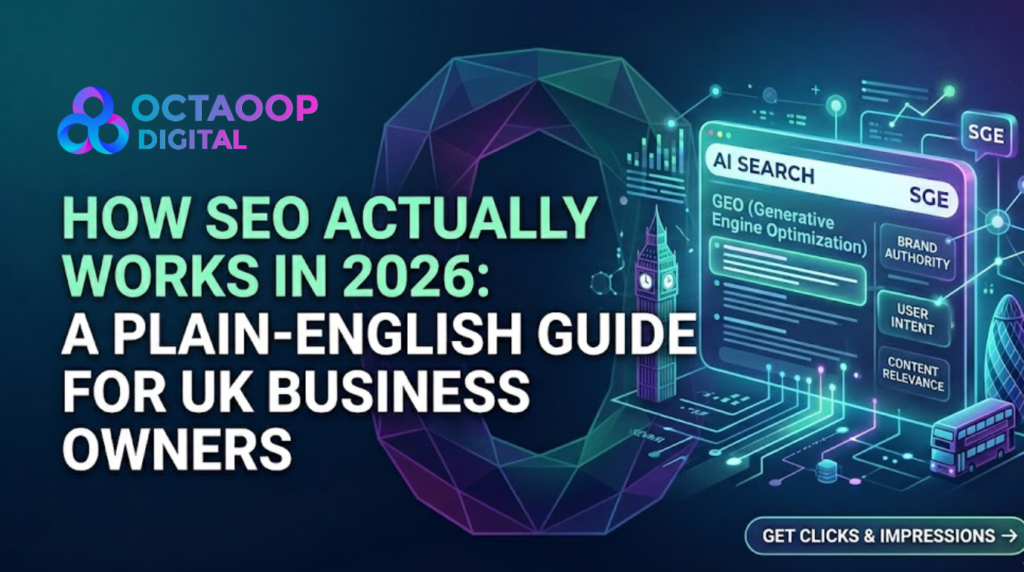
Confused by algorithm updates, AI search, and conflicting advice? This guide cuts through the jargon and explains exactly what drives rankings in 2026 — and what UK businesses need to prioritise to stay visible online.
By Octaoop Digital· Updated June 2026· 12 min read
Understanding how SEO works in 2026 UK has never been more important — and never more confusing. The internet is full of contradictory advice, outdated guides, and agencies using buzzwords to make a straightforward discipline sound impossibly complicated. This guide is different. We’re going to explain exactly how SEO works in 2026 for UK businesses — in plain English, with no fluff — using the same framework we apply for our clients every day at Octaoop Digital.
Whether you’re a business owner in Bolton, a marketing manager in Manchester, or running an e-commerce brand out of London, this guide will give you a solid foundation for understanding how SEO in 2026 works — and making smarter decisions about your online presence.
What is SEO — and how does it work in 2026?
Search Engine Optimisation is the process of making your website more visible to people who are searching for products or services you offer. When someone types “accountant in Sheffield” or “vegan restaurant near me” into Google, SEO is what determines whether your business appears on the first page or gets buried on page five, where no one looks.
That’s it. Everything else — the technical frameworks, the content strategies, the link building — exists in service of that simple goal: showing up when the right people are searching.
Context
In the UK, Google holds over 93% of the search market. When we talk about SEO, we are, for all practical purposes, talking about how to rank well on Google. That said, in 2026, search has expanded well beyond a single results page — but more on that shortly.
How SEO works in 2026 UK: the four pillars Google actually ranks on
Google’s algorithm processes over 200 ranking factors, but the core logic has remained remarkably consistent over the past decade. Google wants to show its users the most relevant, trustworthy, and useful results for any given search. According to Google’s own documentation on how search works, its mission is simply to organise the world’s information and make it universally accessible — and its ranking system exists entirely in service of that goal.
This is actually good news for business owners. It means that the path to ranking well is aligned with what’s good for your customers: create genuinely useful content, build a trustworthy brand, and make sure your website works properly. The businesses that try to “trick” Google into ranking them tend to experience short-term gains followed by devastating losses when the next algorithm update arrives.
In 2026, Google’s ranking signals broadly fall into four pillars:
01 / RELEVANCE
Content Match
Does your page genuinely answer what the user is searching for? Google is now remarkably good at understanding intent, not just keywords.
02 / AUTHORITY
Trust & Credibility
Other websites linking to yours act as votes of confidence. The more credible the source, the more weight the link carries.
03 / EXPERIENCE
User Satisfaction
How do people behave when they land on your page? Fast load times, mobile friendliness, and clear structure all matter enormously.
04 / EXPERTISE
E-E-A-T Signals
Experience, Expertise, Authoritativeness, Trustworthiness. Google actively rewards brands that demonstrate real-world knowledge and credibility.
The three branches of SEO
Most SEO work lives within one of three disciplines. A successful strategy usually requires all three working together.
Technical SEO — the foundation of how SEO works in 2026
This is the foundation. Before Google can rank your content, it needs to be able to find, crawl, and index it. Technical SEO covers everything related to how your website is built: site speed, mobile responsiveness, URL structure, XML sitemaps, crawl errors, HTTPS security, and Core Web Vitals — the suite of performance metrics Google uses to assess user experience. If your technical foundation is broken, no amount of content or link building will get you to page one.
In 2026, Core Web Vitals will remain particularly important for UK businesses. Page speed is not just a nice-to-have; it is a direct ranking factor, and UK consumers have little patience for slow-loading websites. You can test your own site for free using Google’s PageSpeed Insights tool — research consistently shows that a one-second delay in page load time can reduce conversions by 7%.
On-page SEO — the content signals that matter in 2026 UK
This refers to the content and optimisation on each individual page of your website. It includes the words you use, how you structure your content, the titles and meta descriptions that appear in search results, how you use headings, internal links between pages, and the use of imagery with proper alt text. The goal of on-page SEO is to make it absolutely clear to both Google and your visitors what each page is about and why it’s the best answer to their question.
One of the most important shifts in understanding how SEO works in 2026 is that keyword stuffing is not only ineffective — it actively harms your rankings. Google’s natural language processing has become sophisticated enough to penalise content that feels written for a search engine rather than a human reader. The best on-page SEO now looks like excellent writing that happens to use the right terminology naturally. This is closely tied to Google’s E-E-A-T framework — Experience, Expertise, Authoritativeness, and Trustworthiness.
Off-page SEO — building authority in the UK market
This covers everything that happens outside your website to influence your rankings. Backlinks remain the most significant off-page signal — when The Guardian, a respected industry publication, or a credible local business directory links to your website, Google treats it as a signal that you’re a trustworthy source. Earning these links requires building a brand worth talking about, creating content worth sharing, and in many cases, actively building relationships with journalists, bloggers, and industry peers.
For UK businesses, local citations — mentions of your business name, address, and phone number on directories like Yell, Thomson Local, and Google Business Profile — are also a vital component of off-page SEO, particularly for businesses that serve a specific geographic area.
How SEO works differently in 2026: the big shifts UK businesses must know
This is where things get genuinely interesting — and where many UK businesses are either getting left behind or finding new opportunities.
58% of UK searches now return AI-generated overviews before organic results
3× more brand-related searches convert compared to generic keyword searches
72% of UK consumers use their phone as their primary device for search
AI Overviews and Generative Engine Optimisation (GEO)
Perhaps the most significant shift of the past 12 months is the rise of AI-generated answers in search results. Google’s AI Overviews now appear for a significant proportion of searches, providing users with a summary answer directly on the results page — often without them needing to click through to any website.
This has understandably caused concern among business owners. If Google is answering the question itself, why would anyone click your link? The reality is more nuanced. AI Overviews tend to dominate informational queries (“what is…?” “how does…?”) but have far less impact on transactional and local searches (“SEO agency in Bolton”, “accountant near me”). These high-intent searches — the ones most likely to lead to actual enquiries and sales — remain very much click-driven.
The emerging discipline of Generative Engine Optimisation (GEO) is about positioning your brand as a source that AI systems cite and reference. The businesses most likely to be cited are those with strong brand authority, consistent and well-structured content, and genuine expertise signals. In other words, the best SEO practice and the best GEO practice are largely the same thing, which is reassuring.
“The businesses that rank well on Google in 2026 are not the ones who’ve found clever technical loopholes. They’re the ones who’ve built genuine brands that deserve to be found.”
The authority of the brand
Google has become increasingly good at rewarding brands. Searches for your business name, brand mentions across the web, social media presence, and consistent NAP (name, address, phone number) information all contribute to what Google understands about whether your business is legitimate, established, and worth surfacing to its users.
For UK businesses, this means that SEO and brand building are no longer separate disciplines — they are deeply intertwined. A business with weak brand recognition will find it significantly harder to rank, even with technically sound SEO, than one that is known and trusted within its industry or locality.
Search intent is everything
In 2026, understanding search intent — what the user actually wants when they type a query — is the most critical skill in SEO. Google has moved far beyond matching keywords on a page to matching the underlying intent behind a search. There are four main types of intent:
- Informational — the user wants to learn something (“how does VAT work for small businesses”)
- Navigational — the user wants to find a specific brand or website (“Octaoop Digital”)
- Commercial — the user is researching before making a decision (“best SEO agencies UK”)
- Transactional — the user is ready to act (“hire SEO agency, Bolton”)
Creating content that precisely matches the intent behind each target keyword is now far more important than simply including the keyword a certain number of times.
How SEO works in 2026 UK: what’s different about the British market
The UK market has its own distinctive characteristics that shape how SEO works for businesses here. Here’s what UK business owners need to keep front of mind.
Local SEO is a significant opportunity
The UK is a densely populated country with strong regional identities. People in Leeds don’t search the same way as people in London. “SEO agency Manchester” and “SEO agency Liverpool” are entirely different search markets. For businesses serving specific cities or regions, local SEO — optimising for location-based searches — is often the highest-ROI activity available.
Google Business Profile is your most powerful free tool. A fully optimised profile with accurate information, regular posts, and a steady stream of genuine customer reviews can deliver significant local visibility without any additional cost. Many UK SMEs are not using this tool to its full potential.
The 2026 economic climate favours organic
UK businesses are operating in a tough economic environment. Rising operational costs have squeezed marketing budgets, and many organisations are questioning the ROI of paid advertising channels where cost-per-click in competitive sectors continues to rise. Organic search, by contrast, delivers compounding returns. A well-optimised piece of content can continue driving traffic and enquiries for years without ongoing spend. For UK SMEs in particular, building organic visibility is a strategically sound investment that becomes more valuable over time.
Competition in UK cities is intensifying
London remains one of the most competitive SEO markets in the world. But competition is growing rapidly in cities like Manchester, Birmingham, Leeds, and Bristol as more businesses recognise the value of organic search. This makes it increasingly important to build authority now, before your competitors get further ahead. The businesses ranking on page one today started their SEO efforts months or years ago.
A practical checklist: how to apply SEO in 2026 for your UK business
If you’re new to SEO or haven’t reviewed your strategy recently, here are the most impactful areas to audit first. You can also track your performance for free using Google Search Console.
- Google Business Profile is fully completed, verified, and updated regularly with posts and photos
- Your website loads in under 2.5 seconds on mobile — test this using Google PageSpeed Insights
- Every page has a unique, descriptive title tag and meta description written in British English
- Your business name, address, and phone number are consistent across all online directories
- You have a content plan targeting the specific questions your ideal customers are searching for
- Your website is secured with HTTPS (a padlock icon in the browser bar)
- You are actively gathering and responding to Google reviews from real customers
- You have a clear understanding of which 5–10 keywords are most valuable to your business
Common myths about how SEO works in 2026, debunked
“SEO is a one-time job”
It isn’t. Google updates its ranking systems thousands of times per year. Your competitors are constantly improving their own SEO. New content is published daily. SEO is an ongoing discipline — more akin to maintaining a garden than painting a wall.
“I just need to add keywords to my website”
Keywords matter, but context matters far more. Google’s algorithms understand synonyms, related concepts, and user intent. What Google actually wants to see is content that comprehensively and helpfully addresses a topic — and that happens to use relevant language naturally, not content that mechanically repeats a phrase.
“Social media helps my SEO”
Social media signals are not a direct ranking factor. However, strong social presence can drive brand searches, earn backlinks, and increase content visibility — all of which do influence rankings indirectly. Think of social media as supporting your SEO, not powering it.
“SEO results happen quickly”
For a brand new website with no authority, realistic expectations are three to six months before meaningful organic traffic begins to develop — and nine to twelve months before more competitive keywords start moving. For established websites with existing authority, results can come faster. Anyone promising you page-one rankings within weeks should be treated with considerable scepticism.
The bottom line on how SEO works in 2026 UK
How SEO works in 2026 UK can be summed up simply: it is not about gaming an algorithm. It is about building a business that deserves to be found — one with a fast, well-structured website, content that genuinely helps your target audience, a credible and consistent brand presence, and a growing body of evidence that others in your industry and community trust and refer you.
For UK business owners, the opportunity is significant. Most of your local competitors are either not investing in SEO at all, or investing in it poorly. The businesses that take a strategic, patient, and expert-led approach to organic search in 2026 will build an asset that continues to generate enquiries, leads, and revenue long after the initial investment is made.
If you’d like to understand where your business stands today — what’s working, what’s broken, and what the biggest opportunities are — Octaoop Digital offers a free, no-obligation SEO audit for UK businesses.
Find out how your website is really performing
Our free SEO audit gives you a clear picture of where you stand — and a prioritised roadmap for getting found by more of the right people in the UK.
