
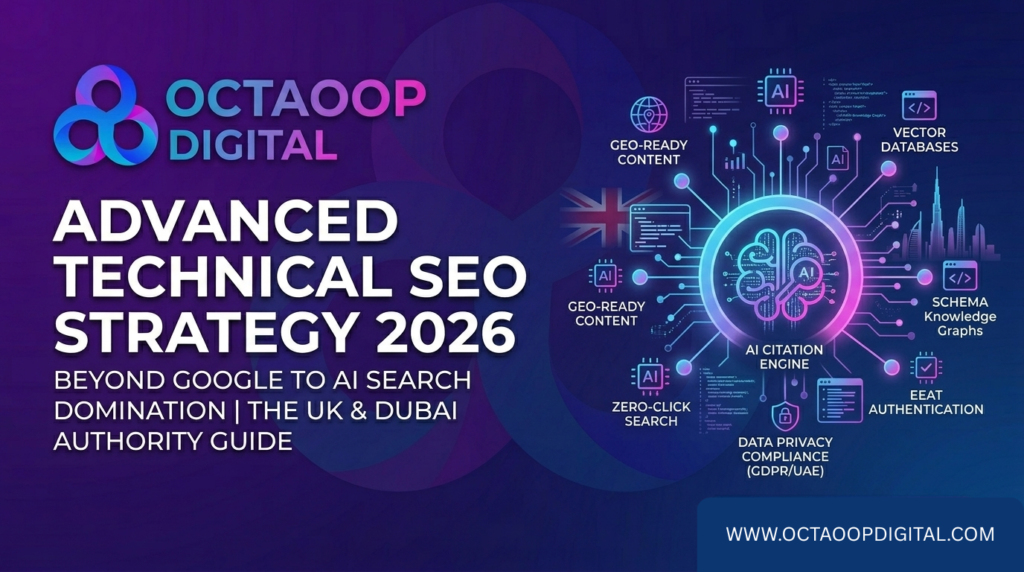
Achieving an Advanced Technical SEO 2026 strategy is no longer optional for brands looking to survive the shift toward AI-driven search. Imagine typing a question into your search bar and getting a full answer right there, no clicks needed. That’s the new normal. Traditional SEO tricks like cramming keywords fall short; instead, Octaoop Digital focuses on semantic authority and machine-readability to ensure your content is the primary source for AI engines.
You face big hurdles. Direct answers kill traffic from clicks. Simple keyword hunts won’t cut it anymore. You need semantic authority – a deep grasp of meaning and context that AI trusts. This shift means rethinking how you build and serve content. Let’s dive into strategies that position you for AI search success.
Section 1: Architecting for Advanced Technical SEO 2026 and AI Consumption
AI doesn’t read as humans do. It processes your site as data points in a huge web of info. By 2026, most search leans on models like those from Google or emerging rivals. They favour sites that feed them clear, structured knowledge. Your job is to make content easy for these systems to grasp and reuse.
Optimising Content for Contextual Embeddings and Vector Databases
AI turns words into numbers called vectors. These capture meaning and links between ideas. If your content jumps around, vectors get messy. Coherent structures help AI see the full picture. Think of it as building a clear map instead of scattered notes.
Focus on topical depth mapping. Map out main ideas and tie them to related subtopics. This beats old keyword stuffing. For example, a guide on fitness might link exercises to nutrition science, not just repeat “workout tips.”
- Start with core topics and branch to details.
- Use tools to check vector similarity in your text.
- Aim for 80% coverage of related concepts per page.
This approach boosts your chances in AI outputs. Sites that do this see better mentions in synthesised answers.
Structured Data Schema as the AI’s Primary Data Source
Schema markup has grown up. It’s no longer just for recipes or events. Now, it builds knowledge graphs that show how things connect. Use properties like “sameAs” to link your entity to trusted sources. This clears up confusion for AI.
E-commerce sites lead here. They use advanced Product schemas to feed Google’s Shopping Graph. One retailer boosted visibility by detailing offers with price validity and availability. AI pulls this for instant shopping advice.
Add JSON-LD scripts to key pages. Test with validators. Watch how it feeds into AI responses over time.
The Rise of Explainable Content (XAI) Signals
AI likes proof. It picks content that shows its work, like a teacher marking steps in maths. Cite sources inline and explain your logic. This builds trust in your data.
Try evidence blocks. These are short sections with links to studies or data. A blog on climate might quote a report and link it. Readers and AI both value this clarity.
- Pick 2-3 strong sources per claim.
- Place citations near the fact, not at the end.
- Update them yearly to stay fresh.
Content like this ranks higher in AI summaries. It cuts bias risks too.
Section 2: Mastering Core Web Vitals for Advanced Technical SEO 2026
Speed matters more than ever. Users expect instant results, and AI demands quick data pulls. Core Web Vitals now include how fast machines access your site. Lag here means your content gets skipped.
Core Web Vitals tie to user experience, but AI amps it up. Slow sites lose out in synthesis tasks. You must hit new benchmarks to stay in the game.
Measuring Perceived Performance for AI Synthesis
Forget just page load times. AI cares about how fast it grabs and mixes your info. Use edge computing to push servers closer to users. This slashes delays.
Industry stats show sub-100ms TTFB as the gold standard. Top models like ChatGPT variants drop sources over 200ms. Test your site with tools that mimic AI crawls.
Reduce scripts and optimise images. Cache dynamic parts. These steps keep you under the threshold.
Server Response Optimisation for API Indexing
Browsers are out; APIs are in. AI bots hit your endpoints directly for fresh data. Build fast pipelines that serve JSON or XML quick.
For programmatic access, compress responses and use CDNs. A news site cut API times by 40% this way. It led to more pulls in AI news briefs.
- Secure endpoints with rate limits.
- Log bot requests to spot patterns.
- Integrate with AI for SEO tools for monitoring.
This setup makes your site a go-to for real-time answers.
Interactivity and Robustness Beyond Layout Shift (CLS)
CLS stops annoying jumps, but goes further. AI samples interactive bits like quizzes or charts. Make them stable and quick to load.
Ensure JavaScript runs smoothly without blocks. Test on slow networks. A finance blog fixed calculator glitches and saw better AI feature picks.
Add fallbacks for no-JS views. This robustness helps all users and machines.
Section 3: Semantic Flow in Advanced Technical SEO 2026
Authority comes from a clear identity now. AI links facts to known entities. Build yours strong across the web. This is entity SEO at its core.
You control how search sees you. Consistent signals build trust. Weak profiles get lost in the noise.
Building a Defensible Entity Profile Across the Web
Entity SEO means one clear version of your brand. Use IDs like D-U-N-S for businesses. Link profiles on Wikipedia, social, and directories.
Run an entity audit first. List all mentions and fix mismatches. A brand did this and unified 500 entries. Sales jumped from better AI recognition.
- Claim profiles on major platforms.
- Use a schema for personnel, too.
- Track with entity tools quarterly.
This creates a moat against competitors.
Advanced Internal Linking for Semantic Flow
Links aren’t just for juice anymore. They guide AI through your site’s logic. Use descriptive text that shows topic ties.
From hub pages, point to deep dives. “Our guide on vector databases explains how AI processes text” – that’s gold. It helps models follow your expertise path.
Vary anchors to cover subtopics. Audit links yearly for relevance.
Navigating Multimodal Content Signals
AI eats text, images, video, and audio. Optimise all. Transcribe videos with timestamps. Add detailed alt text plus schema for images.
A travel site added video schemas and saw AI trip planners cite them more. Metadata like geo-tags boost local relevance.
- Embed transcripts in pages.
- Use EXIF for image context.
- Test audio with speech-to-text tools.
Holistic signals lift your overall score.
Section 4: Technical SEO for Next-Generation SERPs (SGE and Beyond)
SERPs evolve to SGE – search generative experience. AI builds pages from sources like yours. Protect your spot and get credit.
Traditional crawls fade. Focus on what AI values: fresh, accurate feeds.
Defending Against Answer Theft and Attribution Bias
AI might use your words without a nod. Or bury you deep. Structured data fights this by marking ownership.
Check Search Console for SGE signals. One site fixed its schema and gained top attributions. It doubled referral traffic.
- Add creator and publisher schemas.
- Monitor AI outputs manually.
- Use Answer Engine Optimizer for tweaks.
Stay vigilant to claim your due.
Optimising for Voice and Conversational Search Interfaces
Voice queries are chatty and long. Structure content as Q&A. Use schema for FAQ or HowTo.
Anticipate spoken questions like “How do I fix a leaky tap step by step?” Direct answers win. A home site formatted this way and topped voice results.
- List common queries in outlines.
- Keep responses under 50 words.
- Test with voice assistants.
This fits natural talk.
Crawl Budget Allocation in the Age of Infinite Content
Bots have limits. Guide them to key pages with smart robots.txt. Prioritise evergreen over fluff.
Dynamic sitemaps update based on trends. A blog used this to focus on hot topics. Crawls hit vital content 30% more.
- Block low-value paths.
- Tag priorities in XML.
- Analyse logs for waste.
Efficiency keeps you indexed right.
Conclusion: The Inevitability of Semantic Supremacy
We’ve moved from keyword chases to knowledge builds. Technical SEO in 2026 centres on machine-friendly structures. Entities, vectors, and context rule.
Key takeaway: Structure data for comprehension, not just search bots. Authority stems from clear facts and logic in your setup.
Embrace these shifts. Audit your site today. Implement one tip, like schema upgrades, and track wins. Your future in AI search starts now. What step will you take first?
Contact: Octaoopdigital.com
