
Introduction
In the early days of a startup, “Brand Awareness” is the buzzword that keeps everyone feeling good. You see the impressions climbing, the likes pouring in, and the follower count ticking upward. But for a growth-stage startup in 2026, feeling good isn’t the goal—staying solvent and scaling rapidly is.
The marketing landscape has shifted. With the integration of AI-driven search and increasingly crowded ad auctions, the gap between “getting noticed” and “getting paid” has widened. If your performance marketing strategy is still optimized for impressions, you aren’t just falling behind; you’re burning capital.
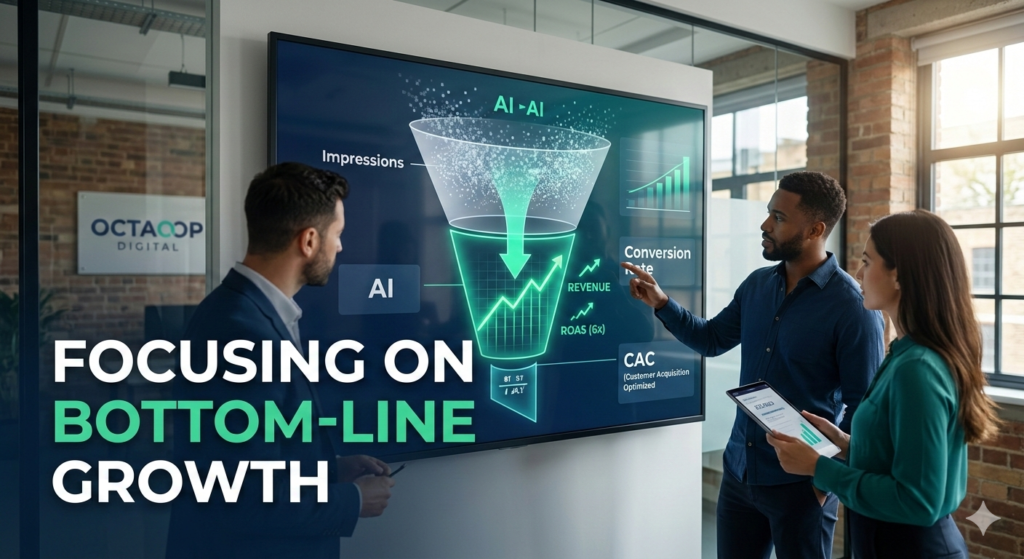
This playbook is designed to strip away the noise. We are moving beyond top-of-funnel fluff to focus on the Performance Marketing Playbook 2026. This is about turning every dollar spent into a measurable impact on your bottom line.
“Check out our guide on Search Generative Experience (SGE) to see how AI is changing the search landscape.
Why “Awareness” is a Trap for Growth-Stage Startups
For a VC-backed or rapidly growing startup, cash efficiency is everything. While Coca-Cola can afford to spend millions on “brand sentiment,” you need to know exactly how much it costs to acquire a customer (CAC) and how much that customer is worth over their lifetime (LTV).
The trap is simple: Vanity Metrics vs. Clarity Metrics.
- Vanity Metrics: Impressions, reach, page views, and raw click-through rates.
- Clarity Metrics: Conversion rate, Customer Acquisition Cost, Return on Ad Spend (ROAS), and Revenue per User.
In 2026, the algorithm rewards those who optimize for the “Deep Funnel.” If you tell an AI-bidding system to find you “traffic,” it will find the cheapest, least-qualified clicks available. If you tell it to find “revenue,” the game changes.
The Three Pillars of the 2026 Performance Framework
1. Predictive Attribution
In 2026, the cookie is long gone. Startups must rely on first-party data and server-side tracking. You need to stop asking “where did this click come from?” and start asking “which sequence of touchpoints leads to a high-value customer?”
2. Creative-Led Growth
The “technical” side of media buying is being automated by platforms. The real lever for performance in 2026 is Creative. Your ad is your targeting. If your creative speaks directly to a pain point, the algorithm will find your audience.
3. Full-Funnel Synchronization
Performance marketing doesn’t stop at the click. If your ad is brilliant but your landing page is generic, your conversion rate dies. The playbook requires a seamless transition from the “Hook” in the ad to the “Solution” on the site.
The Infrastructure of Revenue-First Marketing
Scaling a startup in 2026 isn’t just about spending more; it’s about spending smarter. To move from impressions to revenue, your technical “stack” must be airtight. If your tracking is broken, your AI-bidding is blind.
First-Party Data is Your Competitive Moat
With privacy regulations and the deprecation of third-party cookies, growth-stage startups can no longer rely on platform data alone. You must own your data.
- Server-Side Tracking: Move your tracking from the browser to the server. This ensures 100% data accuracy and bypasses ad-blockers.
- CRM Integration: Your Google and Meta ads should “talk” to your CRM (like HubSpot or Salesforce). When a lead turns into a sale, the ad platform needs to know so it can find more people like that buyer.
Optimizing for Predicted Life Time Value (pLTV)
In 2026, the best performance marketers don’t just optimize for the first sale. They optimize for the highest-value customers. By assigning a higher value to “power users” in your conversion tracking, you train the algorithm to ignore “bargain hunters” and focus on long-term revenue.
Cutting the Fat: Identifying and Killing Vanity Metrics
For a growth-stage startup, every pound/dollar must work. If a channel is giving you thousands of clicks but zero high-intent leads, it’s a vanity trap.
| Vanity Metric (The Trap) | Revenue Metric (The Truth) | Why it Matters |
| CPM (Cost per 1k Impressions) | CAC (Customer Acquisition Cost) | Impressions don’t pay salaries; customers do. |
| CTR (Click-Through Rate) | ROAS (Return on Ad Spend) | A high CTR on a “clickbait” ad leads to wasted spend. |
| Total Leads | SQL (Sales Qualified Leads) | 100 “junk” leads are more expensive than 10 “ready-to-buy” leads. |
The Creative-Led Growth Strategy
In 2026, Creative is the new Targeting. Media buying has become largely automated by “Advantage+” and “Performance Max” campaigns. Your competitive advantage now lies in your creative assets.
The “Hook-Body-Close” Framework for 2026
- The Hook (0–3 Seconds): Address a specific pain point of a growth-stage founder or CMO immediately. No logos, no fluff—just the problem.
- The Body (The Proof): Use social proof, data visualisations, or a “behind-the-scenes” look at your product solving that problem.
- The Close (The High-Intent CTA): Instead of “Learn More,” use “Get Your Growth Audit” or “Start Your Free Trial.” Be specific.
- Rapid Creative Testing
Don’t guess what works. Run “Low-Spend” tests on 5–10 different hooks every week. When you find a winner, move it into your “Scaling” campaign. This is how you avoid Ad Fatigue, which is the silent killer of startup growth.
Scaling Without Breaking the Unit Economics
The biggest mistake startups make is “Scaling at all costs.” When you double your budget, your CAC often triples. To prevent this, follow the 20% Rule.
- The 20% Rule: Only increase your successful ad sets by 20% every 48–72 hours. This allows the algorithm to stay in the “Learning Phase” without panicking and wasting your budget on low-quality placements.
Performance Marketing & SGE (Search Generative Experience)
As Google moves toward AI-generated answers, performance marketing must adapt. Your blog posts and landing pages shouldn’t just target keywords; they must answer complex user intents. > Internal Link Opportunity: Understand how AI is reshaping your traffic by reading our latest insights on Mastering Search Generative Experience (SGE).
The Performance Killers: Common Pitfalls for Growth-Stage Startups
Even with a high budget, startups often fail because of these “silent” performance killers. In 2026, the margin for error is razor-thin.
1. Over-Segmenting Your Audience
In the past, we created dozens of tiny “Interest” groups. In 2026, Broad Targeting combined with High-Intent Creative is more effective. Let the AI find your audience; your job is to give it the right creative “signals.”
2. Ignoring Post-Click Optimization
If you spend £10,000 on ads but your landing page takes 4 seconds to load, you are throwing money away. Performance marketing is a chain—the weakest link (usually the mobile site speed) determines your ROI.
3. Misattributing Success
Be careful with “Last-Click” attribution. A user might see your LinkedIn ad, search for you on Google, and then convert via an email. If you only credit the email, you’ll mistakenly turn off your LinkedIn ads, and your revenue will collapse.
The 2026 Performance Marketing Checklist
Before you scale your next campaign, ensure you can check off every item here:
- [ ] CAPI (Conversions API) is active for Meta and Google.
- [ ] First-Party Data (emails/phone numbers) is hashed and uploaded for “Lookalike” modeling.
- [ ] Landing Pages are optimized for “Answer Engine” queries (SGE friendly).
- [ ] Creative Assets include at least 5 different “Hooks” for testing.
- [ ] Unit Economics (CAC vs LTV) are monitored daily, not monthly.
Conclusion: Revenue is the Only Metric That Matters
As we move through 2026, the divide between “marketers” and “growth engineers” is disappearing. The startups that thrive aren’t the ones with the prettiest ads; they are the ones that treat every impression as a data point and every click as a revenue opportunity.
By cutting out vanity metrics and focusing on the bottom line, Octaoop Digital helps growth-stage startups navigate this complex landscape. The playbook is simple: Test fast, track everything, and scale only what contributes to your bank balance.
SEO Technical Package (For Your Website Post)
To ensure this ranks and satisfies the Google algorithm, use these details when posting to your WordPress site:
1. SEO Title & Metadata
- SEO Title: Performance Marketing Playbook 2026 | Growth-Stage Startup ROI
- Meta Description: Master the 2026 performance marketing playbook. Learn how growth-stage startups can cut vanity metrics and drive real bottom-line revenue growth.
- Slug:
performance-marketing-playbook-2026-revenue
2. SEO Tags (10 Tags)
- Performance Marketing 2026
- Startup Growth Strategy
- Revenue-Focused Marketing
- Digital Marketing ROI
- B2B Growth Playbook
- Scalable Ad Strategies
- Cutting Vanity Metrics
- Performance Marketing Tech Stack
- First-Party Data Strategy
- Octaoop Digital Marketing
3. LSI Keywords (5 Keywords)
- Customer Acquisition Cost (CAC) optimization
- Multi-touch attribution models
- High-intent lead generation
- Creative-led growth framework
- Data-driven marketing automation
4. FAQs (Optimized for Featured Snippets)
Q: What is the most important metric in performance marketing for 2026? A: While many focus on clicks, the most important metric is ROAS (Return on Ad Spend) and CAC (Customer Acquisition Cost) relative to the Lifetime Value (LTV) of the customer.
Q: How do growth-stage startups avoid wasting ad spend? A: Startups should avoid “Vanity Metrics” like impressions and instead use Server-Side Tracking to focus on “Clarity Metrics” like Sales Qualified Leads (SQLs) and actual revenue.
Q: Is brand awareness important in a performance marketing playbook? A: For growth-stage startups, brand awareness should be a by-product of high-performing conversion ads, rather than a separate, unmeasurable expense.
