
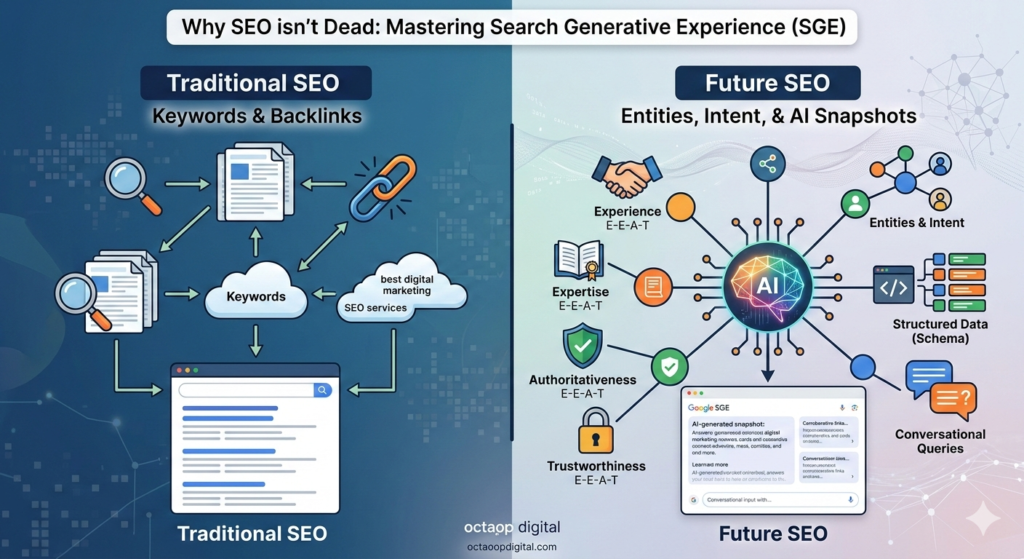
In the boardroom of almost every digital-first business today, a panicked question is being asked: “Is SEO finally dead?”
With the rise of ChatGPT, Perplexity, and Google’s own Search Generative Experience (SGE), the traditional “10 blue links” are being replaced by AI-generated snapshots. If you’ve noticed a dip in your organic click-through rates (CTR) lately, you aren’t alone. Data suggests that AI-powered search can satisfy a user’s query directly on the results page, leading to “zero-click searches.”
But here is the truth: SEO isn’t dying; it is undergoing its most significant evolution since the birth of the smartphone.
For businesses losing traffic to AI search results, the solution isn’t to stop doing SEO. The solution is to move beyond keywords and start mastering Answer Engine Optimization (AEO). At Octaoop Digital, we believe that those who adapt to SGE now will not just survive—they will dominate the next decade of global visibility.
1. What is Search Generative Experience (SGE)?
Before we can master it, we must understand it. Google SGE is an integration of Generative AI into the search engine. Instead of just pointing you to a website, Google now uses a Large Language Model (LLM) to synthesize information from multiple sources and present a comprehensive answer at the very top of the page.Mastering Search Generative Experience
How SGE Changes the Game:
- The AI Snapshot: A shaded box at the top of the SERP (Search Engine Results Page) that answers the query.
- Corroborative Links: To the right of the snapshot, Google provides “cards” or links to the sources used to generate the answer.
- Conversational Follow-ups: Users can ask follow-up questions, turning search into a dialogue.
For a business, being one of those “corroborative links” is the new “Position Zero.”
2. From Keywords to Entities: The Shift to AEO
For twenty years, SEO was about matching keywords. If a user searched for “best digital marketing agency,” you optimized for that specific phrase.
In the world of SGE, Google doesn’t just look for keywords; it looks for entities and intent. This is where Answer Engine Optimization (AEO) comes in. AEO focuses on providing direct, authoritative answers to the complex questions AI engines are trying to solve.
Why AEO Matters for Global Visibility:
AI models prioritize content that is structured, factual, and easy to parse. If your content is buried in fluff, the AI will ignore it. If your content is structured as a clear answer to a specific problem, the AI will cite you as a source. Mastering Search Generative Experience
3. The Pillars of Mastering SGE in 2024 and Beyond
To reclaim your traffic, you need to pivot your strategy toward these four pillars of modern SEO.
A. Prioritize E-E-A-T (Experience, Expertise, Authoritativeness, Trustworthiness)
AI can aggregate facts, but it cannot replicate human experience. Google’s algorithms are now hyper-focused on rewarding “Experience.”
- Case Studies: Don’t just say “how to do SEO.” Share a case study of how you did it.
- Author Bylines: Ensure every blog post is written by a verifiable expert with a linked bio.
- Original Research: AI cannot conduct new surveys or experiments. Doing so makes your site an “source” that AI engines must cite.
B. Implement Advanced Schema Markup
If you want the AI to “read” your site, you must speak its language. Schema markup (structured data) acts as a translator for search engines.
- FAQ Schema: Directly helps SGE pull your answers into the snapshot.
- Organization Schema: Establishes who you are and what you do.
- Product Schema: Essential for e-commerce brands to appear in AI-generated shopping recommendations.
C. Solve for “Long-Tail” Conversational Queries
SGE users search differently. They don’t type “coffee shop”; they ask, “What is the best coffee shop in London for working on a laptop with fast Wi-Fi?”
- Strategy: Create content that answers specific, multi-layered questions. Use tools like AnswerThePublic or Google’s “People Also Ask” to find these queries.
D. Optimize for the “SGE Carousel”
The links appearing next to the AI snapshot are the new gold mine. To get there, your content must be:
- Highly Relevant: Directly addressing the “core” of the search query.
- Scannable: Using H2 and H3 tags effectively so the AI can quickly extract data.
- High-Quality Images: SGE often pulls thumbnails into the carousel.
4. Technical SEO for the AI Era
While content is king, your technical foundation determines if the king has a throne. For WordPress users, this means going beyond the basic Yoast green bullets.
- Site Speed (Core Web Vitals): AI search engines prefer fast-loading sites because they provide a better user experience for those clicking through.
- Mobile-First Indexing: SGE is heavily used on mobile. If your site isn’t flawless on a smartphone, you’re invisible.
- Internal Linking: A strong internal link structure helps Google understand the relationship between your pages, helping it see you as an “authority” on a topic.
5. Why Businesses Are Losing Traffic (and How to Fix It)
Most businesses are losing traffic because they are still chasing “High Volume, Low Intent” keywords.
The Problem: If you write a blog post on “What is SEO?”, Google SGE will answer that question in the snapshot, and no one will click your link. The Solution: Focus on “Middle and Bottom of the Funnel” content. Write about “How to Integrate SGE into a B2B Marketing Budget” or “SEO vs. SGE: Which offers better ROI?”
By targeting opinion, strategy, and complex problem-solving, you provide value that an AI snapshot cannot easily summarize.
6. Checklist: How to “SGE-Proof” Your WordPress Site
If you are using WordPress and Yoast SEO, follow this routine for every new post:
- Direct Answer Start: Answer the primary question of the article in the first 50–100 words. This makes it easy for AI to “snippet” your content.
- Use Yoast’s Schema Tab: Don’t leave it on default. Specify if the page is an “About Page,” a “Technical Report,” or an “Article.”
- Bullet Points & Tables: AI loves structured data. Use tables for comparisons and bullets for lists.
- Update Old Content: Go back to your top-performing 2023 blogs and add an “AI Summary” or a “Direct Answer” section at the top.
- Focus on Brand Authority: Ensure your brand name is mentioned in relation to your niche across the web (PR, Guest Posts, Social Media). SGE favors brands it recognizes.
7. The Future: Global Visibility in a Post-Keyword World
Global visibility no longer means ranking #1 for a single word. It means being the trusted source that AI engines recommend across different languages and regions.
As SGE rolls out globally, it will translate queries and sources in real-time. This means your high-quality, authoritative English content could be used to answer a query in Spanish or Japanese. The “Global” in global visibility is now powered by the AI’s ability to bridge language gaps—but only if your content is authoritative enough to be chosen.
Conclusion: Partner with Octaoop Digital
The “death of SEO” is a myth. The “death of lazy SEO” is a reality.
Mastering Search Generative Experience requires a blend of technical precision, psychological insight, and high-level content strategy. If your business is seeing a decline in traffic, it’s time to stop fighting the AI and start feeding it.
At Octaoop Digital, we specialize in navigating these shifts. We don’t just help you rank; we help you become the answer that Google trusts.
Ready to reclaim your traffic? Contact us today for an SGE-readiness audit.
