
Most digital marketing pitches sound exactly the same. Agencies promise “more leads,” “better ROI,” and “data-driven results,” but when it comes to the actual engineering behind those promises, things fall apart quickly.
For mid-market and enterprise companies, a standard SEO campaign or a basic Facebook pixel just won’t cut it. You need a highly connected growth infrastructure that survives privacy updates, prevents budget cannibalization, and scales securely.
Before you sign your next agency contract, use these 10 highly technical questions to separate the true growth engineers from the pretenders.
1. The System Setup: How do you handle cross-domain tracking and server-side tagging to ensure our data isn’t wiped out by privacy updates?
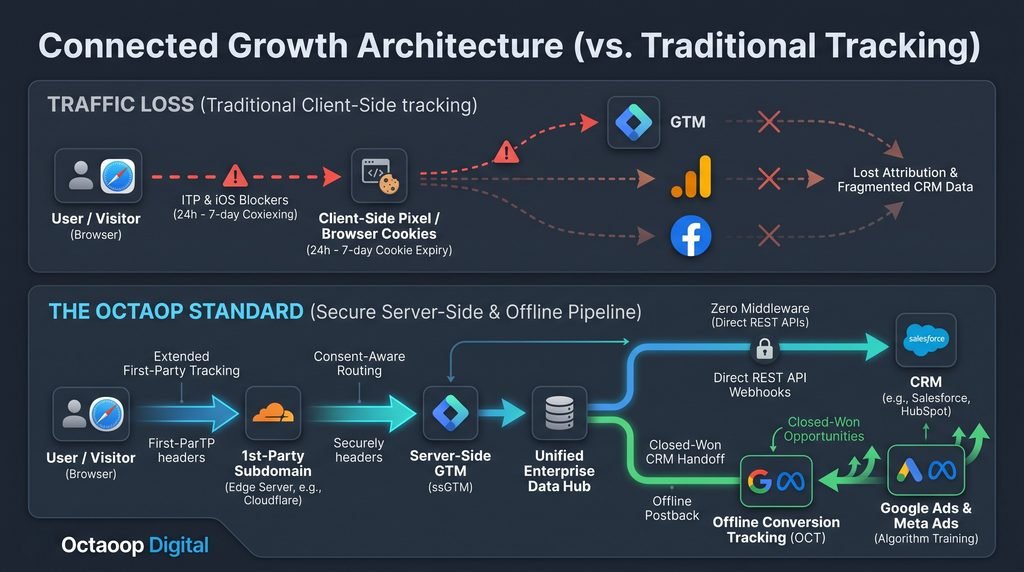
- Why it matters: Safari’s ITP (Intelligent Tracking Prevention) and iOS updates wipe out standard client-side browser cookies within 24 hours to 7 days. If your agency is just installing a standard pixel, you are losing massive amounts of attribution data.
- The Octaoop Standard: We shift away from vulnerable client-side pixels and deploy Server-Side Google Tag Manager (ssGTM) via edge workers (like Cloudflare Workers). By proxying tracking requests through a first-party subdomain, analytics cookies are set via secure HTTP headers. This extends your first-party cookie lifespan up to a full year, while strict edge-level Consent Mode integration ensures you remain perfectly compliant.
2. AI Search Architecture: How do you structure Schema markup and Knowledge Graph assets so LLMs actually cite us?
- Why it matters: Generative AI engines (like ChatGPT or Perplexity) don’t just “read” standard websites—they look for structured entity relationships. Standard FAQPage plugins won’t cut it.
- The Octaoop Standard: We build a deeply nested @graph array in JSON-LD that defines your business entities. We map Organization, Person, and DefinedTerm nodes, and leverage the sameAs array to anchor your entities to authoritative external sources. This dense semantic fingerprint gives AI engines the factual grounding to confidently cite you as a primary source.
3. CRM & Automation Handoff: Do you build custom REST APIs, or do you rely entirely on third-party middleware like Zapier?
- Why it matters: Large accounts cannot afford to rely heavily on Zapier due to PII (Personally Identifiable Information) data leak risks, compliance issues, and task-limit latency during high-traffic spikes.
- The Octaoop Standard: We minimize reliance on vulnerable middleware. We utilize direct REST API webhooks and secure script endpoints (like Google Apps Script connecting directly to our CRM architecture). Capturing data natively eliminates latency and secures your lead flow directly into categorized workflow stages in real-time.
4. Content ROI: How do you measure the direct impact of content marketing on our bottom-line pipeline, rather than just reporting on referral traffic?
- Why it matters: “Brand awareness” and “traffic” do not pay payroll. You need to know exactly which top-of-funnel assets are closing deals.
- The Octaoop Standard: We bridge the gap using Offline Conversion Tracking (OCT). We pass dynamic UTM parameters and Click IDs (like GCLID) through hidden form fields directly into your CRM. When your sales team advances a lead to “Closed-Won,” our system fires a secure server-side postback to Google Ads. We aren’t just reporting; we are mathematically training the algorithms based on closed revenue.
5. Web Infrastructure: How do you optimize the underlying database and architecture to maintain a clean codebase that won’t slow down as we scale?
- Why it matters: Many agencies build bloated WordPress sites heavily reliant on drag-and-drop plugins. Within a year, the database clogs, the site slows to a crawl, and the user experience tanks.
- The Octaoop Standard: We engineer lean environments utilizing lightweight frameworks and optimized configurations. More importantly, we optimize at the server level via cPanel. We deploy strict PHP security hardening, CGI patches, and rely on server-side object caching (like Redis/Memcached) rather than heavy plugins. The DOM stays light, and the database queries remain minimal.
6. Programmatic SEO: How do you prevent Google from flagging pSEO architecture as low-value “doorway pages”?
- Why it matters: Generating thousands of location pages is easy, but Google routinely penalizes low-effort AI spam that just swaps out city names.
- The Octaoop Standard: We inject unique, localized data sets into every programmatic template. We use the Google Maps Platform API to pull localized coordinates, dynamic schema, and real neighborhood signals. To protect your crawl budget, we implement strict robots.txt rules and parameter handling to block crawler traps, using custom diagnostics to force-index high-value pages.
7. Google Ads: How do you ensure Performance Max doesn’t just cannibalize our branded search terms?
- Why it matters: Google wants everyone on automated bidding, but Performance Max loves to claim “easy” conversions from people already searching your brand name, while wasting the rest of your budget on low-quality display networks.
- The Octaoop Standard: We never let Google’s automation run unchecked. We implement strict account-level negative keyword lists and brand exclusions to force PMax to hunt for net-new customers. We also rely on empirical audits of Search Term reports to isolate where budget is bleeding, cutting off low-converting placements and feeding the algorithm only high-intent data.
8. Local SEO: How are you optimizing our regional branches beyond just asking for reviews and posting photos?
- Why it matters: Enterprise local search is a game of entity confidence and algorithmic manipulation, not just basic profile management.
- The Octaoop Standard: We structure your local presence to send the strongest possible E-E-A-T signals. This means perfectly aligning NAP data across high-tier aggregators, leveraging Google Business Profile API integrations for multi-location management, and building localized Knowledge Graph mapping that ties the local profile directly to the schema on your website.
9. Lead Automation Security: How do you ensure automated outreach doesn’t trigger spam filters or violate API limits?
- Why it matters: A rogue AI automation system can permanently damage your brand reputation or get your domains blacklisted in a matter of hours.
- The Octaoop Standard: Our automation architecture is strictly sandboxed for discovery and scoring. We operate on a “zero-action without permission” protocol. The system discovers, scores, and logs prospects, but never executes outbound messaging without explicit human authorization. All approved correspondence routes securely through dedicated, authenticated mailboxes with properly configured SPF, DKIM, and DMARC records.
10. Tech Stack & Data Ownership: Who owns the data, the ad accounts, and the underlying assets when the contract ends?
- Why it matters: Some agencies use proprietary CMS platforms or hold Google Ads accounts hostage when you try to leave, effectively wiping out years of algorithmic learning and pixel data.
- The Octaoop Standard: Complete transparency and ownership. You own your Google Ads account, your Google Analytics properties, your GTM containers, and your CRM data. We build the architecture, connect the pipelines, and train the systems—but the intellectual property and the historical data always belong to the client. We want to retain you through performance, not vendor lock-in.
How We Differ: Systems Over Silos (The Connected Growth Architecture)
Most agencies fail mid-market clients because they operate in silos. They have an “SEO guy” who doesn’t talk to the “PPC guy,” and a web developer who builds pages without considering how the CRM will capture the data. This fragmented approach leads to dropped leads, broken tracking, and wasted ad spend.
At Octaoop Digital, our approach is fundamentally different. We don’t sell isolated marketing tactics; we engineer Connected Growth Architectures. Every search campaign, localized landing page, and schema node is hardwired directly into your sales pipeline.
Here is how our core service pillars integrate into a single, scalable revenue engine:
1. Advanced Technical & Programmatic SEO (pSEO)
While others rely on basic keyword stuffing and standard plugins, we engineer semantic dominance. We utilize proprietary tools—like our Octaoop Smart Indexing Recovery System—to diagnose Search Console bottlenecks and force-index high-value assets. We build AI-first schema and programmatic location pages that map directly to Google’s Knowledge Graph, ensuring you aren’t just ranking, but being cited as the authoritative entity. Explore our Advanced Technical & Programmatic SEO Services
2. Precision PPC & Search Engine Marketing
We protect your budget from Google’s forced automation. Instead of letting Performance Max cannibalize your branded terms, we deploy empirical audits, aggressive negative keyword lists, and Offline Conversion Tracking (OCT). By feeding actual CRM closed-won data back to the ad platform, we mathematically train the algorithm to hunt for revenue, not just clicks. Discover our PPC & Search Ads Engineering
3. Enterprise CRM & Workflow Automation
Data leaks and Zapier latency have no place in a high-ticket sales environment. We bypass third-party middleware entirely, relying on direct REST API webhooks and secure Google Apps Script endpoints to pass leads from your ads straight into categorized tracking systems (like our custom Octaoop Lead Tracker). For outbound discovery, our proprietary Hope Framework identifies and scores prospects strictly within a sandboxed, permission-first environment to protect your domain reputation. 🔗 Custom CRM & Automation Workflows
4. Local Search & Map Pack Dominance
Dominating the local Map Pack requires strict compliance and entity confidence, especially in heavily regulated sectors like immigration law and localized service fleets. We go beyond basic profile updates by leveraging Google Business Profile API integrations, aligning NAP aggregators, and structurally linking your local presence to the geographic schema on your primary web assets. 🔗 Dominate your market with our Local SEO Solutions
5. High-Performance Web Infrastructure
A slow, plugin-bloated website will destroy your ad conversion rates. We engineer lean, enterprise-grade WordPress environments using lightweight frameworks (like Astra) and optimized Elementor builds. By deploying strict cPanel server-side caching, PHP security hardening, and CGI patches, we ensure your platform remains lightning-fast and impenetrable as your traffic scales. Upgrade your infrastructure with our Enterprise Web Development
The bottom line: You don’t need another generic marketing campaign. You need a technical partner who understands edge-worker tracking, API latency, and algorithmic entity recognition.
Ready to audit your current infrastructure? 🔗Book a Technical Strategy Session with Octaoop Digital Today
Editorial Note
This article was prepared by the Octaoop Digital team, with AI-assisted support for research, structuring and editorial refinement. Technical explanations and final recommendations should be reviewed against the specific implementation and business requirements before deployment.